Physical Development Across the Lifespan
Physical development runs from before birth to old age.
Part 1 · Hook
Why this matters
Part 2 · Before you start
What this builds on
Part 3 · Prerequisite check
Quick check before you start
1. Which cue lets you judge depth with both eyes?
- Retinal disparity
- Interposition
- Relative size
- Linear perspective
Show the answer
Each eye sees a slightly different image; the brain uses the difference to judge distance.
- Correct: Retinal disparity:
- Interposition:
- Relative size:
- Linear perspective:
2. What is a reflex?
- An automatic, unlearned response to a stimulus
- A habit formed by practice
- A conscious decision
- A hormone
Show the answer
Reflexes happen without thought or learning, like pulling a hand off a hot stove.
- Correct: An automatic, unlearned response to a stimulus:
- A habit formed by practice:
- A conscious decision:
- A hormone:
3. Which design follows the same people over time?
- Longitudinal
- Cross-sectional
- Case study
- Survey
Show the answer
A longitudinal study retests the same people.
- Correct: Longitudinal:
- Cross-sectional:
- Case study:
- Survey:
Part 4 · See it
See it first
Part 5 · Step by step
How it works, step by step
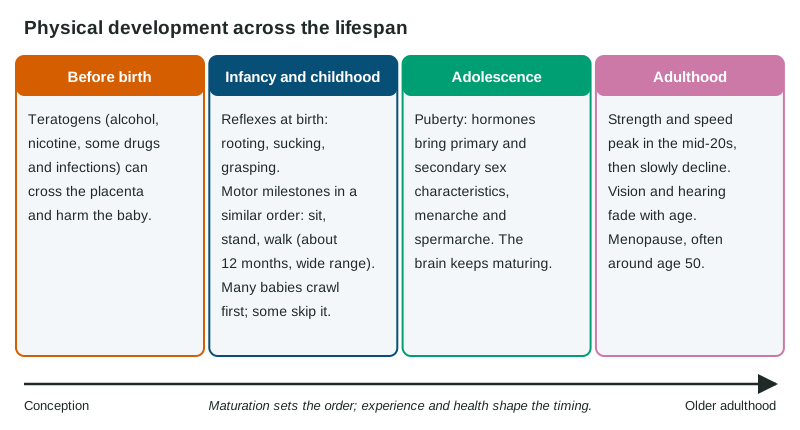
- Teratogens such as alcohol and nicotine cross the placentathey can harm the developing baby, often for life
- Maturation unfolds on a genetic timetablemotor milestones appear in a similar order, at ages that vary between healthy babies
- Some experiences are needed within a time window (critical period) or are easiest then (sensitive period)missing the window can leave lasting effects
- Puberty raises sex hormonesprimary and secondary sex characteristics develop, with menarche and spermarche
- Later in life, senses and speed decline and menopause ends fertility in womenadults adjust, while practiced knowledge and skills stay strong
Part 6 · Key ideas
Key ideas
- Teratogens (alcohol, nicotine, some medicines and infections) can harm development before birth; there is no known safe amount of alcohol in pregnancy.
- Newborns arrive with reflexes such as the rooting reflex; motor development follows a similar order in most babies, with wide variation in timing.
- A critical period is a window when an experience is needed (imprinting in geese); a sensitive period is when learning is easiest (accent-free language).
- Puberty brings primary and secondary sex characteristics, menarche and spermarche; the brain’s frontal areas keep maturing into the 20s.
- In later adulthood, vision, hearing and reaction time decline gradually and menopause ends menstruation, often around 50.
Part 7 · Misconception
A common mistake
The wrong idea: A baby who walks at 15 months is behind and will stay behind.
What actually happens: Milestones come in a similar order, but healthy babies walk anywhere from about 9 to 17 months. Walking age in that range does not predict later ability.
Part 8 · Check yourself
Check yourself
Exam-style questions. Anything you miss goes into your review queue.
Study
The visual cliff
Introduction
Eleanor Gibson and Richard Walk asked whether babies who have just learned to crawl can perceive depth, and whether they avoid a drop.
Participants
36 infants aged 6 to 14 months, each tested with their mother. Young animals of several species were also tested.
Method
Each baby was placed on a board in the middle of a glass table. Under the glass on one side, a checkered pattern sat right below (the shallow side); on the other side, the same pattern lay far below (the deep side, the "cliff"). The glass made both sides safe. The mother called the baby from one side and then the other, and researchers recorded which way each baby crawled.
Results
Of the 27 babies who moved off the center board, all crawled onto the shallow side at least once. Only 3 crept onto the deep side. Many babies called from the deep side crawled away from their mother or cried.
Discussion
Most crawling babies perceive depth. Later research found that wariness of the drop grows with crawling experience, so experience and maturation both play a part.
1. Most crawling babies in this study refused to cross the deep side. Which ability does that best show?
- Depth perception
- The rooting reflex
- Imprinting
- Sensory adaptation
Show the answer
Avoiding the deep side means the baby saw the difference in distance.
- Correct: Depth perception: Right: babies treated the far-away pattern as a drop, so they perceived depth.
- The rooting reflex: The rooting reflex is turning toward a touch on the cheek; it has nothing to do with seeing a drop.
- Imprinting: Imprinting is a newborn animal following the first moving thing it sees; the babies were avoiding a drop.
- Sensory adaptation: Sensory adaptation is reduced response to an unchanging stimulus; the babies responded to a drop.
2. Which best describes the research method?
- An experiment with babies randomly assigned to the deep side or the shallow side
- A longitudinal study following the babies for years
- A survey of mothers about their babies’ fear of heights
- Observation in a set-up situation, recording which side babies crawled to
Show the answer
Building a test situation is not the same as manipulating a variable between groups.
- An experiment with babies randomly assigned to the deep side or the shallow side: Every baby faced both sides; no one was assigned to a condition.
- A longitudinal study following the babies for years: Each baby was tested in one session.
- A survey of mothers about their babies’ fear of heights: Researchers watched babies; they did not ask mothers questions.
- Correct: Observation in a set-up situation, recording which side babies crawled to: Right: the researchers built a setting and recorded behavior; no variable was assigned to groups.
3. A nurse strokes a newborn’s cheek, and the baby turns toward the touch and opens its mouth. What is this?
- The rooting reflex
- A learned habit from feeding
- Imprinting
- A motor milestone such as sitting up
Show the answer
Newborn reflexes are automatic, unlearned responses that help survival.
- Correct: The rooting reflex: Right: turning toward a touch on the cheek, mouth open, helps a newborn find food.
- A learned habit from feeding: It is present at birth, before any feeding experience.
- Imprinting: Imprinting is a young animal following the first moving object it sees.
- A motor milestone such as sitting up: Milestones are skills that appear over months; this is an automatic response at birth.
4. Goslings hatched in a lab follow the first moving thing they see, a researcher’s boots, and keep following it. Geese that see no moving object in the first days do not form this bond later. Which concepts does this show?
- A sensitive period for learning language
- Maturation of motor skills
- A teratogen acting before birth
- Imprinting in a critical period
Show the answer
A critical period is a window when a specific experience is needed for normal development.
- A sensitive period for learning language: Language does not apply to goslings; this is a bond formed in a narrow window.
- Maturation of motor skills: Walking is not the point; the point is whom they follow and when.
- A teratogen acting before birth: Nothing harmful acted before hatching.
- Correct: Imprinting in a critical period: Right: the bond forms only in a narrow early window, and missing it means it does not form.
5. Ana moved to the United States at 4 and speaks English with no accent. Her father moved at 35 and, after 30 years, still has a clear accent, though he speaks fluently. Which concept best explains the difference?
- A teratogen affecting her father
- Menopause slowing her father’s learning
- A sensitive period, when language is easiest to learn
- A critical period for language that had already closed for her father
Show the answer
A sensitive period makes learning easier; a critical period makes it necessary.
- A teratogen affecting her father: Nothing harmed his development before birth.
- Menopause slowing her father’s learning: Menopause is the end of menstruation, which does not apply here.
- Correct: A sensitive period, when language is easiest to learn: Right: learning is easiest early, but her father could still learn, so the window is sensitive rather than absolute.
- A critical period for language that had already closed for her father: Her father became fluent, so learning did not stop; that points to a sensitive period.
6. Sixteen-year-old Theo understands the risks of speeding but speeds anyway when friends are in the car. Which explanation fits current brain research best?
- His brain stopped growing at puberty
- Teenagers do not understand that speeding is risky
- His rooting reflex has returned
- His prefrontal cortex, key to self-control, is still maturing
Show the answer
Brain areas tied to emotion and reward mature earlier than the frontal areas tied to judgment and control.
- His brain stopped growing at puberty: The brain keeps changing well after puberty, especially the frontal areas.
- Teenagers do not understand that speeding is risky: Theo knows the risks; the issue is control in the moment.
- His rooting reflex has returned: Reflexes from infancy do not explain risk-taking.
- Correct: His prefrontal cortex, key to self-control, is still maturing: Right: the prefrontal cortex keeps developing into the early to mid 20s, so control lags behind thrill-seeking with peers.
Part 9 · Summary
Summary
Part 10 · Up next
What comes next
Part 11 · Connections