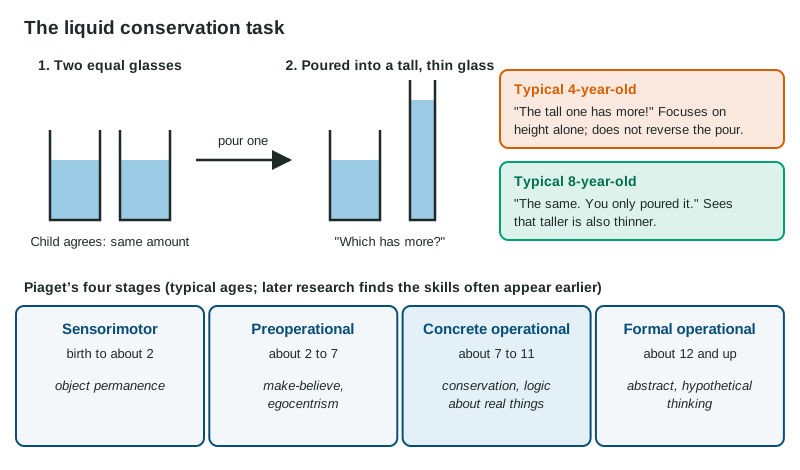
Pour juice from a short, wide glass into a tall, thin one, and most 4-year-olds will say there is more juice now. Most 8-year-olds will tell you that is silly. Their eyes see the same thing; what differs is how they think. This topic follows thinking from infancy to old age, and the exam asks you to recognize each idea in a child's or an adult's behavior.
How children build understanding
Jean Piaget watched children closely and argued that they are active thinkers who build understanding. They organize experience into schemas, mental frameworks such as "doggy: four legs, fur." When something new fits, they assimilate it: the toddler calls a cat "doggy." When it does not fit, they accommodate, changing the schema or making a new one: she learns "kitty." Piaget's big claim was that this process moves children through four stages, each a different kind of thinking, not just more of it.
Piaget's four stages
| Stage (typical ages) | How the child thinks | What it looks like |
|---|---|---|
| Sensorimotor (birth to about 2) | through senses and actions | By about 8 to 12 months, a baby pulls a blanket off a hidden toy: object permanence, knowing things still exist when out of sight. |
| Preoperational (about 2 to 7) | with words and images, but not logic | Make-believe play (a block becomes a phone). Egocentrism: a child covering her eyes says "you can't see me." No conservation: the tall glass "has more." |
| Concrete operational (about 7 to 11) | logically, about real things | Knows the poured juice is the same amount, and can reverse the action in his head. Struggles with abstract versions of the same logic. |
| Formal operational (about 12 and up) | abstractly and hypothetically | Debates "what if nobody needed sleep?" and tests ideas systematically. |
Egocentrism in Piaget's sense is not selfishness. It is difficulty seeing from another person's point of view. A related skill is theory of mind, the understanding that other people have their own beliefs, which can be wrong. In a classic false-belief task, a puppet puts a ball in a basket and leaves; another puppet moves it to a box. Asked where the first puppet will look, most 3-year-olds say "the box" (where it really is). Most 5-year-olds say "the basket," because they understand the puppet believes something untrue.
Worked example: reading a conservation study. In an invented cross-sectional study, 30 children at each of ages 4, 6 and 8 did the liquid task. Passing rates were 10%, 40% and 87%.
How many 6-year-olds passed? children. The rise from 4 to 6 is points; from 6 to 8 it is points.
What it shows: conservation grows sharply between 4 and 8, the move from preoperational to concrete operational thinking. Because each age was a different group tested once, this is a cross-sectional design, and there is wide variation within each age.
How Piaget has held up
Piaget's order of abilities has held up well across many countries. His ages and his clean stages have not. When researchers make tasks simpler and more natural, children often show skills earlier: babies look longer at "impossible" events in which a hidden object seems to vanish, suggesting some grasp of object permanence before they search for it. Development also looks more gradual and uneven than four clear steps, and many adults never use formal operational reasoning in every area. Schooling and culture shape timing, which is where Vygotsky comes in.
Vygotsky: learning with others
Lev Vygotsky stressed that thinking develops through social interaction and language. The zone of proximal development (ZPD) is the range of tasks a child cannot do alone but can do with help. A tutor who breaks long division into steps, gives hints and then steps back is providing scaffolding, support that is removed as the learner's skill grows. Piaget pictured a child exploring like a little scientist; Vygotsky pictured an apprentice learning alongside skilled people.
| Piaget | Vygotsky | |
|---|---|---|
| Main driver | the child's own actions on the world | social interaction and language |
| Key ideas | schemas, stages, conservation | zone of proximal development, scaffolding |
| Teacher's role | provide things to explore | guide, then fade support |
Thinking in adulthood and old age
Two kinds of intelligence age differently. Crystallized intelligence, accumulated knowledge and skills such as vocabulary, holds steady or grows into the 60s and beyond. Fluid intelligence, reasoning quickly about new problems, declines gradually from early adulthood. Older adults also process information more slowly. Longitudinal studies show these declines are smaller than early cross-sectional studies suggested, and staying mentally, physically and socially active is linked to better thinking in later life.
Dementia is different. It is a decline in memory and thinking severe enough to disrupt daily life, caused by brain disease, most often Alzheimer's disease. Forgetting where you put your glasses is normal; getting lost on a familiar walk or not recognizing a family member is not. Dementia becomes more common with age, but most older adults never develop it.