Classical Conditioning
Classical conditioning is learning by association.
Part 1 · Hook
Why this matters
Part 2 · Before you start
What this builds on
Part 3 · Prerequisite check
Quick check before you start
1. A study measures "stress" as the number of times a person checks their phone in ten minutes. What is that?
- An operational definition
- A hypothesis
- A confounding variable
- A random sample
Show the answer
It says exactly how the study measures the variable, which is an operational definition.
- Correct: An operational definition:
- A hypothesis:
- A confounding variable:
- A random sample:
2. Which statement fits natural selection?
- Traits that helped ancestors survive and reproduce become more common
- Animals change their genes on purpose to survive
- Every trait is learned from parents after birth
- Traits that appear late in life are always passed on
Show the answer
Natural selection: heritable traits that helped survival and reproduction become more common over generations. That idea explains biological preparedness in this topic.
- Correct: Traits that helped ancestors survive and reproduce become more common:
- Animals change their genes on purpose to survive:
- Every trait is learned from parents after birth:
- Traits that appear late in life are always passed on:
Part 4 · See it
See it first
Part 5 · Step by step
How it works, step by step
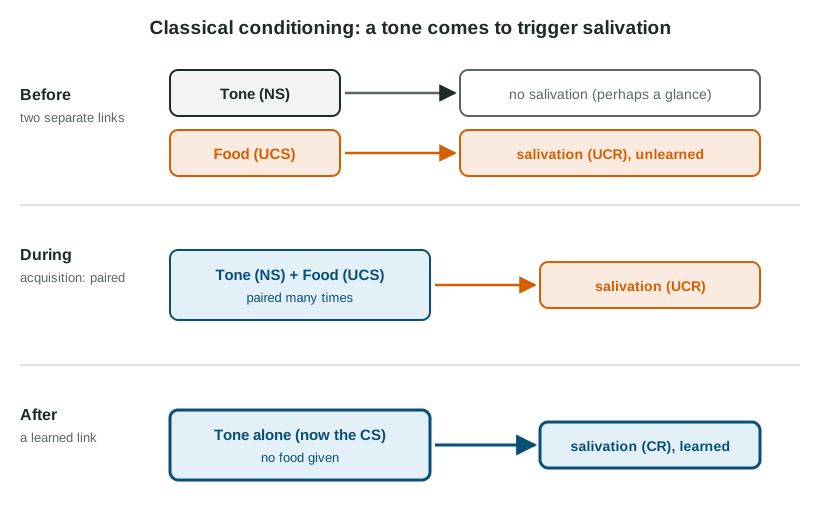
- A neutral stimulus (a tone) comes just before an unconditioned stimulus (food) again and againthe tone starts to predict the food (acquisition)
- The tone now predicts foodthe tone alone triggers salivation: it is a conditioned stimulus and the salivation is a conditioned response
- The tone keeps sounding without foodthe conditioned response fades (extinction)
- Time passes after extinctionthe response can return for a while (spontaneous recovery), so the learning was suppressed, not erased
Part 6 · Key ideas
Key ideas
- Find the UCS first: the thing that causes a response with no learning (food, a shot, a loud noise). Its automatic response is the UCR.
- The CS is the once-neutral stimulus that came before the UCS. The learned reaction to it is the CR. The UCR and CR are often the same movement, triggered by different things.
- Extinction weakens a CR when the CS comes without the UCS; spontaneous recovery brings it back after a rest. Generalization spreads a CR to similar stimuli; discrimination limits it.
- Taste aversion can form after one pairing with hours between taste and illness, an example of biological preparedness. Habituation, a fading response to a repeated stimulus, needs no pairing at all.
Part 7 · Misconception
A common mistake
The wrong idea: Extinction means the animal has forgotten the conditioned stimulus.
What actually happens: Extinction suppresses the conditioned response, but the learning survives: after a rest the response can return (spontaneous recovery), and it is relearned faster than it was first learned.
Part 8 · Check yourself
Check yourself
Exam-style questions. Anything you miss goes into your review queue.
1. Jordan ate sushi for dinner, and a stomach virus made him vomit that night. The sushi did not cause the illness, yet a year later the smell of sushi still makes him queasy. Which concept best explains his reaction?
- Taste aversion, learned after one pairing
- Habituation to the smell of sushi
- Spontaneous recovery of a fear response
- Higher-order conditioning of the smell
Show the answer
A single taste paired with illness, even with hours between them, is enough: the sushi became a CS that now triggers nausea (the CR).
- Correct: Taste aversion, learned after one pairing: Right: one pairing of a taste with illness, even hours apart, made the sushi a conditioned stimulus for nausea.
- Habituation to the smell of sushi: Habituation is a weaker response to a repeated stimulus. Jordan reacts more, not less.
- Spontaneous recovery of a fear response: Spontaneous recovery needs an earlier extinction. Nothing was extinguished here.
- Higher-order conditioning of the smell: Higher-order conditioning pairs a new stimulus with an existing CS. The sushi was paired directly with illness, the UCS.
2. Maya was bitten by a large German shepherd as a child. Now she feels afraid around golden retrievers and huskies too, though they have never hurt her. Which concept explains the wider fear?
- Stimulus generalization
- Stimulus discrimination
- Extinction of the fear
- Habituation to large dogs
Show the answer
Her fear spread from one kind of large dog to similar dogs: stimulus generalization.
- Correct: Stimulus generalization: Right: stimuli similar to the original CS (other large dogs) now trigger the CR.
- Stimulus discrimination: Discrimination is responding to the CS but not to similar stimuli. Maya responds to the similar ones.
- Extinction of the fear: Extinction weakens a CR. Her fear has spread, not faded.
- Habituation to large dogs: Habituation would make her react less to dogs over time, the opposite of what happened.
3. When Priya moved next to a train line, the rumble woke her every night. After a month she sleeps through it. No other event was ever paired with the trains. Which concept explains the change?
- Habituation
- Extinction
- Stimulus discrimination
- Counterconditioning
Show the answer
Habituation is the simplest learning: a response fades to a stimulus that repeats without consequence. It needs no pairing, which is what sets it apart from extinction.
- Correct: Habituation: Right: a repeated stimulus that brings nothing important produces a weaker and weaker response. No pairing is involved.
- Extinction: Extinction weakens a learned CR when a CS stops being paired with its UCS. Waking to a loud noise was never conditioned.
- Stimulus discrimination: Discrimination is telling a CS apart from similar stimuli, not reacting less to one stimulus.
- Counterconditioning: Counterconditioning pairs a stimulus with a new, opposite response. Nothing was paired here.
Study
Invented study: a tone, a puff of air and an eye blink
Introduction
Researchers asked whether a tone that is followed by a puff of air to the eye can come to cause an eye blink on its own.
Participants
24 college students (ages 18 to 23; 14 women and 10 men) volunteered. Each gave informed consent and could stop at any time. The puff was gentle and harmless.
Method
On each trial a tone sounded for half a second and was followed at once by a light puff of air to one eye, which makes people blink without learning. After 40 pairings, the tone was played alone 20 times (no puff). The next day the tone was played alone 5 more times. A sensor recorded a blink as any eyelid closure within half a second after the tone began.
Results
Before any pairing, students blinked to the tone on 5% of trials. After 40 pairings they blinked to the tone alone on 80% of trials. By the end of the 20 tone-alone trials this fell to 10%. On the first tone of the next day it rose to 45%.
Invented study for practice.
4. In this study, what is the unconditioned stimulus?
- The puff of air to the eye
- The tone before training
- The blink to the tone alone
- The sensor on the eyelid
Show the answer
A UCS triggers a response with no learning: the puff of air makes the eye blink (the UCR).
- Correct: The puff of air to the eye: Right: the puff causes a blink without any learning.
- The tone before training: Before training the tone is the neutral stimulus; it caused blinks on only 5% of trials.
- The blink to the tone alone: That is the conditioned response, a learned blink.
- The sensor on the eyelid: The sensor measures blinks. It is part of the method, not a stimulus.
5. After the 40 pairings, a student blinks when the tone sounds alone. In conditioning terms, that blink is the
- conditioned response to the conditioned stimulus
- unconditioned response to the unconditioned stimulus
- unconditioned response to a neutral stimulus
- conditioned stimulus to the unconditioned response
Show the answer
After acquisition, the tone (CS) alone triggers a blink (CR). The same movement is a UCR when the puff causes it and a CR when the tone does.
- Correct: conditioned response to the conditioned stimulus: Right: the tone is now a CS and the learned blink to it is the CR.
- unconditioned response to the unconditioned stimulus: The UCR is the blink to the puff. No puff was given on these trials.
- unconditioned response to a neutral stimulus: A neutral stimulus causes no relevant response, and a blink to it after training is learned.
- conditioned stimulus to the unconditioned response: A blink is a response, not a stimulus.
6. Which result shows spontaneous recovery?
- Blinks rose from 10% to 45% on the first tone of the next day
- Blinks rose from 5% to 80% across the 40 pairings
- Blinks fell from 80% to 10% across 20 tone-alone trials
- Students blinked to the tone on 5% of trials before pairing
Show the answer
Spontaneous recovery is the return of an extinguished CR after a pause. It went from 10% at the end of extinction to 45% the next day.
- Correct: Blinks rose from 10% to 45% on the first tone of the next day: Right: after extinction and a rest, the CR came back, weaker than before.
- Blinks rose from 5% to 80% across the 40 pairings: That rise is acquisition: the tone becoming a CS.
- Blinks fell from 80% to 10% across 20 tone-alone trials: That fall is extinction, the tone presented without the puff.
- Students blinked to the tone on 5% of trials before pairing: That is the baseline, before any learning.
Part 9 · Summary
Summary
Part 10 · Up next
What comes next
Part 11 · Connections