Operant Conditioning
Operant conditioning changes voluntary behavior through its consequences.
Part 1 · Hook
Why this matters
Part 2 · Before you start
What this builds on
Part 3 · Prerequisite check
Quick check before you start
1. A tone is paired with food until the tone alone makes a dog drool. What is the tone after training?
- The conditioned stimulus
- The unconditioned stimulus
- The unconditioned response
- A neutral stimulus
Show the answer
A once-neutral stimulus that now triggers the learned response is the conditioned stimulus.
- Correct: The conditioned stimulus:
- The unconditioned stimulus:
- The unconditioned response:
- A neutral stimulus:
2. A CR fades when the CS keeps coming without the UCS. What is that called?
- Extinction
- Acquisition
- Generalization
- Habituation
Show the answer
Extinction is the weakening of a conditioned response without its UCS. Operant behavior also extinguishes when reinforcement stops.
- Correct: Extinction:
- Acquisition:
- Generalization:
- Habituation:
Part 4 · See it
See it first
Part 5 · Step by step
How it works, step by step
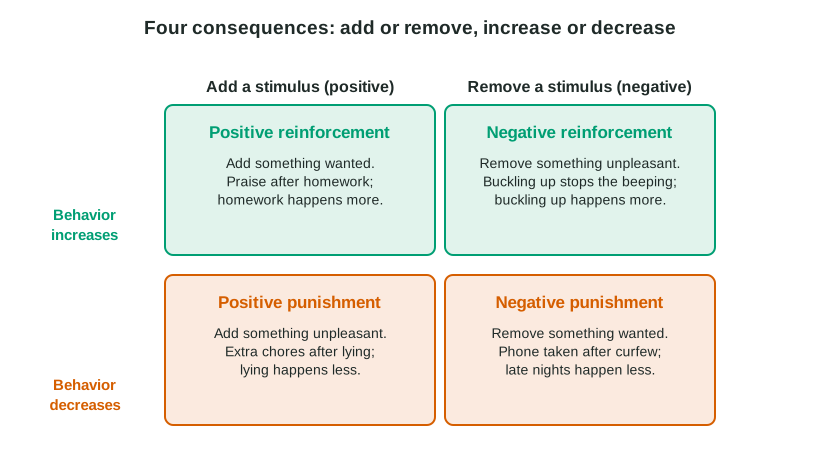
- A behavior is followed by a consequencethe law of effect: satisfying consequences make it more likely, unpleasant ones less likely
- Something wanted is added, or something unpleasant is removedthe behavior increases (positive or negative reinforcement)
- Something unpleasant is added, or something wanted is removedthe behavior decreases (positive or negative punishment)
- Reinforcement comes only some of the time, unpredictablythe behavior is learned more slowly but lasts much longer when reinforcement stops
Part 6 · Key ideas
Key ideas
- Ask two questions. Does the behavior go up (reinforcement) or down (punishment)? Is a stimulus added (positive) or removed (negative)? Positive and negative are math signs, not good and bad.
- Primary reinforcers meet biological needs (food, warmth); secondary reinforcers (money, grades, points) work because they lead to primary ones.
- Shaping reinforces closer and closer steps. Limits and side effects: instinctive drift, superstitious behavior from accidental reinforcement, and learned helplessness after uncontrollable events.
- Ratio schedules pay for responses (fast responding); interval schedules pay for time (slower). Variable schedules give steady responding and resist extinction; fixed ones show pauses or scallops.
Part 7 · Misconception
A common mistake
The wrong idea: Negative reinforcement is a kind of punishment.
What actually happens: Negative reinforcement always increases a behavior, by removing something unpleasant (the beeping stops when you buckle up). Punishment always decreases a behavior.
Part 8 · Check yourself
Check yourself
Exam-style questions. Anything you miss goes into your review queue.
1. Every time Ravi buckles his seatbelt, the car's loud beeping stops. He now buckles up as soon as he sits down. Which concept explains the change?
- Negative reinforcement
- Positive punishment
- Negative punishment
- Positive reinforcement
Show the answer
"Negative" means something is removed and "reinforcement" means the behavior increases. The beeping is removed, and buckling up increases.
- Correct: Negative reinforcement: Right: buckling up removes an unpleasant stimulus (the beeping), so buckling up increases.
- Positive punishment: Punishment makes a behavior less likely. Buckling up became more likely.
- Negative punishment: Negative punishment removes something wanted and lowers a behavior. Ravi lost nothing he wanted.
- Positive reinforcement: Positive reinforcement adds something wanted. Here something unpleasant was taken away.
2. A teenager comes home an hour past curfew, and her parents take away her phone for the weekend. She is home on time after that. Which concept is this?
- Negative punishment
- Negative reinforcement
- Positive punishment
- Extinction
Show the answer
Think of the behavior that changes: coming home late. It decreases (punishment), because a wanted thing was removed (negative).
- Correct: Negative punishment: Right: something wanted (the phone) is removed, and the behavior (coming home late) decreases.
- Negative reinforcement: Negative reinforcement removes something unpleasant and increases a behavior. Losing the phone is not removing something unpleasant.
- Positive punishment: Positive punishment adds something unpleasant, such as extra chores. Here something was taken away.
- Extinction: Extinction is no longer reinforcing a behavior. The parents added a consequence instead.
Data
Invented data: cumulative lever presses on four schedules
3. Curve D rises slowly after each reinforcer and then steeply just before the next one, every 5 minutes. Which schedule is curve D?
- Fixed-interval
- Variable-ratio
- Fixed-ratio
- Variable-interval
Show the answer
Scallops (slow, then fast, then a pause at each set time) are the signature of a fixed-interval schedule.
- Correct: Fixed-interval: Right: responding is slow after a reinforcer and speeds up as the set time approaches, giving a scalloped curve.
- Variable-ratio: A variable-ratio schedule gives the fastest, steadiest curve, with no pauses. That is curve A.
- Fixed-ratio: A fixed-ratio schedule gives fast responding with brief flat pauses after each reinforcer. That is curve B.
- Variable-interval: A variable-interval schedule gives slow, steady responding with no scallops. That is curve C.
4. Which curve most likely shows a variable-ratio schedule?
- Curve A, the steepest, with no pauses
- Curve B, steep with short flat steps
- Curve C, a slow steady line
- Curve D, with scallops
Show the answer
On a variable ratio every press could be the one that pays, so there is no reason to pause: the fastest, steadiest curve.
- Correct: Curve A, the steepest, with no pauses: Right: reward after an unpredictable number of presses keeps responding fast and steady.
- Curve B, steep with short flat steps: Short pauses after each reward are typical of a fixed ratio.
- Curve C, a slow steady line: Slow steady responding fits a variable interval: more presses do not bring rewards sooner.
- Curve D, with scallops: Scallops fit a fixed interval.
5. How many lever presses did the rat on curve C make per minute, on average, over the 30 minutes? (Read the total at 30 minutes.)
Type a number. No calculator needed: work it out by hand, as on the exam.
Show the answer
Curve C reaches 450 presses at 30 minutes: presses per minute.
- Answer: 15
Study
Invented study: rewards on every try or some tries
Introduction
Researchers asked whether being rewarded every time or only some of the time changes how long people keep trying once rewards stop.
Participants
40 high school students (ages 15 to 18) from two schools in Ohio took part with a parent's permission and their own assent. They were randomly assigned to two groups of 20.
Method
Students played a simple online game, pressing a button to try to win points. In the every-time group, every press won a point for the first 60 presses. In the some-times group, presses won a point at random, on average every fourth press. Then, without warning, presses stopped winning points in both groups. Persistence was the number of presses each student made before choosing to quit, up to a limit of 200. Students were debriefed at the end.
Results
After points stopped, the every-time group made a mean of 24 presses before quitting. The some-times group made a mean of 71 presses.
Invented study for practice.
6. Which research method did the researchers use?
- An experiment
- A correlational study
- Naturalistic observation
- A case study
Show the answer
A manipulated variable (the schedule) plus random assignment makes it an experiment.
- Correct: An experiment: Right: they manipulated the reward schedule and randomly assigned students to the two groups.
- A correlational study: A correlational study measures variables as they occur. Here the schedule was manipulated.
- Naturalistic observation: Students were placed in a controlled game the researchers designed, not watched in daily life.
- A case study: A case study looks closely at one person or a few. This compared two groups of 20.
7. Which concept best explains why the some-times group pressed longer after points stopped?
- Partial reinforcement makes behavior more resistant to extinction
- Continuous reinforcement makes behavior more resistant to extinction
- Negative reinforcement made the some-times group press more
- Learned helplessness made the other group quit early
Show the answer
Partial (intermittent) reinforcement produces behavior that lasts longer in extinction than continuous reinforcement does.
- Correct: Partial reinforcement makes behavior more resistant to extinction: Right: when rewards were already unpredictable, a run of no rewards does not signal that rewards have ended.
- Continuous reinforcement makes behavior more resistant to extinction: The every-time group, on continuous reinforcement, quit sooner. Continuous reinforcement gives fast learning but fast extinction.
- Negative reinforcement made the some-times group press more: No unpleasant stimulus was removed when students pressed.
- Learned helplessness made the other group quit early: Learned helplessness follows uncontrollable events. The every-time group had full control until points stopped.
Part 9 · Summary
Summary
Part 10 · Up next
What comes next
Part 11 · Connections