Motivation is whatever starts, directs and keeps behavior going. No single theory explains all of it. Thirst, a craving for dessert, a love of guitar and a fear of public speaking each fit a different theory, and the exam asks you to pick the one that fits a scenario. So learn each theory by the kind of behavior it explains best.
Push from inside, pull from outside
Instinct theory was an early answer: behavior comes from instincts, complex patterns that are unlearned and found throughout a species. It works well for some animal behavior. A spider raised alone, which has never seen a web being built, spins its species' web pattern on the first try. For people it explains little, because naming an instinct for every behavior ("people fight because of a fighting instinct") describes the behavior without explaining it.
Drive-reduction theory starts from the body's need for balance, or homeostasis. A need, such as low water, creates a drive, an uncomfortable aroused state (thirst). The drive pushes you to act, and the action (drinking) reduces it. It explains basic biological motives well. It cannot explain why people seek out arousal, such as riding a roller coaster, or eat when they are not hungry.
Incentive theory covers that second gap. Incentives are rewards in the environment that pull behavior: money, grades, praise, a slice of cheesecake. Drives push from inside; incentives pull from outside. Most real behavior has both: you eat lunch because you are hungry and because the food looks good.
Arousal: not too little, not too much
Arousal theory says we are motivated to keep an optimal level of arousal. When bored, we look for stimulation; when overwhelmed, we look for calm. People differ in where their best level sits. Sensation seekers prefer high arousal and look for varied, new and intense experiences, from skydiving to trying unusual foods, and accept risk to get them.
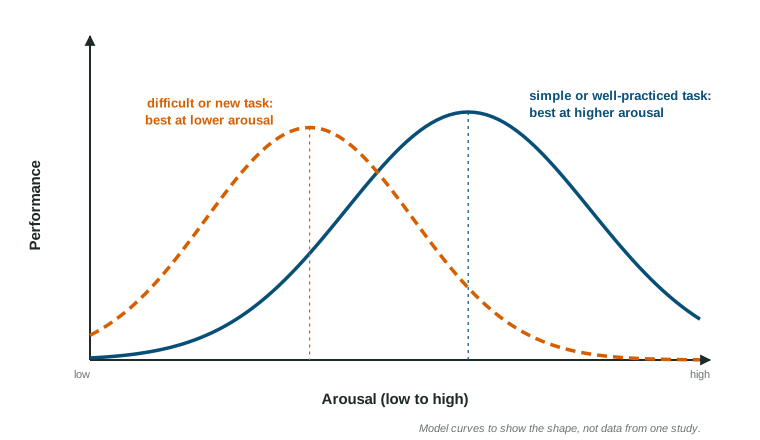
The Yerkes-Dodson law links arousal to performance. Performance is best at a moderate level of arousal and drops when arousal is too low (you are sluggish and careless) or too high (you are anxious and scattered). The best level depends on the task. For a simple or well-practiced task, such as an expert typing, performance holds up at fairly high arousal. For a difficult or new task, such as a beginner taking a hard test, performance peaks at lower arousal and falls off sooner.
Worked example: applying Yerkes-Dodson. A pianist who has played a piece hundreds of times and a student playing a new piece for the first time both perform in a packed concert hall. Who is more likely to play worse than in practice?
Step 1, judge the arousal: a packed hall means high arousal for both. Step 2, judge the task: well-practiced for the pianist, new and hard for the student. Step 3, apply the curves: the new-task curve peaks at lower arousal, so high arousal pushes the student past the peak. The expert can handle more arousal, so the pianist is less likely to suffer and may even do better.
Why we do things: intrinsic and extrinsic
Self-determination theory (Edward Deci and Richard Ryan) says people have three basic psychological needs: autonomy (choosing for yourself), competence (getting better at things) and relatedness (connection with others). When these needs are met, people are more likely to act from intrinsic motivation, doing something because it is interesting or satisfying. Extrinsic motivation means doing something for a reward or to avoid a punishment from outside the activity.
The two can clash. In the overjustification effect, giving an expected reward for something a person already enjoys can lower their interest once the reward stops. The person comes to explain their behavior by the reward ("I draw to get a certificate") instead of the enjoyment. The effect is strongest for expected, tangible rewards given just for doing the task. Surprise rewards and specific praise for good work usually do not lower interest, and rewards can help get people started on tasks nobody enjoys.
Motivational conflicts
Kurt Lewin described four kinds of conflict between goals.
| Conflict | The choice | Example |
|---|---|---|
| Approach-approach | two attractive options | two colleges you love equally |
| Avoidance-avoidance | two unattractive options | study for a test you dread or fail it |
| Approach-avoidance | one option with good and bad sides | you love acting but fear the stage |
| Multiple approach-avoidance | several options, each with good and bad sides | three job offers, each with a different trade-off |
Hunger
Hunger is more than an empty stomach. Several signals reach the hypothalamus, which combines them:
- Ghrelin, released by an empty stomach, signals hunger. It rises before meals and falls after eating.
- Leptin, released by fat cells, signals that the body has enough stored energy and lowers appetite over the longer term. Mice that cannot make leptin eat far more than normal and become very heavy.
Learning and environment matter too. External eating cues, such as the sight or smell of food, a big serving bowl, the time on the clock or other people eating, can trigger eating without hunger. In experiments, people given larger bowls tend to eat more, even when they are no hungrier.
The need to belong
People are strongly motivated to form and keep close relationships. The need to belong helps explain why we join groups, why being left out hurts, and why social support predicts health and happiness. People who feel they belong tend to cope better with stress, and lonely or excluded people tend to report worse moods and health.