If you are struggling, you are not alone. In the US, call or text 988 (the Suicide and Crisis Lifeline), or talk to a trusted adult.
Everyone has days of worry, sadness or odd habits. A psychological disorder is something more: a pattern that is unusual, that hurts, and that gets in the way of living. This topic is about where that line is drawn, who draws it, and how psychologists explain why a disorder appears in one person and not another. You are learning the science here, not a checklist to apply to yourself or your friends; only a trained clinician, after a full assessment, can diagnose anyone.
What makes a pattern a disorder
Clinicians look for three features, often called the three Ds.
| Feature | What it means | Example |
|---|---|---|
| Deviation | The pattern is unusual for the person's culture and setting. | Washing your hands for two hours before you can leave the house. |
| Distress | The pattern causes real suffering for the person. | Feeling intense dread every morning, most days, for months. |
| Dysfunction | The pattern gets in the way of school, work, relationships or self-care. | Missing so many classes that you fail a semester. |
Why do we need more than one feature? Because being different is not the same as being unwell. A person who lives alone in a cabin, paints all night and is happy and productive is unusual, but there is no distress and no dysfunction. Clinicians look for deviation together with distress or dysfunction.
Culture matters for the first D. Speaking aloud to a relative who has died may be expected during mourning in one community and unusual in another. A clinician who judges a behavior by the norms of their own culture instead of the person's can mistake a normal practice for a symptom. That is why the sociocultural perspective is part of every good assessment.
Classifying disorders: the DSM-5-TR and the ICD
To study and treat disorders, professionals need shared names and shared criteria. Two systems provide them.
- The Diagnostic and Statistical Manual of Mental Disorders, published by the American Psychiatric Association. The current edition is the DSM-5-TR (2022). For each disorder it lists the symptoms, how many must be present, how long they must last, and what else must be ruled out. It is the main system used by clinicians in the United States.
- The International Classification of Diseases, published by the World Health Organization. The ICD codes every health condition, physical and psychological, and is used by health systems around the world. Its psychological categories line up closely with the DSM's.
Why classify at all? A shared label lets researchers compare studies, lets clinicians choose treatments that have worked for others with the same pattern, and lets insurers pay for care. Labels have a cost too. People with a diagnosis can face stigma, and a label can shape how others see them. That is why careful writers use person-first language, such as "a person with a disorder" rather than a label for the whole person, and never use a diagnosis as a casual word.
Perspectives: seven ways to explain a disorder
The perspectives you met at the start of the course each offer a different kind of explanation. On the exam, your job is usually to match an explanation in a scenario to its perspective.
| Perspective | Explains a disorder by | For a fear of dogs, it might say |
|---|---|---|
| Biological | genes, brain structures, neurotransmitters, hormones | an overactive amygdala makes fear responses stronger |
| Behavioral | learning: conditioning and reinforcement | a bite paired dogs with pain, and avoiding dogs is negatively reinforced |
| Cognitive | thoughts, beliefs and interpretations | the person believes every dog is likely to attack |
| Psychodynamic | unconscious conflicts, often from childhood, held back by defense mechanisms | the fear stands in for an unconscious conflict |
| Humanistic | blocked growth; a gap between self-concept and experience | the person feels unworthy and unsafe, which blocks growth |
| Evolutionary | traits that helped ancestors survive | fearing animals that could bite was useful for our ancestors |
| Sociocultural | culture, family, social roles and conditions | the person grew up where stray dogs were a real danger |
Worked example: match the explanation to the perspective. "Maya gets one low grade and thinks, 'I am a failure at everything.' Her mood drops for days." Which perspective explains her mood?
Step 1. Find the cause the scenario names. The cause is a thought: she turns one grade into a belief about herself.
Step 2. Ask which perspective is about that kind of cause. Thoughts and interpretations belong to the cognitive perspective. Brain chemistry would be biological; rewards and punishments would be behavioral.
Step 3. Apply it to the people in the scenario. "The cognitive perspective explains Maya's low mood: she overgeneralizes one low grade into the belief that she fails at everything, and that belief, not the grade itself, drives her mood."
Putting causes together
Real disorders rarely have a single cause. Two models, and one way of working, combine the perspectives.
The biopsychosocial model says a disorder comes from biological, psychological and social factors acting together. For one person with depression, that could be a family history of depression (biological), a habit of blaming herself (psychological) and a job loss in a town with few jobs (social).
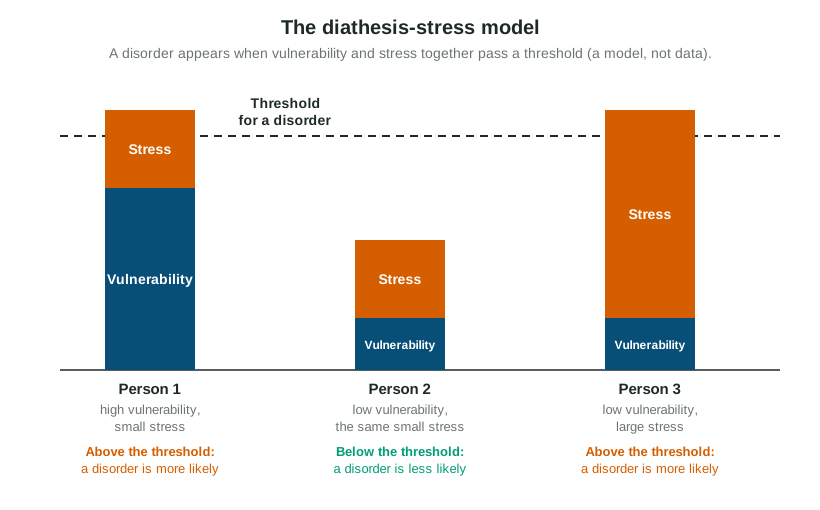
The diathesis-stress model spells out how two kinds of cause combine. A diathesis is a vulnerability, such as genes or harsh early experiences. A disorder tends to appear when the vulnerability meets enough stress. This explains why identical twins, who share their genes, do not always share a disorder: if only one twin meets a severe stressor, only that twin may become ill. Look at the figure: what matters is the total.
The eclectic approach is about practice. A clinician who works eclectically draws methods from several perspectives and chooses what fits each person, for example a cognitive method for one client's self-critical thoughts and a behavioral method for another client's fear.
Reading studies about disorders
Most research on the causes of disorders is correlational: researchers measure family history, stress or income as they occur, because they cannot ethically assign people to hardship. A study might find that adults with a family history and many stressful events had the highest rates of depression. That supports the diathesis-stress model, but it shows a relationship, not proof of cause. A third variable, such as poverty, could raise both stress and the risk of depression.
Experiments are possible on some questions. Researchers can randomly assign people to read about a coworker with or without a diagnostic label and measure how willing they are to work with that person. Because the label is manipulated and people are randomly assigned, a difference between groups can be traced to the label: evidence that labels can carry stigma.