For most of its history, psychology focused on what goes wrong: disorders, damage and distress. Around 2000, Martin Seligman and others argued that a full science of people should also study what goes right. Positive psychology is the scientific study of well-being, strengths and the conditions that help people and communities thrive. It does not replace the study of problems, and it is not the same as "just think positive." It uses the same research methods as the rest of psychology, and its claims are held to the same standard.
Measuring happiness: subjective well-being
Psychologists cannot see happiness directly, so they ask people. Subjective well-being is a person's own judgment of how their life is going: how satisfied they are with it overall, plus how often they feel pleasant rather than unpleasant emotions. A typical survey item asks for a rating of life satisfaction from 1 to 7 or 0 to 10.
Some findings are fairly steady across studies. Close relationships predict well-being strongly. Money matters more when it lifts people out of hardship and less once basic needs are met. People tend to adapt to many good and bad changes over time, returning toward their usual level, though some events, such as long-term unemployment, can have lasting effects. Because these are mostly correlational findings, a third variable could explain part of each link.
Bouncing back and growing: resilience and posttraumatic growth
Resilience is adapting well after adversity, trauma or serious stress: a person is shaken, but returns to their earlier level of functioning. One of the most important findings in this area is that resilience is common. When researchers follow people over time after a disaster or loss, the largest group usually shows fairly low, steady distress, and smaller groups show slow recovery or long-lasting distress. Social support, coping skills and a sense of control are linked to resilience.
Posttraumatic growth is something different: positive change beyond one's earlier level after struggling with a highly challenging event. People describe closer relationships, new priorities, a sense of personal strength or new possibilities. Growth often comes alongside real distress, not instead of it. One caution: most evidence comes from people's own reports of how they have changed, and some studies that measured people before and after a trauma found less change than people later reported.
| Resilience | Posttraumatic growth | |
|---|---|---|
| What happens | returns to the earlier level of functioning | positive change beyond the earlier level |
| Sounds like | "It was hard, but I got back to my life." | "I value my family more and changed my career." |
| How common | the most common response to adversity | reported by many people, though hard to measure |
Gratitude
Gratitude is noticing and appreciating the good things in life and the people behind them. In gratitude experiments, people are randomly assigned to write regularly about things they are thankful for or about neutral events. The gratitude groups usually report slightly higher well-being afterward.
Worked example: significant versus large. In an invented study, 120 students were randomly assigned to gratitude writing or neutral writing for 10 weeks. Life satisfaction (1 to 7) went from 4.8 to 5.3 in the gratitude group and from 4.8 to 4.9 in the neutral group. The difference was statistically significant, but the effect size was small.
Step 1, the change: the gratitude group rose points; the neutral group rose . Step 2, why the neutral group matters: it shows what changes from time passing and from writing itself, so the extra gain can be credited to gratitude. Step 3, read the statistics: significant means the gap is unlikely to be chance alone; small means it is modest. A fair conclusion: "Gratitude writing raised life satisfaction a little, on average, in these students."
Character strengths and virtues
Positive psychologists Christopher Peterson and Martin Seligman looked across philosophies, religions and cultures for strengths that are widely valued. They grouped 24 character strengths into six broad virtue categories.
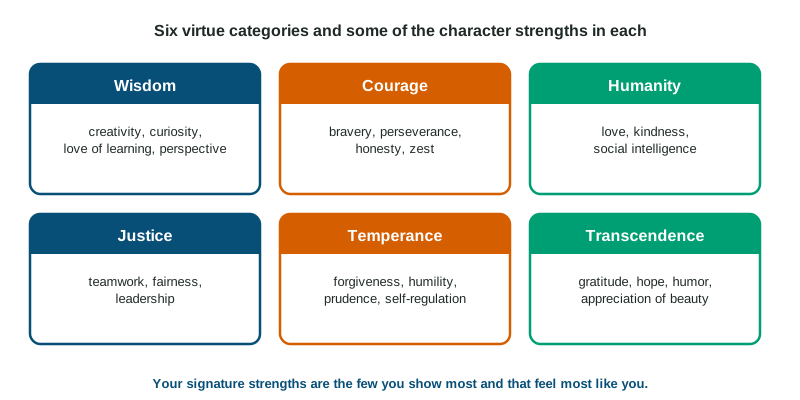
- Wisdom: strengths of knowing, such as curiosity, creativity and perspective.
- Courage: acting well despite difficulty, such as bravery, perseverance and honesty.
- Humanity: close relationships, such as love and kindness.
- Justice: healthy group life, such as fairness, teamwork and leadership.
- Temperance: protection against excess, such as forgiveness, humility and self-regulation.
- Transcendence: connection to something larger, such as gratitude, hope and humor.
Everyone has all of these to some degree. Your signature strengths are the few you show most and that feel most like "the real you." Studies that ask people to use a top strength in a new way each day find small gains in happiness on average.
Keeping it scientific
Positive psychology is easy to oversell. Most of its exercises show small average effects, many findings are correlational, and self-reports can be biased. Optimism has modest links with better health, but no evidence shows that positive thinking cures illness, and telling sick people they just need a better attitude is both wrong and unfair. Read each claim the way you would any other study: what was measured, how big the effect was, and whether the design can show cause.