Psychodynamic and Humanistic Theories of Personality
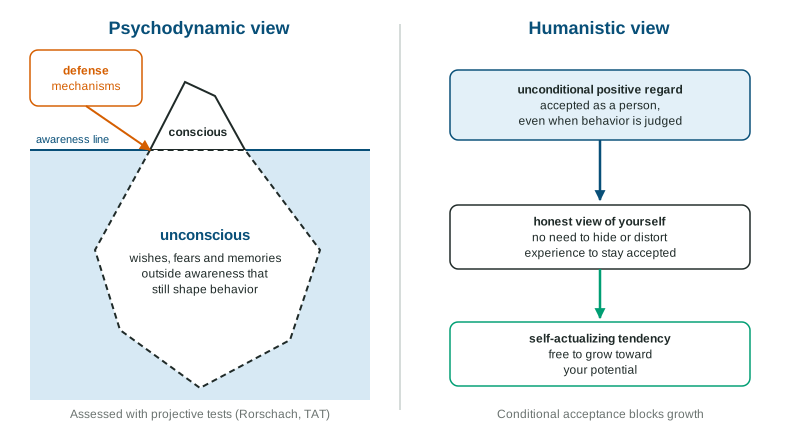
The psychodynamic view explains personality through unconscious processes and the defense mechanisms that protect us from anxiety (repression, denial, displacement, projection, rationalization, reaction formation, regression, sublimation), assessed with projective tests whose reliability and validity are often weak.
Part 1 · Hook
Why this matters
Part 2 · Before you start
What this builds on
Part 3 · Prerequisite check
Quick check before you start
1. A woman cannot remember a frightening event from her childhood, and a theory says the memory was pushed out of awareness to protect her. What is this idea called?
- Repression
- Retroactive interference
- Encoding failure
- Source amnesia
Show the answer
Repression is the proposed pushing of painful memories out of awareness; memory researchers find little evidence that it explains most forgetting.
- Correct: Repression:
- Retroactive interference:
- Encoding failure:
- Source amnesia:
2. Two scorers rate the same answers and often give very different scores. Which quality of the measure is weak?
- Reliability
- Standardization
- Heritability
- Random sampling
Show the answer
Reliability is consistency; scorers who disagree make the measure unreliable.
- Correct: Reliability:
- Standardization:
- Heritability:
- Random sampling:
Part 4 · See it
See it first
Part 5 · Step by step
How it works, step by step
- A thought or urge would cause anxiety if you admitted itin the psychodynamic view, a defense mechanism keeps it out of awareness or disguises it
- The defense works without your noticingit shows up as behavior, such as excuses (rationalization) or anger aimed at a safer target (displacement)
- Psychologists cannot ask directly about unconscious materialthey use projective tests, such as inkblots, whose ambiguous images may reveal hidden concerns
- In the humanistic view, a person is accepted without conditions (unconditional positive regard)they can see themselves honestly, and the self-actualizing tendency moves them toward growth
Part 6 · Key ideas
Key ideas
- The psychodynamic view says much of personality runs on the unconscious: wishes, fears and memories outside awareness that still shape behavior.
- Defense mechanisms protect us from anxiety: repression, denial, displacement, projection, rationalization, reaction formation, regression and sublimation. Learn to spot each in a scenario.
- Projective tests (Rorschach inkblots, the Thematic Apperception Test) use ambiguous images. Scoring often has weak reliability and validity.
- The humanistic view stresses free choice and growth: unconditional positive regard frees the self-actualizing tendency.
Part 7 · Misconception
A common mistake
The wrong idea: Projection means being angry at someone and taking it out on someone else.
What actually happens: That is displacement (a feeling moved to a safer target). Projection is seeing your own unacceptable trait or urge in other people, such as a dishonest person accusing everyone of lying.
Part 8 · Check yourself
Check yourself
Exam-style questions. Anything you miss goes into your review queue.
1. After his manager criticizes him in front of coworkers, Jamal says nothing at work. At home that evening he snaps at his younger brother over a small mess. Which defense mechanism does this show?
- Regression
- Displacement
- Reaction formation
- Denial
Show the answer
Displacement redirects a feeling from its real source to a safer target.
- Regression: Regression is a return to childish behavior, such as a tantrum; snapping at a sibling is not a retreat to an earlier stage.
- Correct: Displacement: Right: anger at the manager, a risky target, is shifted onto his brother, a safer one.
- Reaction formation: Reaction formation would mean acting the opposite of his feeling, such as being extra kind to the manager.
- Denial: Denial is refusing to accept a reality; Jamal does not deny that he was criticized.
2. A student who is often tempted to copy homework constantly accuses other students of cheating, even with little evidence. According to the psychodynamic view, which defense mechanism is at work?
- Displacement
- Denial
- Reaction formation
- Projection
Show the answer
Projection puts one's own unacceptable thoughts or urges onto other people.
- Displacement: Displacement moves a feeling to a safer target; here the student is attributing a trait, not shifting anger.
- Denial: Denial would be refusing to accept an outside fact; the student is assigning a motive to others.
- Reaction formation: Reaction formation would be acting as an extreme rule follower, the opposite of the urge, rather than accusing others.
- Correct: Projection: Right: the student's own unacceptable urge to cheat is seen in other people instead of in himself.
3. A father tells his son, "I love you no matter what, and I am disappointed that you lied about the broken window." From the humanistic view, which concept does the father's first statement show?
- Reaction formation
- The self-actualizing tendency
- Conditional acceptance
- Unconditional positive regard
Show the answer
Unconditional positive regard is acceptance of the person that does not depend on behavior; the behavior can still be judged.
- Reaction formation: Reaction formation is a defense that hides a feeling behind its opposite; the father states his feelings openly.
- The self-actualizing tendency: The self-actualizing tendency is the son's drive to grow; the father's statement is the condition that supports it.
- Conditional acceptance: Conditional acceptance would make love depend on good behavior; he says he loves his son no matter what.
- Correct: Unconditional positive regard: Right: he accepts his son as a person while still disapproving of the behavior.
Study
Do scorers agree on inkblot responses?
Introduction
Projective tests are scored by trained clinicians. Researchers asked whether two clinicians scoring the same inkblot responses would give similar scores, and whether a person's score would be similar six weeks later.
Participants
60 adult volunteers (ages 20 to 64; 34 women, 26 men) recruited through a community health center in one US city. Each gave informed consent. Responses were stored under ID numbers, not names, so no one could be identified.
Method
Each participant described what they saw in 10 standard inkblot cards. Two trained clinicians, working separately, scored every set of responses for hostility on a scale from 0 (none) to 20 (very high). Six weeks later, the same participants did the test again and one clinician scored it.
Results
The two clinicians' hostility scores for the same responses showed only a weak to moderate positive correlation. Scores from the first and second sessions also showed a weak to moderate positive correlation.
Discussion
The researchers concluded that hostility scores from this test were not consistent enough to use alone when making decisions about a person.
Invented study for practice.
4. Which research method did this study use?
- An experiment
- A case study
- Naturalistic observation
- A correlational study
Show the answer
The study measured the relationship between scorers and between sessions, which makes it correlational.
- An experiment: No variable was manipulated and no one was randomly assigned to conditions.
- A case study: A case study looks in depth at one person or a few; this study compared scores across 60 people.
- Naturalistic observation: Participants were tested with cards in a set procedure, not watched in an everyday setting.
- Correct: A correlational study: Right: the researchers measured how strongly two sets of scores were related, without manipulating anything.
5. The results raise the most doubt about which quality of this hostility score?
- Its reliability, because scores were inconsistent across scorers and over time
- Its validity, because the hostility scores did not predict who later acted aggressively
- Its generalizability, because the sample was too small to matter
- Its random assignment, because people were not placed into groups
Show the answer
Interrater agreement and test-retest consistency are both forms of reliability; a test that is not reliable cannot be fully valid either.
- Correct: Its reliability, because scores were inconsistent across scorers and over time: Right: agreement between scorers and between sessions are both measures of reliability.
- Its validity, because the hostility scores did not predict who later acted aggressively: The study never compared scores with real behavior, so it did not test that kind of validity.
- Its generalizability, because the sample was too small to matter: Generalizability depends on who the participants were, not mainly on sample size.
- Its random assignment, because people were not placed into groups: There were no groups or conditions, so random assignment does not apply here.
6. Write the operational definition of hostility used in this study.
Build the answer part by part, then write it in your own words.
Show the answer
An operational definition says exactly how the variable was measured: the 0 to 20 score from the 10 cards.
- An answer that earns the point: Hostility was measured as a score from 0 to 20 given by a trained clinician, based on what the participant said they saw in 10 standard inkblot cards.
7. Which ethical safeguard does the summary say the researchers used, and how?
- Debriefing, by revealing a deception at the end of the study
- Random assignment, by placing participants in groups by chance
- Confidentiality, by storing responses under ID numbers instead of names
- Protection from harm, by screening out people with high hostility
Show the answer
Name a safeguard the summary actually describes and say how it was applied: confidentiality through ID numbers (informed consent is also described).
- Debriefing, by revealing a deception at the end of the study: The summary describes no deception and no debriefing.
- Random assignment, by placing participants in groups by chance: Random assignment is a design feature, not an ethical safeguard, and was not used.
- Correct: Confidentiality, by storing responses under ID numbers instead of names: Right: the summary says responses were stored under ID numbers so no one could be identified.
- Protection from harm, by screening out people with high hostility: The summary does not describe any screening of participants.
Part 9 · Summary
Summary
Part 10 · Up next
What comes next
Part 11 · Connections