Emotion
Emotion combines physiological arousal, a felt experience and expression.
Part 1 · Hook
Why this matters
Part 2 · Before you start
What this builds on
Part 3 · Prerequisite check
Quick check before you start
1. Which part of the nervous system speeds the heart and breathing in a frightening moment?
- Sympathetic nervous system
- Parasympathetic nervous system
- Somatic nervous system
- Spinal reflex arc
Show the answer
The sympathetic division arouses the body for action; the parasympathetic calms it afterward.
- Correct: Sympathetic nervous system:
- Parasympathetic nervous system:
- Somatic nervous system:
- Spinal reflex arc:
2. A study finds a difference that is "not statistically significant." What does that mean?
- The difference could plausibly be due to chance
- The difference is large and important
- The study used random sampling
- The two variables are correlated
Show the answer
Not significant means the result could plausibly have happened by chance; it says nothing about size or importance.
- Correct: The difference could plausibly be due to chance:
- The difference is large and important:
- The study used random sampling:
- The two variables are correlated:
Part 4 · See it
See it first
Part 5 · Step by step
How it works, step by step
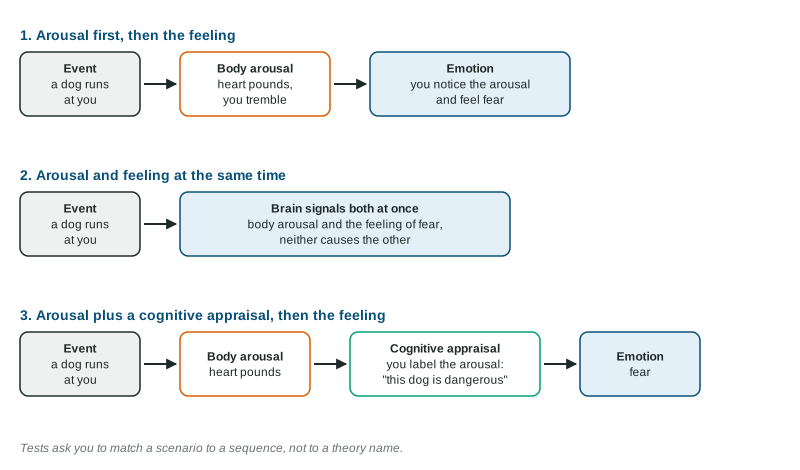
- A frightening event happensthe sympathetic nervous system produces physiological arousal: racing heart, fast breathing, sweating
- In one view, you notice that arousaland the feeling follows from it (arousal first, then emotion)
- In another view, the brain signals body and cortex at onceso arousal and the feeling happen together, neither causing the other
- In a third view, you appraise the situation and label the arousalthe same arousal can become excitement or fear, depending on the label
Part 6 · Key ideas
Key ideas
- Three sequences: arousal first, then the feeling; arousal and feeling at the same time; arousal plus a cognitive appraisal, then the feeling. Some reactions are fast, before appraisal.
- Physiological arousal comes mainly from the sympathetic nervous system. The amygdala helps detect threats quickly.
- The facial feedback hypothesis says expressions can shape feelings. Evidence is mixed: large replications of the pen-in-teeth study found no reliable effect.
- Some universal emotions are recognized across cultures above chance, but better within one's own culture. Display rules govern how much is shown. Broaden-and-build: positive emotions widen thinking and build resources.
Part 7 · Misconception
A common mistake
The wrong idea: The facial feedback hypothesis is proven: smiling reliably makes you happier.
What actually happens: Evidence is mixed. A classic pen-in-teeth study reported an effect, but a large replication across 17 labs found none, and later multi-lab work found at most small effects for some methods. Teach it as a hypothesis with mixed support.
Part 8 · Check yourself
Check yourself
Exam-style questions. Anything you miss goes into your review queue.
1. Walking home at night, Nia hears footsteps behind her. Her heart races, and only then, noticing her pounding heart, does she realize she feels afraid. Which sequence of emotion does her experience fit?
- The feeling of fear comes first and then causes the body to react
- Body arousal comes first, and noticing it produces the feeling
- Arousal and the feeling happen at the same time, neither causing the other
- A display rule tells her which feeling is acceptable to show
Show the answer
One view says we feel an emotion because we notice our body's arousal.
- The feeling of fear comes first and then causes the body to react: In her account the body reacts first and the feeling follows.
- Correct: Body arousal comes first, and noticing it produces the feeling: Right: arousal, then awareness of the arousal, then the emotion.
- Arousal and the feeling happen at the same time, neither causing the other: She describes the feeling coming after she noticed her racing heart.
- A display rule tells her which feeling is acceptable to show: Display rules govern showing an emotion, not the order in which it arises.
2. A researcher argues that when a snake appears, the brain sends signals to the body (racing heart) and to the cortex (the feeling of fear) at the same moment. Which sequence is she describing?
- Arousal first, then the feeling
- A cognitive appraisal first, then arousal, then the conscious feeling
- Arousal and the feeling occur together, neither causing the other
- The feeling first, then a facial expression that matches it
Show the answer
A second view says the brain triggers arousal and the conscious feeling at the same time.
- Arousal first, then the feeling: She says neither comes first.
- A cognitive appraisal first, then arousal, then the conscious feeling: She does not describe a thinking step that labels the arousal.
- Correct: Arousal and the feeling occur together, neither causing the other: Right: signals go to body and cortex at the same time.
- The feeling first, then a facial expression that matches it: The claim is about body arousal and feeling, not facial expression.
3. Two students feel the same racing heart and sweaty palms before a concert. One thinks, "I'm so excited!" and the other thinks, "I'm terrified." Which idea best explains why they report different emotions?
- The arousal is labeled by an appraisal of the situation
- Arousal and feeling occur at the same time, so labels do not matter
- The facial feedback hypothesis
- Display rules for performers
Show the answer
A third view adds a cognitive label: arousal plus the appraisal of the situation produce the emotion.
- Correct: The arousal is labeled by an appraisal of the situation: Right: the same arousal is labeled differently, so they feel different emotions.
- Arousal and feeling occur at the same time, so labels do not matter: This view leaves no role for labeling, but the labels here make the difference.
- The facial feedback hypothesis: Nothing in the scenario involves their facial expressions changing their feelings.
- Display rules for performers: Display rules affect what emotion is shown, not what is felt.
Figure
Three sequences for emotion
4. A patient with a spinal cord injury that reduces body feedback reports that his emotions feel less intense than before. Which sequence in the figure does this support most?
- Sequence 1, since it says the feeling depends on noticing arousal
- Sequence 2, because it says the body is the source of the feeling
- Sequence 3, because it says there is no role for the body
- No sequence, since body feedback is missing from each of the three
Show the answer
If feelings come from noticing arousal (sequence 1), reducing body feedback should weaken them.
- Correct: Sequence 1, since it says the feeling depends on noticing arousal: Right: if body feedback drives the feeling, less feedback should mean weaker feelings.
- Sequence 2, because it says the body is the source of the feeling: Sequence 2 says arousal and feeling are separate and simultaneous, so less body feedback should not weaken feelings.
- Sequence 3, because it says there is no role for the body: Sequence 3 includes body arousal as one of its steps.
- No sequence, since body feedback is missing from each of the three: Body arousal appears in each of the three sequences.
5. In an experiment, people given an arousing (but harmless) injection without being told its effects felt angry when a partner acted angry and happy when a partner acted silly. Which sequence does this best fit?
- Sequence 1, because the arousal by itself produced one fixed emotion for everyone
- Sequence 2, because arousal and feeling were simultaneous
- Sequence 3, because people labeled the same arousal by the situation
- No sequence, because the injection lowered arousal in these people
Show the answer
The same arousal, labeled differently by situation, produced different emotions: the appraisal sequence. (Later studies found this effect hard to replicate in full.)
- Sequence 1, because the arousal by itself produced one fixed emotion for everyone: The same arousal produced different emotions, so arousal alone cannot decide the feeling.
- Sequence 2, because arousal and feeling were simultaneous: The emotion depended on the partner, which points to a labeling step.
- Correct: Sequence 3, because people labeled the same arousal by the situation: Right: arousal plus a cognitive appraisal of the situation produced the emotion.
- No sequence, because the injection lowered arousal in these people: The injection increased arousal.
6. Which step appears in sequence 3 but not in sequence 1?
- Body arousal such as a pounding heart
- An appraisal that labels arousal
- The event that starts the whole sequence
- The emotion that results at the end
Show the answer
The appraisal step is what sets sequence 3 apart.
- Body arousal such as a pounding heart: Both sequences 1 and 3 include body arousal.
- Correct: An appraisal that labels arousal: Right: sequence 3 adds a thinking step that interprets the situation.
- The event that starts the whole sequence: All three sequences start with the same event.
- The emotion that results at the end: All three sequences end in an emotion.
7. At a funeral in her community, Hana weeps loudly, as is expected there. In her new workplace abroad, she hides her sadness at a coworker's funeral because quiet grief is expected. Which concept explains the difference?
- Universal emotions
- The facial feedback hypothesis
- Display rules
- Physiological arousal
Show the answer
Display rules are cultural norms about expressing emotion.
- Universal emotions: Her sadness is the same; what changes is how much she shows.
- The facial feedback hypothesis: She is not changing her feelings through her face.
- Correct: Display rules: Right: cultural norms tell people when, how and how much emotion to show.
- Physiological arousal: Arousal is a body state; the difference is in the expression her culture expects.
Part 9 · Summary
Summary
Part 10 · Up next
What comes next
Part 11 · Connections