Sensation
Sensation is detecting energy and transducing it into neural signals.
Part 1 · Hook
Why this matters
Part 2 · Before you start
What this builds on
Part 3 · Prerequisite check
Quick check before you start
1. Which lobe processes vision?
- The occipital lobe
- The temporal lobe
- The frontal lobe
- The parietal lobe
Show the answer
The occipital lobe, at the back, processes visual information.
- Correct: The occipital lobe:
- The temporal lobe:
- The frontal lobe:
- The parietal lobe:
2. What does the thalamus do with signals from the senses?
- Relays them to the right areas of the cortex
- Turns them into motor commands
- Converts them into hormones
- Blocks them during the day
Show the answer
The thalamus relays signals from every sense except smell to the cortex.
- Correct: Relays them to the right areas of the cortex:
- Turns them into motor commands:
- Converts them into hormones:
- Blocks them during the day:
Part 4 · See it
See it first
Part 5 · Step by step
How it works, step by step
- Energy (light, sound waves, chemicals, pressure) reaches a sense organreceptor cells transduce it into neural signals
- The signal must be strong enoughit is detected at or above the absolute threshold; a change is noticed only above the just-noticeable difference (Weber's law)
- A stimulus stays the same for a whilesensory adaptation lowers the response
- Signals travel to the brain (most through the thalamus)the brain codes color, pitch, taste and pain, explained by trichromatic and opponent-process, place and frequency, and gate control theories
Part 6 · Key ideas
Key ideas
- Sensation starts with transduction. The absolute threshold is the faintest stimulus detected half the time; the just-noticeable difference grows with the stimulus (Weber's law: a constant proportion). Signal detection theory adds expectations and stakes.
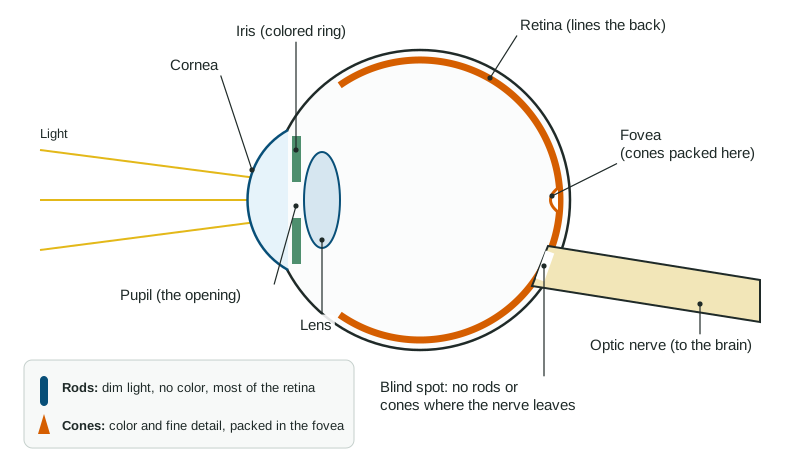
- Vision: rods (dim light, no color, around the edge) and cones (color, detail, packed in the fovea). Color: trichromatic theory (three cone types) and opponent-process theory (paired processes; afterimages).
- Hearing: hair cells in the cochlea. Place theory explains high pitches, frequency theory low ones, the volley principle in between. Conduction deafness: outer or middle ear. Sensorineural deafness: cochlea or auditory nerve.
- Chemical senses: olfaction and gustation (sweet, salty, sour, bitter, umami, and oleogustus for fat). Pain: gate control theory, phantom limbs. Body: vestibular sense (balance) and kinesthesis (position).
Part 7 · Misconception
A common mistake
The wrong idea: Your eyes see everything in front of you in sharp color, all the time.
What actually happens: Only the fovea sees sharp detail and color; the edges of your vision rely on rods that see poorly in color. You also have a blind spot in each eye with no receptors. The brain fills in the gaps.
Part 8 · Check yourself
Check yourself
Exam-style questions. Anything you miss goes into your review queue.
Figure
The eye, cut from side to side
1. To read the small print on a medicine label, Ines looks straight at it. Where in the eye does the image of the print fall, and why does that help?
- On the fovea, where cones are packed for fine detail
- On the blind spot, where the optic nerve leaves the eye
- On the lens, which detects color and fine detail
- On the outer edge of the retina, where rods are densest
Show the answer
Looking straight at something focuses its image on the fovea, which is packed with cones, the receptors for color and sharp detail.
- Correct: On the fovea, where cones are packed for fine detail: Right: the fovea, full of cones, gives the sharpest vision.
- On the blind spot, where the optic nerve leaves the eye: The blind spot has no receptors at all, so nothing there is seen.
- On the lens, which detects color and fine detail: The lens focuses light; it does not detect anything. Receptors are in the retina.
- On the outer edge of the retina, where rods are densest: Rods at the edge detect dim light but not fine detail.
2. Out stargazing, Theo notices a faint star is easier to see when he looks slightly to one side of it. What explains this?
- Off to the side, the image falls where rods are dense; rods work in dim light
- Off to the side, the image falls on the fovea, which is packed with cones
- Looking away moves the image onto the blind spot, which boosts faint light
- Looking away lets the lens collect more light from the faint, distant star
Show the answer
Rods, which respond to dim light, are spread across the retina outside the fovea. Looking slightly away puts a faint image on rods instead of the cone-packed fovea.
- Correct: Off to the side, the image falls where rods are dense; rods work in dim light: Right: rods outside the fovea are better at detecting dim light.
- Off to the side, the image falls on the fovea, which is packed with cones: Looking straight at the star puts it on the fovea; looking away moves it off.
- Looking away moves the image onto the blind spot, which boosts faint light: Nothing is seen at the blind spot, because it has no receptors.
- Looking away lets the lens collect more light from the faint, distant star: Where you look does not change how much light the lens gathers.
3. In the figure, why is there a blind spot where the optic nerve leaves the eye?
- There are no rods or cones there to detect light
- The cones there detect color but not any shapes
- The lens does not bend light toward that spot
- Too many rods there overload the optic nerve
Show the answer
The axons that form the optic nerve leave through one spot, so there is no room for receptors there. Light falling on it is not detected. We rarely notice because the other eye and the brain fill in the gap.
- Correct: There are no rods or cones there to detect light: Right: no receptors means no detection at that spot.
- The cones there detect color but not any shapes: There are no cones at the blind spot at all.
- The lens does not bend light toward that spot: Light reaches the spot; there is simply nothing there to detect it.
- Too many rods there overload the optic nerve: The blind spot has no rods, so it cannot be overloaded by them.
4. Holding a 100-gram letter, Dani can just tell when 2 grams are added. By Weber's law, about how much must be added to a 400-gram package for her to just notice a change?
- About 8 grams
- About 2 grams
- About 4 grams
- About 20 grams
Show the answer
Weber's law says the just-noticeable difference is a constant proportion of the original stimulus. 2 out of 100 is 2%; 2% of 400 grams is 8 grams.
- Correct: About 8 grams: Right: the same 2% of 400 grams is 8 grams.
- About 2 grams: 2 grams is the same amount, but the difference needed grows with the size of the stimulus.
- About 4 grams: 4 grams would be only 1% of 400 grams, which she would not notice.
- About 20 grams: 20 grams is 5%, much more than she needs.
5. With a bad cold and a blocked nose, Lucas says his favorite soup tastes like "hot water." Which concept explains this?
- Sensory interaction
- Sensory adaptation
- Weber's law
- Signal detection theory
Show the answer
Much of what we call flavor comes from smell. When smell is blocked, taste alone is flat. One sense changing another is sensory interaction.
- Correct: Sensory interaction: Right: losing smell changes taste, which is sensory interaction.
- Sensory adaptation: Adaptation is a drop in response to a constant stimulus, not a blocked nose.
- Weber's law: Weber's law is about noticing changes in stimulus strength.
- Signal detection theory: Signal detection is about deciding whether a faint stimulus is present; his soup is not faint, it lacks smell.
6. Stare at a green square for 30 seconds, then look at a white wall, and you briefly see a red square. Which theory explains this best?
- Opponent-process theory
- Trichromatic theory
- Place theory
- Gate control theory
Show the answer
Opponent-process theory says color is coded in pairs (red-green, blue-yellow). Staring tires the green side, so the white wall drives the red side more: a red afterimage.
- Correct: Opponent-process theory: Right: the paired red-green process explains the red afterimage.
- Trichromatic theory: Three cone types explain color matching and most color deficiency, but not opposite-color afterimages.
- Place theory: Place theory explains how we hear high pitches.
- Gate control theory: Gate control theory explains why pain can be blocked.
7. A guitarist has played loud concerts without ear protection for years. Now high-pitched sounds are hard for him to hear, and a hearing aid helps only somewhat. What kind of hearing loss is most likely?
- Sensorineural, from damage to hair cells in the cochlea
- Conduction, from damage to the hair cells in the cochlea
- Sensorineural, from a torn eardrum that blocks the sound
- Conduction, from a buildup of wax deep in the inner ear
Show the answer
Loud noise damages the hair cells in the cochlea, which do not grow back. Damage to the cochlea or auditory nerve is sensorineural hearing loss. Hair cells near the base, which respond to high pitches, are often hit first.
- Correct: Sensorineural, from damage to hair cells in the cochlea: Right: noise damages cochlear hair cells, causing sensorineural loss.
- Conduction, from damage to the hair cells in the cochlea: Hair-cell damage is sensorineural; conduction loss is in the outer or middle ear.
- Sensorineural, from a torn eardrum that blocks the sound: A torn eardrum blocks sound before the cochlea: that is conduction loss.
- Conduction, from a buildup of wax deep in the inner ear: Wax builds up in the ear canal, the outer ear, and causes conduction loss.
Part 9 · Summary
Summary
Part 10 · Up next
What comes next
Part 11 · Connections