Perception
Perception turns sensations into meaning.
Part 1 · Hook
Why this matters
Part 2 · Before you start
What this builds on
Part 3 · Prerequisite check
Quick check before you start
1. Which step happens in sensation, before perception begins?
- Receptors change light into neural signals (transduction)
- The brain decides what an object is
- A memory of the object is formed
- Attention picks one conversation to follow
Show the answer
Sensation is detecting the stimulus: receptors transduce energy into neural signals. Interpreting those signals is perception.
- Correct: Receptors change light into neural signals (transduction):
- The brain decides what an object is:
- A memory of the object is formed:
- Attention picks one conversation to follow:
2. Which lobe of the brain first processes visual information?
- Occipital lobe
- Frontal lobe
- Temporal lobe
- Parietal lobe
Show the answer
The occipital lobe, at the back of the brain, holds the primary visual cortex.
- Correct: Occipital lobe:
- Frontal lobe:
- Temporal lobe:
- Parietal lobe:
Part 4 · See it
See it first
Part 5 · Step by step
How it works, step by step
- Receptors send signals about lines, edges and colorsbottom-up processing begins to build a picture of the scene
- Knowledge, expectations and context join intop-down processing and perceptual set tilt what we perceive
- The brain applies Gestalt grouping and depth cueswe see whole objects, at a distance, in three dimensions
- Attention is limitedwhat we do not attend to can go unseen (inattentional and change blindness)
Part 6 · Key ideas
Key ideas
- Bottom-up processing builds a percept from raw features; top-down processing uses knowledge, schemas and expectations (perceptual set). Both run at once.
- Selective attention filters input. Important words still break through (the cocktail party effect), but unattended things can be missed (change blindness, inattentional blindness).
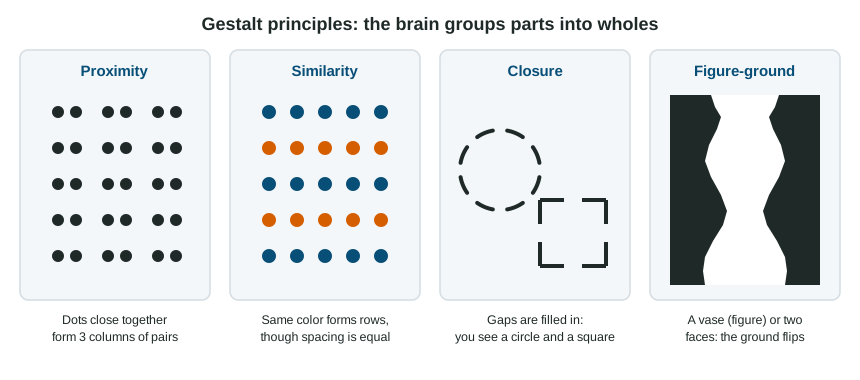
- Gestalt principles group parts into wholes: proximity, similarity, closure and figure-ground.
- Depth comes from binocular cues (retinal disparity, convergence) and monocular cues (relative size, interposition, linear perspective, texture gradient, relative clarity).
- Perceptual constancy keeps size, shape and color stable; apparent movement turns still frames into motion.
Part 7 · Misconception
A common mistake
The wrong idea: Your eyes work like a camera, so what you see is an exact copy of the world.
What actually happens: Perception is built by the brain. The same image can be seen two ways depending on expectations, context and attention, and things in plain view can be missed entirely.
Part 8 · Check yourself
Check yourself
Exam-style questions. Anything you miss goes into your review queue.
Figure
Three perception figures: grouping, a road scene and an illusion
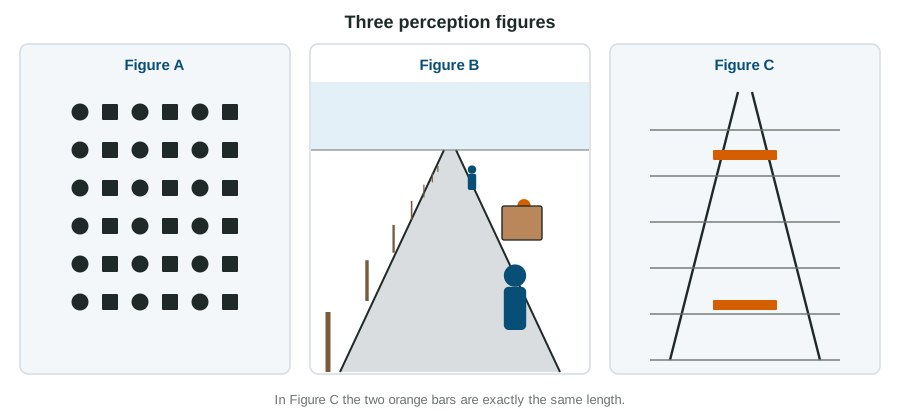
1. In Figure A every shape is the same distance from its neighbors, yet most people see six columns rather than six rows. Which Gestalt principle explains this?
- Similarity: shapes that look alike are grouped together
- Proximity: shapes that are close together are grouped
- Closure: gaps in an outline are filled in to make a whole
- Figure-ground: one part stands out against a background
Show the answer
The spacing is equal in both directions, so nothing but the look of the shapes can group them. Each column holds one kind of shape, so similarity groups the columns.
- Correct: Similarity: shapes that look alike are grouped together: Right: The spacing is equal in both directions, so nothing but the look of the shapes can group them. Each column holds one kind of shape, so similarity groups the columns.
- Proximity: shapes that are close together are grouped: Proximity needs some shapes to sit closer together. Here the spacing is equal everywhere, so it cannot favor columns over rows.
- Closure: gaps in an outline are filled in to make a whole: Closure fills in a broken outline. Figure A has no outline with gaps.
- Figure-ground: one part stands out against a background: Figure-ground separates an object from its background; it does not explain why columns win over rows.
2. In Figure B the two blue people have the same shape, but one is drawn much smaller. Which depth cue makes the smaller one look farther away rather than tiny?
- Retinal disparity
- Relative size
- Interposition
- Convergence
Show the answer
When two objects are known to be about the same size, the one that casts the smaller image is perceived as farther away. That is relative size, a monocular cue.
- Retinal disparity: Retinal disparity is a binocular cue that comes from the two eyes seeing slightly different views. A flat drawing gives both eyes the same image.
- Correct: Relative size: Right: When two objects are known to be about the same size, the one that casts the smaller image is perceived as farther away. That is relative size, a monocular cue.
- Interposition: Interposition is one object blocking part of another. The two blue people do not overlap anything.
- Convergence: Convergence is the inward turning of the eyes for near objects, a binocular cue. It does not come from a drawing.
3. In Figure B the box covers part of the orange person. Which depth cue tells a viewer that the box is closer than the person?
- Linear perspective
- Texture gradient
- Interposition
- Relative clarity
Show the answer
An object that blocks part of another is perceived as nearer. That overlap is interposition.
- Linear perspective: Linear perspective is parallel lines, like the road edges, seeming to meet in the distance. It is in the picture, but it is not what shows the box is in front.
- Texture gradient: A texture gradient is detail becoming finer and denser with distance, like the fence posts. The box and person do not show it.
- Correct: Interposition: Right: An object that blocks part of another is perceived as nearer. That overlap is interposition.
- Relative clarity: Relative clarity is hazy objects seeming farther away. Both the box and the person are drawn equally sharp.
4. At a loud party, Keisha is talking with a friend and hears nothing of the other conversations, until someone across the room says her name. Which concept does this show?
- The cocktail party effect
- Change blindness
- Inattentional blindness
- Apparent movement
Show the answer
Selective attention filters out most sounds, yet an important word like your own name can still break through. That is the cocktail party effect.
- Correct: The cocktail party effect: Right: Selective attention filters out most sounds, yet an important word like your own name can still break through. That is the cocktail party effect.
- Change blindness: Change blindness is failing to notice a change in a scene. Keisha did notice something.
- Inattentional blindness: Inattentional blindness is missing something in plain view because attention is elsewhere. Keisha did not miss her name.
- Apparent movement: Apparent movement is seeing motion in a series of still images. It has nothing to do with hearing a name.
5. As a friend walks away from you down a hallway, the image of her on your retina shrinks, but she does not seem to be getting smaller. Which concept explains this?
- Relative size cue
- Convergence
- Size constancy
- Closure
Show the answer
Size constancy keeps a familiar object's perceived size stable even as its retinal image shrinks with distance.
- Relative size cue: Relative size is a depth cue: the smaller image looks farther away. It tells you she is farther, but not why she still looks the same size.
- Convergence: Convergence is the eyes turning inward for near objects. It does not keep size stable.
- Correct: Size constancy: Right: Size constancy keeps a familiar object's perceived size stable even as its retinal image shrinks with distance.
- Closure: Closure fills in gaps in an outline. Your friend is not an incomplete outline.
6. A movie is a rapid series of still frames, yet viewers see smooth motion. Which concept explains this?
- Apparent movement
- Perceptual constancy (size and shape)
- Selective attention
- Interposition
Show the answer
When still images appear in quick succession, the brain perceives motion between them. That is apparent movement.
- Correct: Apparent movement: Right: When still images appear in quick succession, the brain perceives motion between them. That is apparent movement.
- Perceptual constancy (size and shape): Constancy keeps size, shape or color stable. It does not create motion.
- Selective attention: Selective attention picks what to focus on. It does not turn still frames into motion.
- Interposition: Interposition is a depth cue from overlap. It is about distance, not motion.
Part 9 · Summary
Summary
Part 10 · Up next
What comes next
Part 11 · Connections