Thinking, Problem-Solving, Judgments, and Decision-Making
Thinking runs on concepts and prototypes, and schemas grow by assimilation and accommodation.
Part 1 · Hook
Why this matters
Part 2 · Before you start
What this builds on
Part 3 · Prerequisite check
Quick check before you start
1. What is a schema?
- A mental framework that organizes what we know about something
- A depth cue that uses both eyes
- A memory of a single event
- A rule for grouping similar shapes
Show the answer
A schema organizes knowledge, such as what a restaurant is like, and shapes what we expect.
- Correct: A mental framework that organizes what we know about something:
- A depth cue that uses both eyes:
- A memory of a single event:
- A rule for grouping similar shapes:
2. Which part of the brain is most involved in planning and controlling impulses?
- Prefrontal cortex
- Cerebellum
- Occipital lobe
- Medulla
Show the answer
The prefrontal cortex, at the front of the frontal lobes, supports planning, judgment and self-control.
- Correct: Prefrontal cortex:
- Cerebellum:
- Occipital lobe:
- Medulla:
Part 4 · See it
See it first
Part 5 · Step by step
How it works, step by step
- The mind sorts things into concepts with prototypeswe recognize and categorize quickly
- Schemas meet new informationwe assimilate it, or accommodate by changing the schema
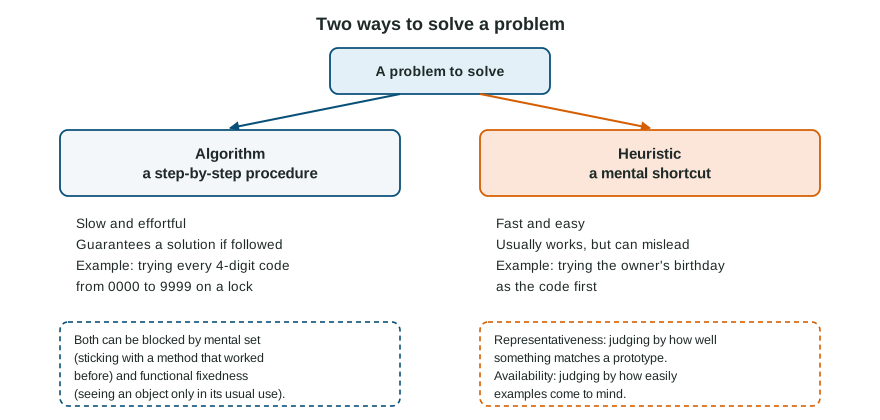
- Time and effort are limitedwe use heuristics instead of algorithms
- Heuristics ignore base rates, wording and independencepredictable errors: availability, representativeness, framing, the gambler's and sunk-cost fallacies
Part 6 · Key ideas
Key ideas
- A concept is a mental category; its prototype is the most typical example. New information is assimilated into a schema, or the schema is changed (accommodation).
- An algorithm guarantees a solution step by step; a heuristic is a fast shortcut that can mislead.
- The representativeness heuristic matches to a prototype; the availability heuristic goes by what comes to mind easily.
- Problem-solving is blocked by mental set and functional fixedness; judgments are tilted by priming, framing, the gambler's fallacy and the sunk-cost fallacy.
- Executive functions (prefrontal cortex) plan and control; creativity needs divergent thinking to generate ideas and convergent thinking to pick one.
Part 7 · Misconception
A common mistake
The wrong idea: Heuristics are mistakes that careful thinkers never use.
What actually happens: Everyone uses heuristics all the time, and most of the time they give good, fast answers. They cause errors in predictable situations, which is why knowing them helps.
Part 8 · Check yourself
Check yourself
Exam-style questions. Anything you miss goes into your review queue.
Data
Same facts, different wording
Sixty adults read about a surgery and decided whether they would choose it. A computer randomly assigned each person to one of two versions. Half (30) read that 90% of patients survive the surgery; the other half (30) read that 10% of patients die from it. The graph shows the percent in each version who chose the surgery.
1. Both versions give the same survival odds. Which concept explains why the choices differed?
- The framing effect
- The availability heuristic
- Functional fixedness
- The gambler's fallacy
Show the answer
The facts were identical; only the wording changed. A gain frame ("90% survive") led to more choices of surgery than a loss frame ("10% die"). That is the framing effect.
- Correct: The framing effect: Right: The facts were identical; only the wording changed. A gain frame ("90% survive") led to more choices of surgery than a loss frame ("10% die"). That is the framing effect.
- The availability heuristic: The availability heuristic is judging likelihood by how easily examples come to mind. Nothing here asked people to recall examples.
- Functional fixedness: Functional fixedness is seeing an object only in its usual use. No object or problem to solve is involved.
- The gambler's fallacy: The gambler's fallacy is expecting a run of outcomes to "even out". The participants made one choice from one description.
2. In the "10% die" version, 12 of the 30 people chose the surgery. Check the graph: what percent is that?
Type a number (%). No calculator needed: work it out by hand, as on the exam.
Show the answer
, the height of the second bar.
- Answer: 40 %
Study
The candle problem and the box of tacks
Introduction
Researchers asked whether seeing an object in its usual role makes it harder to use it in a new way. Participants had to attach a candle to a wall so it could burn without dripping wax on the table, using a candle, a book of matches and a box of thumbtacks. The solution is to empty the box, tack it to the wall and use it as a shelf.
Participants
48 high school juniors from two schools took part with written parental permission and their own agreement. Each was told they could stop at any time.
Method
Students were randomly assigned to one of two groups of 24. In the full-box group, the tacks were given inside the box. In the empty-box group, the tacks were given beside the empty box. Each student worked alone, and a researcher timed how many minutes the student took to reach the solution, up to 10 minutes.
Results
The empty-box group solved the problem in an average of 2 minutes; the full-box group took an average of 6 minutes, and 7 of its students did not solve it within 10 minutes.
Discussion
The researchers concluded that seeing the box as a container made it harder to see it as a shelf.
Invented study for practice.
3. Which concept best explains why the full-box group took longer?
- The representativeness heuristic
- Divergent thinking
- Functional fixedness
- Priming
Show the answer
With the tacks inside, students saw the box only as a container, its usual function, and were slow to see it as a shelf. That is functional fixedness.
- The representativeness heuristic: The representativeness heuristic judges how likely something is by how well it matches a prototype. Students were not judging likelihood.
- Divergent thinking: Divergent thinking is producing many possible solutions, the opposite of being stuck. It describes what helped, not what slowed students down.
- Correct: Functional fixedness: Right: With the tacks inside, students saw the box only as a container, its usual function, and were slow to see it as a shelf. That is functional fixedness.
- Priming: Priming is earlier exposure making a related idea come to mind faster. It could help solve problems, but the slowdown came from seeing the box only as a container.
4. After a week of news stories about a plane crash, Jordan decides to drive across the country instead of flying, though driving is far more dangerous per mile. Which concept explains his judgment?
- The representativeness heuristic
- The availability heuristic
- The sunk-cost fallacy
- Functional fixedness
Show the answer
Vivid, recent crash stories come to mind easily, so Jordan judges flying as more dangerous than it is. That is the availability heuristic.
- The representativeness heuristic: Representativeness is judging by how well something matches a prototype. Jordan is judging by how easily examples come to mind.
- Correct: The availability heuristic: Right: Vivid, recent crash stories come to mind easily, so Jordan judges flying as more dangerous than it is. That is the availability heuristic.
- The sunk-cost fallacy: The sunk-cost fallacy is sticking with something because of what you have already invested. Jordan has invested nothing.
- Functional fixedness: Functional fixedness is about seeing objects only in their usual use, not about judging risk.
5. Told that a quiet man loves poetry, most people guess he is a classics professor rather than a truck driver, even though there are far more truck drivers. Which concept explains the guess?
- The availability heuristic
- The framing effect
- The representativeness heuristic
- Mental set
Show the answer
People judge by how well he matches their prototype of a professor and ignore how common each job is. That is the representativeness heuristic.
- The availability heuristic: Availability is about how easily examples come to mind. The guess comes from matching a description to a prototype.
- The framing effect: The framing effect is about wording a choice as a gain or a loss. Nothing is framed that way here.
- Correct: The representativeness heuristic: Right: People judge by how well he matches their prototype of a professor and ignore how common each job is. That is the representativeness heuristic.
- Mental set: A mental set is a habit of solving problems one way. This is a judgment of likelihood, not a problem-solving habit.
6. Priya has paid for a concert ticket. On the night she is sick and would rather stay home, but she goes anyway because "I already paid for it." Which concept explains her choice?
- The sunk-cost fallacy
- The gambler's fallacy
- The framing effect
- Mental set
Show the answer
The money is spent whether she goes or not. Letting a past, unrecoverable cost drive a choice is the sunk-cost fallacy.
- Correct: The sunk-cost fallacy: Right: The money is spent whether she goes or not. Letting a past, unrecoverable cost drive a choice is the sunk-cost fallacy.
- The gambler's fallacy: The gambler's fallacy is about expecting random outcomes to even out. No chance event is involved.
- The framing effect: The framing effect is a change in choice caused by wording. The ticket was not described two ways.
- Mental set: A mental set is a habit of solving problems one way. Priya is deciding whether to go, not solving a problem.
Part 9 · Summary
Summary
Part 10 · Up next
What comes next
Part 11 · Connections