Interaction of Heredity and Environment
Behavior and mental processes come from heredity and environment working together.
Part 1 · Hook
Why this matters
Part 2 · Before you start
What this builds on
Part 3 · Prerequisite check
Quick check before you start
1. Which correlation shows the strongest relationship?
Show the answer
Strength is the size of r; 0.80 is the largest here.
- Correct: :
- :
- :
- :
2. A study finds that children who read more at home have higher test scores. Why can it not show that reading causes higher scores?
- A third variable, such as family resources, could affect both
- The correlation is too strong to be meaningful
- Children were randomly assigned to read
- Test scores cannot be correlated with reading
Show the answer
Correlational data cannot rule out a third variable or the reverse direction.
- Correct: A third variable, such as family resources, could affect both:
- The correlation is too strong to be meaningful:
- Children were randomly assigned to read:
- Test scores cannot be correlated with reading:
3. A study uses 50 pairs of twins from one city. Who do its results describe most safely?
- Twins similar to those in the sample
- All people everywhere
- Only identical twins raised apart
- Nobody, since twins are unusual
Show the answer
Results generalize to people similar to the participants.
- Correct: Twins similar to those in the sample:
- All people everywhere:
- Only identical twins raised apart:
- Nobody, since twins are unusual:
Part 4 · See it
See it first
Part 5 · Step by step
How it works, step by step
- People inherit tendencies from their biological parents (heredity)relatives who share more genes tend to be more alike on many traits
- The environment, from nutrition to schooling to culture, shapes how those tendencies developthe same inheritance can lead to different outcomes in different environments
- Twin, family and adoption studies compare relatives who share different amounts of genes and environmentresearchers can estimate heritability: how much of the variation in a group is linked to genetic differences
Part 6 · Key ideas
Key ideas
- Nature and nurture interact: heredity sets tendencies, and the environment shapes how they develop. Behavior comes from both, never one alone.
- Heritability is the share of variation in a trait, within one group and environment, linked to genetic differences. It says nothing about one person, or about differences between groups.
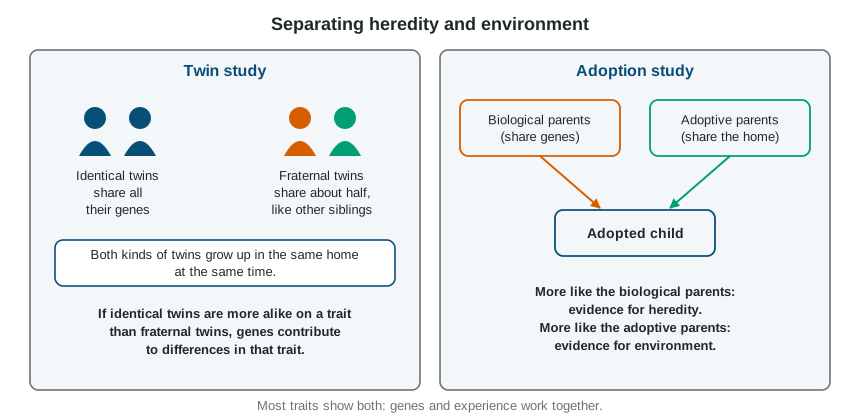
- Twin studies compare identical twins (all genes shared) with fraternal twins (about half); adoption studies compare a child with biological and adoptive parents; family studies track a trait across relatives.
- Evolutionary psychology explains shared human traits by natural selection. Its misuse to rank people led to eugenics and forced sterilization.
Part 7 · Misconception
A common mistake
The wrong idea: A heritability of 0.60 means 60% of a person’s trait comes from genes, and a heritable trait cannot be changed.
What actually happens: Heritability describes differences among people in a group, not the makeup of one person. An inherited condition such as PKU can be transformed by the environment.
Part 8 · Check yourself
Check yourself
Exam-style questions. Anything you miss goes into your review queue.
1. Two brothers inherit a tendency to grow tall. One grows up with plenty of food; the other, raised during a long famine, ends up much shorter. Which idea does this best illustrate?
- Heredity and environment interact to shape a trait
- Height is set by heredity, so the famine had little effect
- Height is set by environment, so inheritance plays no part
- The brothers are probably fraternal twins with different inheritance
Show the answer
Inherited potential is expressed through the environment. Nature and nurture work together rather than one alone.
- Correct: Heredity and environment interact to shape a trait: Right: the same inherited potential led to different heights in different environments.
- Height is set by heredity, so the famine had little effect: The famine clearly changed the outcome, so heredity alone does not set height.
- Height is set by environment, so inheritance plays no part: Both brothers inherited a tendency to be tall; inheritance still matters.
- The brothers are probably fraternal twins with different inheritance: The stem says both inherited the same tendency; the environment differed.
2. Researchers find that a trait has a heritability of 0.60 in a large group of adults. What does this mean?
- In each adult, 60% of the trait comes from genes and 40% from environment
- About 60% of the differences among these adults are linked to genes
- The environment has little power to change the trait in these adults
- 60% of the adults inherited the trait from a parent
Show the answer
Heritability is the share of the variation among people in a particular group and environment that is linked to genetic differences. It says nothing about how much of one person’s trait comes from genes.
- In each adult, 60% of the trait comes from genes and 40% from environment: Heritability is not about the makeup of any one person’s trait.
- Correct: About 60% of the differences among these adults are linked to genes: Right: heritability describes variation within a group.
- The environment has little power to change the trait in these adults: A heritable trait can still change a great deal with the environment.
- 60% of the adults inherited the trait from a parent: Heritability is not the share of people who have a trait.
Data
How alike are relatives in reading test scores?
| Pair of relatives | Raised | r |
|---|---|---|
| Identical twins | together | +0.82 |
| Identical twins | apart | +0.72 |
| Fraternal twins | together | +0.55 |
| Adoptive siblings | together | +0.25 |
3. Which comparison in the table gives the clearest evidence that heredity matters for reading scores?
- Adoptive siblings (+0.25) compared with fraternal twins (+0.55)
- Identical twins raised together (+0.82) compared with raised apart (+0.72)
- Adoptive siblings (+0.25) compared with identical twins apart (+0.72)
- Identical (+0.82) versus fraternal twins (+0.55), both raised together
Show the answer
In twin studies, both kinds of twins grow up together. Identical twins share all their genes, fraternal twins about half; when identical twins are more alike, genes are contributing.
- Adoptive siblings (+0.25) compared with fraternal twins (+0.55): Fraternal twins share both genes and a womb and are the same age, so this mixes heredity and environment.
- Identical twins raised together (+0.82) compared with raised apart (+0.72): Here genes are the same and the home differs, so this comparison is about environment.
- Adoptive siblings (+0.25) compared with identical twins apart (+0.72): This changes both genes and home at once, so neither can be singled out.
- Correct: Identical (+0.82) versus fraternal twins (+0.55), both raised together: Right: the home is shared in both, so the extra likeness tracks the extra genes.
4. Adoptive siblings, who share a home but no genes, correlate at +0.25. What does this suggest?
- The shared home has some influence on reading scores
- Reading scores are inherited, with no role for the home
- Adoptive siblings share half their genes
- The home environment lowers children’s reading scores
Show the answer
Because adoptive siblings share no genes, their similarity points to the shared environment: the same home, books and schools.
- Correct: The shared home has some influence on reading scores: Right: genetically unrelated children raised together are still somewhat alike.
- Reading scores are inherited, with no role for the home: If they were, unrelated siblings would show about zero correlation.
- Adoptive siblings share half their genes: Adoptive siblings are not biologically related.
- The home environment lowers children’s reading scores: A positive correlation means the siblings are alike, not that their scores are low.
5. Identical twins raised apart still correlate at +0.72. Which caution applies to this finding?
- A correlation of +0.72 shows that reading is caused by genes in each twin
- Twins raised apart often had similar homes, so some likeness is environmental
- Twins raised apart do not share any genes, so the result is surprising
- The correlation is negative, so separated twins read very differently
Show the answer
Separated twins shared a womb, are the same age and are often placed with similar families. These shared environments can inflate their similarity, which is why researchers combine several designs.
- A correlation of +0.72 shows that reading is caused by genes in each twin: A correlation shows a relationship, not that each individual’s reading is caused by genes.
- Correct: Twins raised apart often had similar homes, so some likeness is environmental: Right: separated twins are often placed in similar families and communities.
- Twins raised apart do not share any genes, so the result is surprising: Identical twins share all their genes, wherever they are raised.
- The correlation is negative, so separated twins read very differently: The correlation is +0.72, positive and strong.
Study
Phenylketonuria (PKU): an inherited condition shaped by diet
Introduction
Phenylketonuria (PKU) is an inherited condition in which the body cannot break down phenylalanine, a building block of protein found in many foods. Untreated, it builds up and damages the developing brain, causing severe intellectual disability.
Participants
Bickel and colleagues treated a 2-year-old girl in England who had PKU and severe developmental delays.
Method
The researchers gave her a special diet very low in phenylalanine and recorded her behavior and blood levels over several months.
Results
On the diet, her blood levels fell and her alertness and behavior improved; when phenylalanine was added back to her food, her symptoms worsened again.
Discussion
Later work showed that starting the diet in the first weeks of life largely prevents the brain damage, so newborns in many countries are now screened for PKU.
6. A classmate says, "If a trait is inherited, there is no point trying to change it." How does PKU answer this?
- Its harm can be largely prevented by changing the diet
- PKU shows that inherited traits are usually harmless
- PKU shows that inherited traits disappear by adulthood
- PKU shows that the environment, not heredity, shapes the brain
Show the answer
Inherited is not the same as fixed. Newborn screening and a special diet let children with PKU develop typically, which is why screening is routine.
- Correct: Its harm can be largely prevented by changing the diet: Right: inherited does not mean unchangeable.
- PKU shows that inherited traits are usually harmless: Untreated PKU is very harmful.
- PKU shows that inherited traits disappear by adulthood: People with PKU keep the condition; the diet manages it.
- PKU shows that the environment, not heredity, shapes the brain: The condition itself is inherited; both matter.
Part 9 · Summary
Summary
Part 10 · Up next
What comes next
Part 11 · Connections