Overview of the Nervous System
The nervous system is made of neurons organized into two parts.
Part 1 · Hook
Why this matters
Part 2 · Prerequisite check
Quick check before you start
1. A researcher wants to show that a breathing exercise causes a slower heart rate. Which method can show this?
- An experiment with random assignment
- A survey of people who breathe slowly
- A case study of one calm person
- Naturalistic observation in a park
Show the answer
Only an experiment with a manipulated variable and random assignment can show cause and effect.
- Correct: An experiment with random assignment:
- A survey of people who breathe slowly:
- A case study of one calm person:
- Naturalistic observation in a park:
2. Identical twins raised apart are still alike on many traits. What does this suggest?
- Heredity contributes to those traits
- The environment plays no part
- The twins were randomly assigned to homes
- The traits are learned from each other
Show the answer
Similarity despite different homes points to shared genes, though environment still matters.
- Correct: Heredity contributes to those traits:
- The environment plays no part:
- The twins were randomly assigned to homes:
- The traits are learned from each other:
Part 3 · See it
See it first
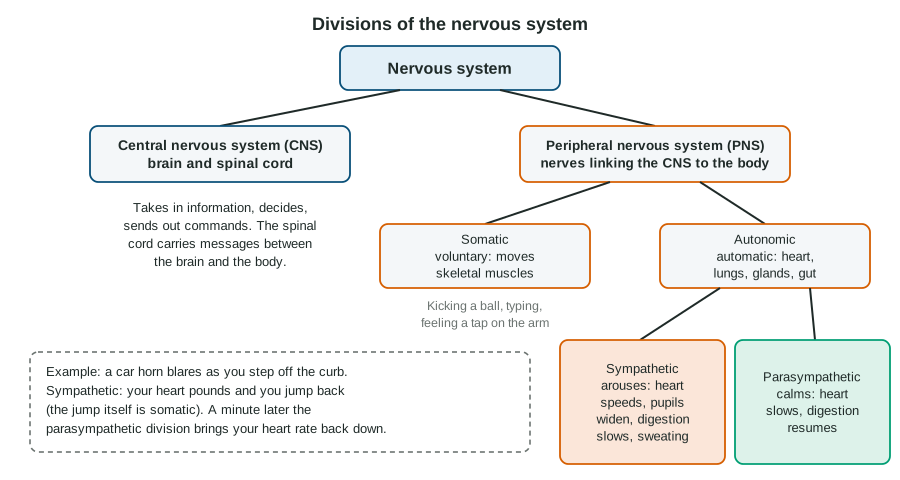
Part 4 · Step by step
How it works, step by step
- The central nervous system (the brain and spinal cord) takes in information and decidesit sends commands out through the peripheral nervous system
- Commands reach the skeletal muscles through the somatic nervous systemyou move on purpose: catching, kicking, typing
- A threat triggers the sympathetic division of the autonomic nervous systemthe heart speeds, pupils widen and digestion slows: the body is ready to act
- Once the threat passes, the parasympathetic division takes overthe heart slows and digestion resumes: the body calms and saves energy
Part 5 · Key ideas
Key ideas
- The central nervous system (CNS) is the brain and spinal cord. The peripheral nervous system (PNS) is every nerve linking the CNS to the rest of the body.
- The PNS has two parts: the somatic nervous system (voluntary movement of skeletal muscles, plus sensations from the body) and the autonomic nervous system (automatic control of the heart, lungs, glands and gut).
- The autonomic system has two divisions that work in balance: the sympathetic nervous system arouses; the parasympathetic nervous system calms.
- The neuron, or nerve cell, is the basic unit that carries information through every part of the system.
Part 6 · Misconception
A common mistake
The wrong idea: The sympathetic nervous system is the "nice", calming one, and the parasympathetic one is for emergencies.
What actually happens: It is the reverse. Sympathetic arouses (heart speeds, pupils widen, digestion slows); parasympathetic calms (heart slows, digestion resumes). Memory hook: parasympathetic, "rest and digest".
Part 7 · Check yourself
Check yourself
Exam-style questions. Anything you miss goes into your review queue.
1. A goalkeeper sees a penalty kick coming and dives to her left. Which division of the nervous system carries the commands that move her arms and legs?
- The somatic nervous system
- The parasympathetic nervous system
- The autonomic nervous system
- The sympathetic nervous system
Show the answer
The somatic nervous system, part of the peripheral nervous system, carries commands from the central nervous system to the skeletal muscles and brings in sensations from the body.
- Correct: The somatic nervous system: Right: it controls voluntary movement of the skeletal muscles.
- The parasympathetic nervous system: The parasympathetic division calms the body; it does not move skeletal muscles.
- The autonomic nervous system: The autonomic system runs automatic functions such as heart rate, not deliberate movement.
- The sympathetic nervous system: The sympathetic division arouses the body’s organs; it does not direct the dive itself.
2. Walking home at night, Leo hears footsteps behind him. His heart pounds, his breathing quickens and his mouth goes dry. Which division is most active?
- The parasympathetic nervous system
- The sympathetic nervous system
- The somatic nervous system
- The central nervous system alone
Show the answer
The sympathetic division of the autonomic nervous system speeds the heart and breathing, widens the pupils and slows digestion, preparing the body to act.
- The parasympathetic nervous system: The parasympathetic division calms the body, slowing the heart.
- Correct: The sympathetic nervous system: Right: it arouses the body for action.
- The somatic nervous system: The somatic system moves skeletal muscles; these are automatic changes in organs.
- The central nervous system alone: The heart and breathing changes are carried out through the peripheral, autonomic system.
3. After a big holiday dinner, Rosa relaxes on the couch. Her heart rate slows and her stomach digests the meal. Which division is most active?
- The sympathetic nervous system
- The somatic nervous system
- The parasympathetic nervous system
- The spinal cord alone
Show the answer
The parasympathetic division conserves energy: it slows the heart, lowers blood pressure and lets digestion resume.
- The sympathetic nervous system: The sympathetic division arouses the body and slows digestion.
- The somatic nervous system: Digestion and heart rate are automatic, not voluntary movement.
- Correct: The parasympathetic nervous system: Right: it calms the body and supports digestion.
- The spinal cord alone: The spinal cord is part of the central nervous system; the calming of organs is autonomic.
Figure
The divisions of the nervous system
4. In the diagram, which two divisions make up the peripheral nervous system?
- The sympathetic and parasympathetic divisions
- The brain and the spinal cord
- The central and autonomic nervous systems
- The somatic and autonomic nervous systems
Show the answer
The peripheral nervous system divides into the somatic (voluntary) and autonomic (automatic) systems.
- The sympathetic and parasympathetic divisions: Those two are the divisions of the autonomic system.
- The brain and the spinal cord: Those make up the central nervous system.
- The central and autonomic nervous systems: The central nervous system is separate from the peripheral.
- Correct: The somatic and autonomic nervous systems: Right: both branch from the peripheral nervous system.
5. According to the diagram, which change would the sympathetic division produce?
- Wider pupils and slower digestion
- A slower heart and resumed digestion
- A voluntary kick of a ball
- Taking in information and making decisions
Show the answer
The sympathetic division prepares the body for action: faster heart, wider pupils, slower digestion, more sweating.
- Correct: Wider pupils and slower digestion: Right: the diagram lists both under the sympathetic division.
- A slower heart and resumed digestion: Those are parasympathetic effects.
- A voluntary kick of a ball: Kicking a ball is somatic.
- Taking in information and making decisions: That is the role of the central nervous system.
6. In the diagram’s example, a car horn makes a pedestrian’s heart pound and he jumps back. Which divisions are involved, in order?
- Somatic for the pounding heart, sympathetic for the jump
- Sympathetic for the pounding heart, somatic for the jump
- Parasympathetic for the pounding heart, autonomic for the jump
- Central for the pounding heart, parasympathetic for the jump
Show the answer
The heart’s pounding is sympathetic (autonomic) arousal; jumping back moves skeletal muscles through the somatic system.
- Somatic for the pounding heart, sympathetic for the jump: This swaps the two: the heart is autonomic and the jump uses skeletal muscles.
- Correct: Sympathetic for the pounding heart, somatic for the jump: Right: an automatic arousal and a voluntary-muscle movement.
- Parasympathetic for the pounding heart, autonomic for the jump: The parasympathetic division calms the heart rather than speeding it.
- Central for the pounding heart, parasympathetic for the jump: The jump uses skeletal muscles, moved by the somatic system.
Part 8 · Summary
Summary
Part 9 · Up next
What comes next
Part 10 · Connections