Selection of Categories of Psychological Disorders
The DSM-5-TR groups disorders by their core features.
Part 1 · Hook
Why this matters
Part 2 · Before you start
What this builds on
Part 3 · Prerequisite check
Quick check before you start
1. A clinician says a pattern counts as a disorder only if it is unusual and also causes distress or gets in the way of life. Which idea is that?
- The three features of a psychological disorder
- The diathesis-stress model
- The eclectic approach
- The biopsychosocial model
Show the answer
Deviation plus distress or dysfunction is how a psychological disorder is defined.
- Correct: The three features of a psychological disorder:
- The diathesis-stress model:
- The eclectic approach:
- The biopsychosocial model:
2. Which neurotransmitter is most linked to reward and to movement, and appears in explanations of psychotic symptoms?
- Dopamine
- GABA
- Acetylcholine
- Endorphins
Show the answer
Dopamine is involved in reward, movement and attention.
- Correct: Dopamine:
- GABA:
- Acetylcholine:
- Endorphins:
Part 4 · See it
See it first
Part 5 · Step by step
How it works, step by step
- A clinician sees a pattern of symptoms that causes distress or dysfunctionthey compare it with the DSM-5-TR criteria: which symptoms, how many and for how long
- The core feature is low mood, or mood swings with mania or hypomaniathe pattern points to a depressive or a bipolar disorder
- The core feature is fear, worry, intrusive thoughts or a past traumait points to an anxiety, obsessive-compulsive or trauma-related disorder
- The core feature is a break from reality, or gaps in memory and identityit points to schizophrenia spectrum or to a dissociative disorder, two very different things
Part 6 · Key ideas
Key ideas
- Mood: major depressive disorder (two weeks or more), persistent depressive disorder (two years or more); bipolar I needs a manic episode, bipolar II hypomania plus major depression.
- Schizophrenia is a break from reality: positive symptoms add (hallucinations, delusions); negative symptoms take away (emotion, speech, motivation). It is not a "split personality."
- Anxiety disorders (phobia, agoraphobia, panic, social anxiety, generalized anxiety) are separate from OCD and hoarding, from PTSD, and from the dissociative disorders, including DID.
- Personality disorders are lasting, rigid patterns in three clusters: A odd, B dramatic, C anxious. Eating disorders: anorexia (low weight), bulimia (binge and compensate).
Part 7 · Misconception
A common mistake
The wrong idea: Schizophrenia means having a split or multiple personality.
What actually happens: Schizophrenia is a break from reality, with symptoms such as hallucinations, delusions and flat emotion. Distinct identity states with memory gaps describe dissociative identity disorder, a different disorder in a different category.
Part 8 · Check yourself
Check yourself
Exam-style questions. Anything you miss goes into your review queue.
1. For ten days, Jordan has slept two or three hours a night yet feels full of energy. He talks so fast that friends cannot follow, has spent his savings on a plan to start five companies, and says he is destined to be famous. He has never had a depressive episode. Which disorder best fits?
- Bipolar II disorder
- Major depressive disorder
- Bipolar I disorder
- Generalized anxiety disorder
Show the answer
Bipolar I disorder is defined by at least one manic episode. Many people with bipolar I also have depressive episodes, but one is not needed for the diagnosis.
- Bipolar II disorder: Bipolar II involves hypomania, a milder high that does not seriously disrupt life, plus a major depressive episode. Jordan's episode is severe and he has had no depression.
- Major depressive disorder: Major depressive disorder involves low mood or loss of interest, the opposite of Jordan's high energy.
- Correct: Bipolar I disorder: Right: a full manic episode lasting at least a week, with reduced need for sleep, racing speech, risky spending and grandiosity, defines bipolar I. A depressive episode is not required.
- Generalized anxiety disorder: Generalized anxiety disorder is about ongoing worry, not about a long stretch of high energy and grandiosity.
2. A news story calls a woman with schizophrenia a person with a "split personality." Why is that description wrong?
- Schizophrenia is a mood disorder, not a psychotic one
- Schizophrenia involves a break from reality, not separate identities
- Schizophrenia involves several identities, not one split
- Schizophrenia begins in early childhood, not later
Show the answer
"Split personality" confuses schizophrenia with dissociative identity disorder. In schizophrenia the "split" is from reality: false perceptions and beliefs.
- Schizophrenia is a mood disorder, not a psychotic one: Schizophrenia is in the schizophrenia spectrum, not among the mood disorders.
- Correct: Schizophrenia involves a break from reality, not separate identities: Right: schizophrenia involves symptoms such as hallucinations and delusions. Distinct identity states belong to dissociative identity disorder.
- Schizophrenia involves several identities, not one split: Schizophrenia does not involve separate identities at all.
- Schizophrenia begins in early childhood, not later: Schizophrenia usually begins in late adolescence or early adulthood, not in early childhood.
3. Several times over the past few months, Sasha has suddenly felt her heart pound, her chest tighten and an overwhelming fear that she was dying, once while sitting calmly on her couch. Since then she worries every day about the next attack. Which disorder best fits?
- Specific phobia
- Social anxiety disorder
- Panic disorder
- Bipolar II disorder
Show the answer
Panic disorder means unexpected panic attacks plus ongoing worry about future attacks or changes in behavior to avoid them.
- Specific phobia: A specific phobia is fear of one object or situation. Sasha's attacks come out of the blue.
- Social anxiety disorder: Social anxiety centers on fear of being judged by others. Her attacks happen even when she is alone.
- Correct: Panic disorder: Right: repeated unexpected panic attacks followed by at least a month of worry about more attacks define panic disorder.
- Bipolar II disorder: Bipolar II involves periods of high and low mood, not sudden attacks of intense fear.
4. Nadia has unwanted thoughts that she left the stove on and will cause a fire. She knows the thought is unlikely, but it makes her so anxious that she checks the stove 20 times before leaving home, which makes her late every day. Which disorder best fits?
- Generalized anxiety disorder
- Obsessive-compulsive personality disorder
- Obsessive-compulsive disorder
- Hoarding disorder
Show the answer
In obsessive-compulsive disorder, obsessions raise anxiety and compulsions lower it for a while, which keeps the cycle going. The DSM-5-TR places it in its own category, apart from the anxiety disorders.
- Generalized anxiety disorder: Generalized anxiety disorder involves broad worry without a ritual that the person feels driven to repeat.
- Obsessive-compulsive personality disorder: That personality disorder is about perfectionism and control. It does not involve unwanted thoughts relieved by rituals.
- Correct: Obsessive-compulsive disorder: Right: an intrusive thought (the obsession) and the repeated checking to relieve the anxiety (the compulsion) define obsessive-compulsive disorder.
- Hoarding disorder: Hoarding disorder is difficulty discarding possessions, not checking the stove.
Figure
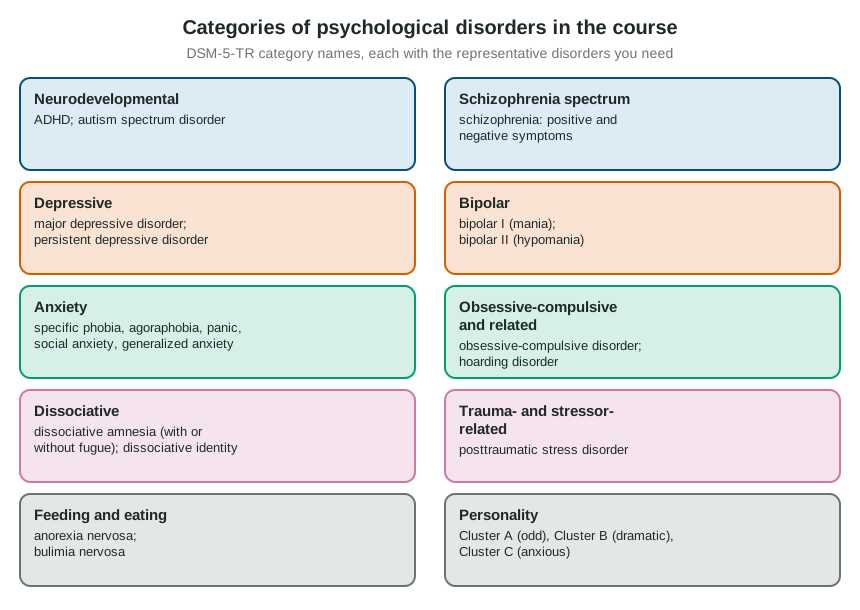
Categories of psychological disorders
5. Using the figure, into which category does posttraumatic stress disorder fall in the DSM-5-TR?
- Anxiety
- Dissociative
- Trauma- and stressor-related
- Depressive
Show the answer
Since the DSM-5 (2013), and still in the DSM-5-TR, PTSD has been in the trauma- and stressor-related category rather than with the anxiety disorders, as the figure shows.
- Anxiety: Anxiety is a large part of PTSD, but the figure and the DSM-5-TR place it in the trauma- and stressor-related category.
- Dissociative: Dissociative disorders involve gaps in memory or identity. PTSD has its own category.
- Correct: Trauma- and stressor-related: Right: the figure places PTSD in its own category, defined by exposure to a traumatic event.
- Depressive: Depressive disorders center on low mood and loss of interest. PTSD follows trauma.
6. According to the figure, which pair of disorders shares a category?
- Obsessive-compulsive disorder and generalized anxiety
- Obsessive-compulsive disorder and hoarding disorder
- Major depressive disorder and bipolar I disorder
- Schizophrenia and dissociative identity disorder
Show the answer
The figure groups obsessive-compulsive disorder with hoarding disorder, apart from the anxiety disorders.
- Obsessive-compulsive disorder and generalized anxiety: They are in different boxes: generalized anxiety is with the anxiety disorders.
- Correct: Obsessive-compulsive disorder and hoarding disorder: Right: both are in the obsessive-compulsive and related category.
- Major depressive disorder and bipolar I disorder: The figure gives depressive and bipolar disorders separate boxes.
- Schizophrenia and dissociative identity disorder: They are in different categories, and confusing them is a common error.
7. A student sees that "Depressive" and "Bipolar" are separate boxes in the figure. What best explains why they are separated?
- Bipolar disorders include periods of mania or hypomania
- Depression does not occur in people with bipolar disorder
- Bipolar disorders are a kind of personality disorder
- Depressive disorders begin in early childhood
Show the answer
The bipolar disorders are set apart by manic or hypomanic episodes. Low mood can occur in both categories.
- Correct: Bipolar disorders include periods of mania or hypomania: Right: what defines the bipolar disorders is a period of abnormally high mood and energy, which depressive disorders never include.
- Depression does not occur in people with bipolar disorder: Many people with bipolar disorder also have depressive episodes; bipolar II requires one.
- Bipolar disorders are a kind of personality disorder: They are mood-related disorders with episodes, not lasting personality patterns.
- Depressive disorders begin in early childhood: Depressive disorders can begin at any age.
Part 9 · Summary
Summary
If you are struggling, you are not alone. In the US, call or text 988 (the Suicide and Crisis Lifeline), or talk to a trusted adult.
Part 10 · Up next
What comes next
Part 11 · Connections