Treatment of Psychological Disorders
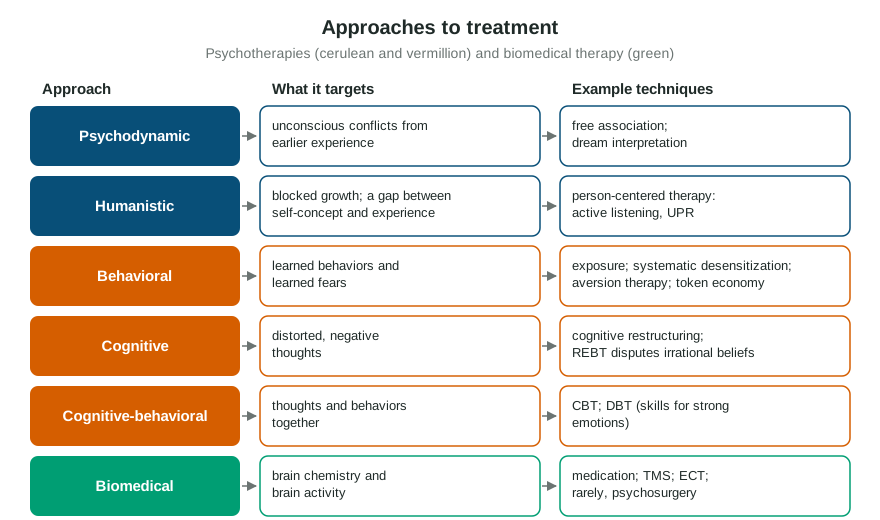
Each approach to therapy targets a different cause: psychodynamic therapy seeks insight into unconscious conflicts, humanistic therapy offers acceptance, behavioral therapy changes learned responses, cognitive therapy changes thoughts, and CBT combines the two.
Part 1 · Hook
Why this matters
Part 2 · Before you start
What this builds on
Part 3 · Prerequisite check
Quick check before you start
1. A drug blocks the reabsorption of serotonin by the sending neuron, so more serotonin stays in the synapse. What kind of drug is it?
- A reuptake inhibitor
- An antagonist
- A depressant
- A hallucinogen
Show the answer
Blocking reuptake leaves more neurotransmitter in the synapse; that is a reuptake inhibitor.
- Correct: A reuptake inhibitor:
- An antagonist:
- A depressant:
- A hallucinogen:
2. A child's fear of a dog fades after he is paired, again and again, with a pleasant snack while the dog sits calmly nearby. Which process is this?
- Counterconditioning
- Spontaneous recovery
- Stimulus generalization
- Higher-order conditioning
Show the answer
Replacing a fear response with a pleasant one is counterconditioning.
- Correct: Counterconditioning:
- Spontaneous recovery:
- Stimulus generalization:
- Higher-order conditioning:
3. Which of these is a description of a psychological disorder?
- A pattern that is unusual and causes distress or dysfunction
- Any behavior that is unusual
- Any strong emotion
- A habit that others dislike
Show the answer
A disorder involves deviation plus distress or dysfunction.
- Correct: A pattern that is unusual and causes distress or dysfunction:
- Any behavior that is unusual:
- Any strong emotion:
- A habit that others dislike:
Part 4 · See it
See it first
Part 5 · Step by step
How it works, step by step
- A perspective explains a disorder by a particular causeits therapy targets that cause: conflicts, thoughts, learning, growth or brain chemistry
- Researchers compare a treatment with a control group, often in many studies combined by meta-analysisthe treatment earns a place in evidence-based practice, or not
- A clinician weighs that evidence with expertise, the therapeutic alliance and the client's culture and preferencesthe client gets a treatment matched to them
- Ethical rules such as informed consent and confidentiality guide every stepclients can trust the process, which strengthens the alliance
Part 6 · Key ideas
Key ideas
- Match technique to approach: free association and dream interpretation (psychodynamic); active listening with unconditional positive regard (humanistic); cognitive restructuring, REBT (cognitive); CBT, DBT (cognitive-behavioral).
- Behavioral: exposure and systematic desensitization reduce fear, aversion therapy pairs a habit with discomfort, token economies reward behavior, biofeedback trains body control.
- Medications: antidepressants (often SSRIs), anti-anxiety drugs (GABA, risk of dependence), lithium (bipolar), antipsychotics (block dopamine; risk of tardive dyskinesia). Also ECT, TMS, rare psychosurgery.
- Judge treatments by evidence. Hypnosis helps pain and anxiety but does not recover memories; the lobotomy is history, not treatment.
Part 7 · Misconception
A common mistake
The wrong idea: Hypnosis can recover accurate memories that a person has forgotten.
What actually happens: Hypnosis makes people more confident in what they "remember," but it also increases false memories. It has some use for pain and anxiety, not for recovering memories.
Part 8 · Check yourself
Check yourself
Exam-style questions. Anything you miss goes into your review queue.
1. Ines is terrified of elevators. Her therapist first teaches her deep muscle relaxation. Then, while relaxed, she imagines a list of scenes from least to most frightening, starting with looking at a photo of an elevator and ending with riding one to the top floor. Which technique is this?
- Aversion therapy
- Systematic desensitization
- Token economy
- Psychodynamic free association
Show the answer
Systematic desensitization counterconditions a fear: relaxation, which is incompatible with anxiety, is paired with feared scenes step by step.
- Aversion therapy: Aversion therapy pairs an unwanted behavior with something unpleasant, the reverse of pairing fear with relaxation.
- Correct: Systematic desensitization: Right: relaxation paired with a step-by-step hierarchy of feared scenes is systematic desensitization, a form of counterconditioning.
- Token economy: A token economy rewards target behaviors with tokens. Nothing is being rewarded here.
- Psychodynamic free association: Free association is a psychodynamic technique of saying whatever comes to mind.
2. A man with schizophrenia has fewer hallucinations after he starts a medication that blocks dopamine receptors. After years on an older drug of this kind, he develops repeated, involuntary movements of his lips and tongue. What is the drug, and what is the side effect?
- An antidepressant; serotonin syndrome
- An antipsychotic; tardive dyskinesia
- Lithium; manic episodes
- An anti-anxiety drug; dependence
Show the answer
Antipsychotics act as dopamine antagonists. Tardive dyskinesia, involuntary facial and tongue movements, can follow long-term use and may not go away.
- An antidepressant; serotonin syndrome: Antidepressants target serotonin and other transmitters, not dopamine receptors, and do not mainly treat hallucinations.
- Correct: An antipsychotic; tardive dyskinesia: Right: antipsychotics block dopamine receptors to reduce positive symptoms; long-term use, especially of older ones, can cause tardive dyskinesia.
- Lithium; manic episodes: Lithium is a mood stabilizer for bipolar disorder. It does not block dopamine receptors.
- An anti-anxiety drug; dependence: Anti-anxiety drugs act on GABA, not on dopamine receptors, and do not reduce hallucinations.
3. A woman asks a hypnotist to help her "recover" memories from early childhood. Based on research, what is the most accurate response?
- Hypnosis reliably brings back accurate early memories
- Hypnosis lets people relive childhood exactly as it happened
- Hypnosis can increase confidence in memories without making them more accurate
- Hypnosis has no use in treatment of any kind
Show the answer
Hypnosis can help with pain and anxiety, but it does not recover accurate memories or regress people to an earlier age.
- Hypnosis reliably brings back accurate early memories: Research does not support this. Hypnosis raises confidence but also false memories.
- Hypnosis lets people relive childhood exactly as it happened: Age regression under hypnosis does not take people back. They act out what they expect.
- Correct: Hypnosis can increase confidence in memories without making them more accurate: Right: under hypnosis, people report more "memories" and feel more sure of them, but false memories increase too.
- Hypnosis has no use in treatment of any kind: Hypnosis has some evidence for reducing pain and anxiety when combined with other treatment.
Study
Therapy, medication or a waitlist for depression
Introduction
Researchers asked whether cognitive-behavioral therapy (CBT) and antidepressant medication each reduce symptoms of depression more than waiting for treatment.
Participants
150 adults ages 18 to 65, all diagnosed with major depressive disorder by a clinician, were recruited from three community clinics in one US state. Each gave written informed consent after being told the risks of each treatment and that they could leave the study at any time. A university institutional review board approved the study.
Method
Participants were randomly assigned to 12 weeks of weekly CBT sessions, 12 weeks of an SSRI antidepressant, or a 12-week waitlist (they were offered treatment when the study ended). Depression was measured with a 21-item symptom questionnaire (scores from 0 to 63; higher scores mean more severe symptoms), given before and after the 12 weeks by an interviewer who did not know each person's group.
Results
Mean scores fell from 30 to 16 in the CBT group, from 30 to 17 in the medication group, and from 30 to 26 in the waitlist group. The CBT and medication groups each improved significantly more than the waitlist group; the difference between CBT and medication was not statistically significant.
Discussion
Both treatments outperformed waiting, and neither clearly outperformed the other over 12 weeks.
Invented study for practice.
4. What was the independent variable in this study?
- The score on the 21-item symptom questionnaire
- The treatment condition each person received
- The participants' ages, from 18 to 65 years
- Whether the interviewer knew each person's group
Show the answer
The independent variable is what the researchers manipulated: the treatment condition.
- The score on the 21-item symptom questionnaire: That is the dependent variable, what was measured.
- Correct: The treatment condition each person received: Right: the researchers manipulated which condition each participant received.
- The participants' ages, from 18 to 65 years: Age was not manipulated; it describes the sample.
- Whether the interviewer knew each person's group: The interviewer was kept unaware to reduce bias. That is a design feature, not the independent variable.
5. Why did the researchers include a waitlist group?
- To show how symptoms change without treatment
- To give the waitlist group a different medication
- To make sure the groups had identical starting scores
- To test whether waiting causes depression to get worse
Show the answer
The waitlist is the control group: it shows how symptoms change over 12 weeks with no study treatment, which may include natural improvement and the effect of expecting help later.
- Correct: To show how symptoms change without treatment: Right: depression often eases somewhat on its own; the waitlist group is a control showing that change, so the treatment effects can be judged against it.
- To give the waitlist group a different medication: The waitlist group received no study treatment during the 12 weeks.
- To make sure the groups had identical starting scores: All groups started at 30, but the waitlist is there as a comparison, not to equalize scores.
- To test whether waiting causes depression to get worse: The question was whether treatments beat waiting, not whether waiting harms. Scores in that group actually fell a little.
6. The difference between CBT and medication was not statistically significant. What does that mean?
- CBT and medication had no effect on symptoms
- Medication was better than CBT for most participants
- The study was not ethical, so its results do not count
- The 1-point gap could plausibly be due to chance
Show the answer
Not statistically significant means the difference could plausibly be due to chance; it does not prove the two treatments are identical.
- CBT and medication had no effect on symptoms: Both groups improved significantly more than the waitlist. The non-significant result is only about CBT compared with medication.
- Medication was better than CBT for most participants: The CBT mean (16) was slightly lower, and the difference was not significant either way.
- The study was not ethical, so its results do not count: Statistical significance has nothing to do with ethics.
- Correct: The 1-point gap could plausibly be due to chance: Right: "not statistically significant" means the gap of 1 point could be due to chance, so neither treatment can be called better from this study.
7. Which ethical safeguard is described in the summary?
- Debriefing after deception about the true purpose
- Random assignment of participants to three groups
- The right to withdraw at any time
- A blind interviewer who did not know the groups
Show the answer
The summary describes informed consent, the right to withdraw and institutional review board approval. Offering waitlisted people treatment afterward also protects them.
- Debriefing after deception about the true purpose: No deception is described, so no debriefing after deception is mentioned.
- Random assignment of participants to three groups: Random assignment is a design feature that supports causal claims, not an ethical safeguard.
- Correct: The right to withdraw at any time: Right: the summary says participants were told they could leave the study at any time.
- A blind interviewer who did not know the groups: Keeping the interviewer unaware reduces bias. It is a design feature, not an ethical safeguard.
Part 9 · Summary
Summary
If you are struggling, you are not alone. In the US, call or text 988 (the Suicide and Crisis Lifeline), or talk to a trusted adult.
Part 10 · Up next
What comes next
This is the last topic in the course.
Part 11 · Connections