Psychology studies people and animals, so it has to protect them. These protections are not paperwork for its own sake. They came out of real harm done in research, and the exam asks you to spot them in a study summary and explain how researchers used them.
Why the rules exist
In the early 1960s, Stanley Milgram's studies at Yale told volunteers to give what they believed were stronger and stronger electric shocks to another man whenever he made a mistake. The shocks were fake and the "learner" was working with the researcher, but many volunteers sweated, trembled and begged to stop while being told to continue. Milgram told participants afterward that the shocks were not real, though later reviews of his records found these explanations were not always complete or immediate, and critics argued that the stress went too far. A 2009 partial repeat by Jerry Burger stopped at a much lower "shock" level and screened out vulnerable volunteers. Medical studies in the same era did far worse, such as withholding treatment from patients without telling them. In the 1970s, U.S. law began requiring a review board for research with human participants, and psychology's ethics codes grew stricter. A study like Milgram's original could not be approved in that form today.
The safeguards, in order
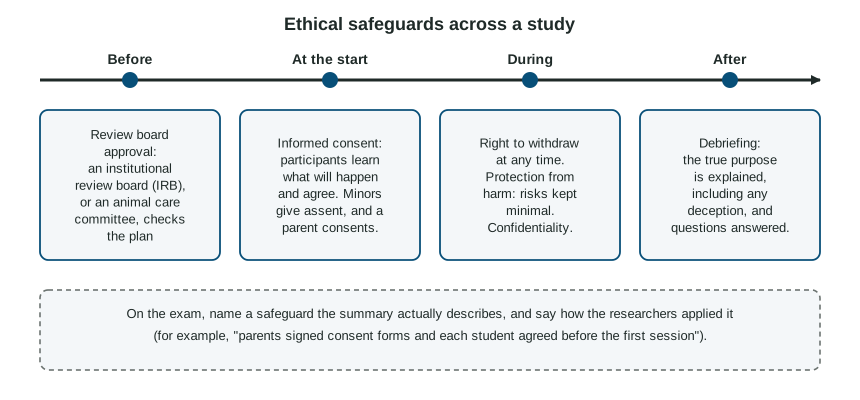
| Safeguard | What it means | What it looks like in a summary |
|---|---|---|
| Institutional review board (IRB) | a committee approves the plan before the study starts | "The university's IRB approved the study." |
| Informed consent | participants learn what will happen, including risks, and agree | "Each student read and signed a consent form." |
| Informed assent | a minor agrees, along with a parent's consent | "Parents signed consent forms and each teen agreed." |
| Right to withdraw | participants may stop at any time without penalty | "Participants were told they could stop at any time." |
| Confidentiality | identities and data are kept private | "Answers were stored under code numbers." |
| Protection from harm | physical and emotional risk is kept minimal | "The task lasted five minutes; a counselor was available." |
| Debriefing | the true purpose is explained afterward, including any deception | "Afterward, researchers explained the cover story." |
Deception means misleading participants about the purpose or the procedure. It is allowed only when the question cannot be studied honestly, the risk is small, and participants are debriefed as soon as possible. A study of honesty described as "a handwriting study" is a typical example: telling people it is about honesty would change how honest they are.
Animal research
Animal research lets scientists study questions that cannot ethically be studied in people, such as the effects of damage to a specific brain area. Animals cannot consent, so an animal care and use committee reviews each study: the animals' housing, how pain is prevented or treated, and whether the question justifies using animals at all. Researchers are expected to use as few animals as possible and the least invasive methods that work.
Answering the ethics question
On the free-response section you will be asked to identify an ethical guideline the summary describes and explain how the researchers applied it. Readers have two common reasons for refusing the point: naming a safeguard the summary never mentions, and naming a design feature such as random assignment or a control group.
Worked example. A summary says: "The university's IRB approved the study. Each student signed a consent form describing a memory task and stating they could stop at any time. Some students were told they would give a speech that was never planned. At the end, researchers explained that no speech had been planned and why."
Misses the point: "The researchers used random assignment so the groups were equal." A design feature, not an ethical guideline.
Misses the point: "The researchers kept the data confidential." The summary never says so.
Misses the point: "They used debriefing." Named, but not applied.
Earns the point: "The researchers debriefed participants: at the end of the session they told each student that no speech had been planned and explained why the cover story was needed."