Ethics in Research
Psychologists follow ethical guidelines that protect participants.
Part 1 · Hook
Why this matters
Part 2 · Prerequisite check
Quick check before you start
1. In an experiment, what does random assignment do?
- Uses chance to decide which condition each participant gets
- Gets participants’ agreement to take part
- Keeps participants’ names private
- Explains the study after it ends
Show the answer
Random assignment is a design feature that makes groups comparable; it is not an ethical safeguard.
- Correct: Uses chance to decide which condition each participant gets:
- Gets participants’ agreement to take part:
- Keeps participants’ names private:
- Explains the study after it ends:
2. In a double-blind study, who does not know which participants are in which condition?
- Both the participants and the researchers who collect the data
- Only the participants
- Only the researchers who collect the data
- The review board that approved the study
Show the answer
Double-blind means both the participants and the data collectors are unaware of the conditions.
- Correct: Both the participants and the researchers who collect the data:
- Only the participants:
- Only the researchers who collect the data:
- The review board that approved the study:
Part 3 · See it
See it first
Part 4 · Step by step
How it works, step by step
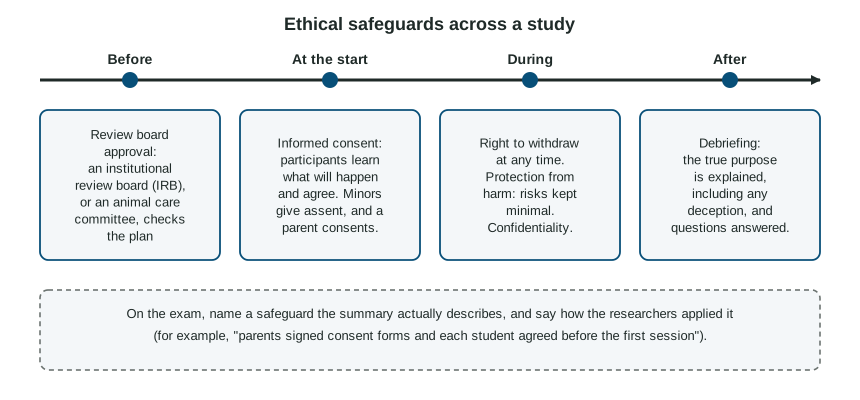
- A researcher plans a study with people or animalsan institutional review board (or an animal care committee) checks that risks are minimal and justified
- Participants are told what the study involves before they agreetheir informed consent (or a parent’s consent plus a minor’s assent) is real, and they may withdraw at any time
- A study needs deception to workit is allowed only with small risk and must end with debriefing that tells the truth
Part 5 · Key ideas
Key ideas
- An institutional review board (IRB) approves research with people before it starts; animal studies need an animal care committee.
- Informed consent before taking part; informed assent from minors, with a parent’s consent; the right to withdraw at any time without penalty.
- Confidentiality keeps identities and data private. Protection from harm keeps physical and emotional risk minimal.
- Deception is allowed only when needed and low in risk, followed by debriefing. On the exam, name a safeguard the summary describes and say how it was applied.
Part 6 · Misconception
A common mistake
The wrong idea: Random assignment, a control group or a large sample count as ethical safeguards.
What actually happens: Those are design features that make results trustworthy. Ethical safeguards protect participants: review board approval, consent and assent, the right to withdraw, confidentiality, protection from harm and debriefing.
Part 7 · Check yourself
Check yourself
Exam-style questions. Anything you miss goes into your review queue.
1. Fifteen-year-olds take part in a study of attention. Their parents sign a form allowing it, and each teen also agrees after the study is explained to them. What do the teens give?
- Debriefing
- Informed assent
- Confidentiality
- Peer review
Show the answer
Minors cannot give legal consent, so a parent or guardian consents and the minor gives assent: their own agreement after the study is explained in terms they understand.
- Debriefing: Debriefing explains the study afterward; it is not agreement to take part.
- Correct: Informed assent: Right: a minor’s own agreement, given alongside a parent’s consent.
- Confidentiality: Confidentiality protects participants’ data, not their agreement.
- Peer review: Peer review is experts checking a study for a journal.
2. In a study of honesty, participants are told it is a study of handwriting. Afterward, the researcher explains the true purpose, why the cover story was needed, and answers questions. What is this final step called?
- Informed consent
- Peer review
- A double-blind procedure
- Debriefing
Show the answer
When a study uses deception, ethics codes require debriefing: telling participants the truth and the reason for the deception as soon as possible.
- Informed consent: Consent comes before the study, and here the true purpose was hidden at that point.
- Peer review: Peer review is experts evaluating the study for a journal.
- A double-blind procedure: Blinding hides conditions during the study; this step reveals the purpose after it.
- Correct: Debriefing: Right: explaining the study, and any deception, after participation.
3. A student summarizing a study for an exam answer writes: "One ethical guideline the researchers followed was random assignment, because each participant had an equal chance of being in either group." Why does this not earn credit?
- Random assignment is a feature of surveys rather than experiments
- Random assignment is a design feature, not an ethical safeguard
- The answer needed to name the IRB, which is the guideline readers prefer
- Ethical guidelines apply to animal research, not to studies of people
Show the answer
An ethics answer must name a safeguard the summary describes (consent, withdrawal, confidentiality, debriefing, IRB approval, protection from harm) and say how it was applied.
- Random assignment is a feature of surveys rather than experiments: Random assignment is used in experiments.
- Correct: Random assignment is a design feature, not an ethical safeguard: Right: readers do not accept design features as ethics.
- The answer needed to name the IRB, which is the guideline readers prefer: Any safeguard the summary describes can earn the point if its use is explained.
- Ethical guidelines apply to animal research, not to studies of people: Ethical guidelines protect both human and animal participants.
Study
Does a stressful speech task affect memory?
Introduction
Researchers asked whether preparing for a surprise speech affects how many words people remember.
Participants
Sixty university students (ages 18 to 24) took part. The university’s institutional review board approved the study. Each student read and signed a consent form that described a "memory task" and said they could stop at any time.
Method
Students were randomly assigned to two groups. One group was told they would soon give a speech that would be video-recorded and judged; the other group was not. In fact, no one gave a speech. All students then studied 20 words and wrote down as many as they could recall in two minutes.
Results
The speech group recalled an average of 9 words; the comparison group recalled 12.
Discussion
At the end of the session, researchers told each student that no speech had been planned, explained why the study needed this cover story, and answered their questions.
Invented study for practice.
4. Which part of the study used deception?
- Assigning students to two groups at random
- Counting the words recalled in two minutes
- Asking students to sign a consent form
- Telling one group about a speech that was never planned
Show the answer
The speech was a cover story. Deception is allowed only when the study needs it, the risk is small and participants are debriefed.
- Assigning students to two groups at random: Random assignment is a design feature, not deception.
- Counting the words recalled in two minutes: That is the measure, recorded honestly.
- Asking students to sign a consent form: Consent is a safeguard, not deception.
- Correct: Telling one group about a speech that was never planned: Right: the students were misled about the speech.
5. Build an answer to: identify one ethical guideline the summary describes and explain how the researchers applied it.
Build the answer part by part, then write it in your own words.
Show the answer
Name a safeguard the summary describes, then say exactly how these researchers carried it out.
- An answer that earns the point: The researchers followed debriefing by telling each student at the end of the session that no speech had been planned, explaining why the cover story was needed, and answering their questions.
6. A critic says the consent form was not fully informed. What is the strongest basis for this claim?
- The form said "memory task" but not the speech threat
- The form said students could stop at any time
- The study was approved by the review board
- Students were randomly assigned to two groups
Show the answer
Informed consent means knowing what participation involves. The cover story kept the speech threat out of the form, which is why debriefing was required.
- Correct: The form said "memory task" but not the speech threat: Right: the stressful part was not described in advance.
- The form said students could stop at any time: Saying participants may withdraw is part of proper consent.
- The study was approved by the review board: Review board approval supports the study’s ethics.
- Students were randomly assigned to two groups: Assignment is a design feature unrelated to consent.
Part 8 · Summary
Summary
Part 9 · Up next
What comes next
Part 10 · Connections