Research Methods and Variables
Psychologists test hypotheses with operationally defined variables.
Part 1 · Hook
Why this matters
Part 2 · See it
See it first
Part 3 · Step by step
How it works, step by step
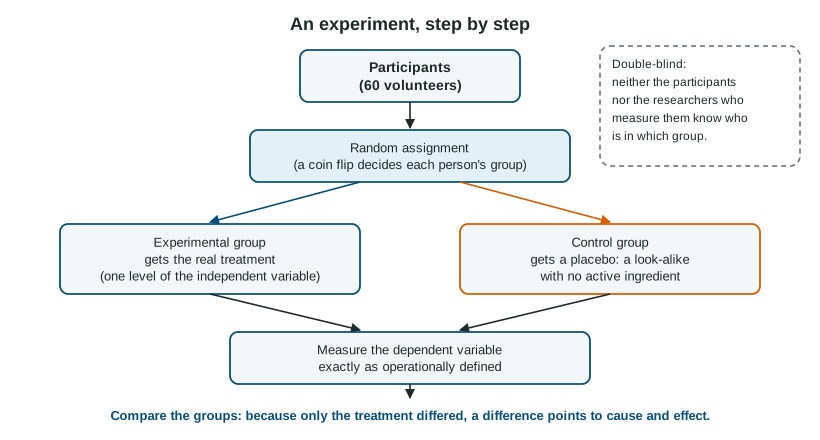
- A researcher manipulates one variable (the independent variable) and randomly assigns people to conditionsthe groups start out alike, on average, in everything else
- The groups then differ only in the treatmenta difference in the dependent variable can be traced to the treatment: cause and effect
- Without manipulation and random assignment (a correlational study, a case study, observation or a survey)a third variable or the reverse direction could explain the result, so no cause can be claimed
- Placebos and double-blind procedures hide the conditionsexpectations of participants and researchers cannot push the results
Part 4 · Key ideas
Key ideas
- Name the method exactly. An experiment needs a manipulated independent variable and random assignment. Otherwise it is a correlational study, a case study, naturalistic observation or a survey.
- An operational definition says how this study measured a variable: "the number of words written down in two minutes", not "memory".
- Controls: a control group (often given a placebo), and single-blind or double-blind procedures against expectations and experimenter bias.
- Surveys are open to wording effects and social desirability bias. Science corrects itself through peer review, replication and meta-analysis.
Part 5 · Misconception
A common mistake
The wrong idea: Any study that compares groups is an experiment, so its results show a cause.
What actually happens: A study is an experiment only when the researcher assigns the conditions at random. Comparing groups that already exist (pet owners and non-owners, students who chose a course) is correlational and cannot show a cause.
Part 6 · Check yourself
Check yourself
Exam-style questions. Anything you miss goes into your review queue.
1. A psychologist sits in a park café for six weeks and records how often strangers who share a table start a conversation. She never speaks to them or changes anything about the setting. Which research method is she using?
- Naturalistic observation
- A field experiment in a café
- A case study of café customers
- A survey of café customers
Show the answer
She watches and records natural behavior in its real setting without intervening, which is naturalistic observation.
- Correct: Naturalistic observation: Right: she records behavior where it happens and changes nothing.
- A field experiment in a café: An experiment needs a variable the researcher manipulates and random assignment to conditions; she changes nothing.
- A case study of café customers: A case study looks in depth at one person or a small group; she counts behavior across many strangers.
- A survey of café customers: A survey asks people to report on themselves; she never asks anyone anything.
2. Researchers ask 900 teenagers how many hours they sleep on school nights and how often they feel irritable, then find that teens who sleep less report feeling irritable more often. What can the researchers conclude?
- Losing sleep causes teenagers to become more irritable
- Sleep and irritability are related, but the study cannot show which causes which
- Feeling irritable keeps teenagers from falling asleep easily at night, which is what the data show
- The relationship is due to chance because the data came from teenagers’ own self-reports
Show the answer
The researchers measured two variables as they occurred. A correlational study shows that variables are related, not that one causes the other: a third variable, such as stress, could affect both.
- Losing sleep causes teenagers to become more irritable: Nothing was manipulated and no one was randomly assigned, so a cause cannot be claimed.
- Correct: Sleep and irritability are related, but the study cannot show which causes which: Right: this is a correlational study; it shows a relationship, not a cause.
- Feeling irritable keeps teenagers from falling asleep easily at night, which is what the data show: That is one possible direction, but the data cannot show it any more than the reverse.
- The relationship is due to chance because the data came from teenagers’ own self-reports: Self-reports can be biased, but that does not make a relationship a chance result.
3. In a study, the researchers define "aggression" as the number of times a child hits or kicks the inflatable doll during a 10-minute play session. What have the researchers written?
- An operational definition
- A hypothesis
- A theory
- A confounding variable
Show the answer
An operational definition turns a concept into the exact procedure or count used to measure it, here hits and kicks counted in 10 minutes.
- Correct: An operational definition: Right: it states exactly how aggression is measured in this study.
- A hypothesis: A hypothesis predicts how variables are related; this only says how one variable is measured.
- A theory: A theory is a broad explanation that organizes many findings, not a measurement rule.
- A confounding variable: A confounding variable is an unwanted difference between groups; this is the measure of the outcome.
Study
Does a new caffeine-free energy drink improve reaction time?
Introduction
A company claims its caffeine-free energy drink makes people react faster. Researchers tested the claim.
Participants
Eighty college students volunteered (ages 18 to 22, 44 women and 36 men) at one university.
Method
A computer randomly assigned each student to one of two groups. The experimental group drank the energy drink; the control group drank a look-alike drink with the same taste and color but none of the active ingredients. Neither the students nor the research assistants who ran the test knew which drink each student had. Twenty minutes later, each student pressed a key as fast as possible when a light flashed, 20 times. Reaction time was the average number of milliseconds between the flash and the key press.
Results
The experimental group’s average reaction time was 312 milliseconds; the control group’s was 318 milliseconds.
Discussion
The researchers concluded that the drink made at most a very small difference in reaction time.
Invented study for practice.
4. What is the independent variable in this study?
- Which drink a student was given, the energy drink or the look-alike
- The number of milliseconds between the flash and the key press
- Whether the research assistants knew which drink each student had
- The students’ ages, from 18 to 22 years
Show the answer
The independent variable is the one the researchers manipulate: here, the type of drink.
- Correct: Which drink a student was given, the energy drink or the look-alike: Right: the researchers set this for each student.
- The number of milliseconds between the flash and the key press: That is measured, so it is the dependent variable.
- Whether the research assistants knew which drink each student had: That is part of the blinding procedure, kept the same for everyone.
- The students’ ages, from 18 to 22 years: Age describes the participants; the researchers did not manipulate it.
5. Why did the control group receive a look-alike drink instead of no drink at all?
- To make the two groups the same size so the averages could be compared
- To control the placebo effect, so both groups expected a boost
- To give the control group an operational definition of reaction time
- To let the research assistants see which students were in which group
Show the answer
A placebo looks like the treatment but has no active ingredient. If expecting a boost made people faster, both groups would show it, so any difference left over points to the drink itself.
- To make the two groups the same size so the averages could be compared: Group size is set by assignment, not by what the control group drinks.
- Correct: To control the placebo effect, so both groups expected a boost: Right: a placebo makes expectations the same in both groups.
- To give the control group an operational definition of reaction time: The operational definition is the same for both groups; the placebo is about expectations.
- To let the research assistants see which students were in which group: The look-alike drink keeps the conditions hidden, not visible.
6. What feature of the method allows the researchers to draw a cause-and-effect conclusion about the drink?
- Students were volunteers from one university
- Reaction time was measured in milliseconds
- Students were randomly assigned to the two drinks
- Each student pressed a key 20 times instead of once
Show the answer
Random assignment spreads differences such as alertness or sleep evenly across the groups, so a difference afterward can be traced to the drink.
- Students were volunteers from one university: Volunteering says who took part; it does not make the two groups comparable.
- Reaction time was measured in milliseconds: A precise measure is useful, but it does not by itself allow a causal claim.
- Correct: Students were randomly assigned to the two drinks: Right: random assignment makes the groups alike, on average, before the drinks.
- Each student pressed a key 20 times instead of once: Several trials make the measure steadier; they do not make the groups comparable.
7. Build the operational definition of reaction time used in this study.
Build the answer part by part, then write it in your own words.
Show the answer
An operational definition says exactly how this study measured the variable, with the unit and the procedure.
- An answer that earns the point: Reaction time was the average number of milliseconds between the light flashing and the student pressing the key, over 20 trials.
Part 7 · Summary
Summary
Part 8 · Up next
What comes next
Part 9 · Connections