Sampling and Generalizability
A sample stands in for a population.
Part 1 · Hook
Why this matters
Part 2 · Prerequisite check
Quick check before you start
1. A study compares students who chose to join a study group with students who did not. What kind of study is this?
- A correlational study, since no one was randomly assigned
- An experiment, since two groups are compared
- A case study, since students are studied
- Naturalistic observation, since nothing was asked
Show the answer
The students chose their own groups, so nothing was manipulated or randomly assigned: the study is correlational.
- Correct: A correlational study, since no one was randomly assigned:
- An experiment, since two groups are compared:
- A case study, since students are studied:
- Naturalistic observation, since nothing was asked:
2. What is the job of random assignment in an experiment?
- It makes the groups alike, on average, before the treatment
- It picks who from the population is studied
- It hides the conditions from the researchers
- It says how the outcome will be measured
Show the answer
Random assignment uses chance to decide which condition each participant gets, so the groups start out alike.
- Correct: It makes the groups alike, on average, before the treatment:
- It picks who from the population is studied:
- It hides the conditions from the researchers:
- It says how the outcome will be measured:
Part 3 · See it
See it first
Part 4 · Step by step
How it works, step by step
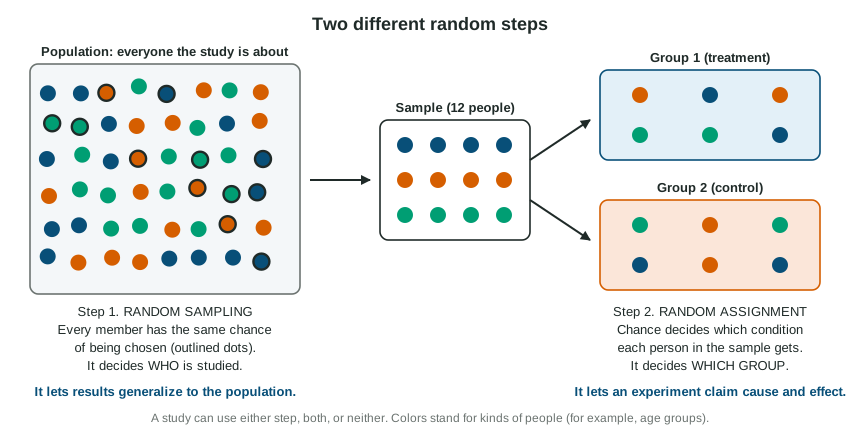
- Every member of the population has the same chance of being chosen (random sampling)the sample is likely to be representative: it mirrors the population
- People are chosen because they are easy to reach or volunteer (a convenience or self-selected sample)the sample is biased, and a larger biased sample is still biased
- The participants differ from a group in age, culture or settingresults may not generalize to that group; argue from those characteristics
Part 5 · Key ideas
Key ideas
- The population is everyone a study wants to describe; the sample is the people actually studied.
- Random sampling gives everyone the same chance of being chosen, so a representative sample is likely. A convenience sample or volunteers create sampling bias.
- Random sampling decides who is studied and supports generalizability. Random assignment decides which condition each person gets and supports cause and effect.
- Judge generalizability from participant characteristics (age, culture, setting), not from the sample size alone.
Part 6 · Misconception
A common mistake
The wrong idea: A bigger sample always fixes sampling problems, and random sampling and random assignment are the same thing.
What actually happens: Size cannot fix a biased sample: two million returned ballots still did not represent voters. Random sampling (who is studied) and random assignment (which condition) are separate steps with separate jobs.
Part 7 · Check yourself
Check yourself
Exam-style questions. Anything you miss goes into your review queue.
1. To study teen screen habits, a researcher posts a link on a gaming forum and analyzes the 2,000 replies. Which problem most limits who the results describe?
- There was no random assignment to screen habits
- Sampling bias: forum users may differ from typical teens
- The sample of 2,000 replies is too small to describe teens in general
- A wording effect in the questions that the forum survey used
Show the answer
A convenience sample takes whoever is easy to reach. Gaming-forum users differ from teens in general, so the sample is biased no matter how many reply.
- There was no random assignment to screen habits: Random assignment matters for causal claims in experiments; the question is who the results describe.
- Correct: Sampling bias: forum users may differ from typical teens: Right: a convenience sample of forum users is unlikely to be representative.
- The sample of 2,000 replies is too small to describe teens in general: 2,000 is a large sample; size cannot fix a sample drawn from the wrong place.
- A wording effect in the questions that the forum survey used: The stem says nothing about the wording; the problem it describes is where the sample came from.
2. A study of a new reading program randomly selects 60 schools from across the state, then randomly assigns 30 to use the program and 30 to continue as usual. What does each random step allow?
- Random selection supports a causal claim; random assignment supports generalizing to the state’s schools
- Both steps do the same job, so the second one adds nothing to the study design
- Neither step matters much, because 60 schools is a large enough sample on its own
- Random selection supports generalizing to the state’s schools; random assignment supports a causal claim
Show the answer
Random sampling (selection) lets results generalize to the population; random assignment to conditions lets an experiment show cause and effect.
- Random selection supports a causal claim; random assignment supports generalizing to the state’s schools: This swaps the two: assignment is what allows the cause-and-effect conclusion.
- Both steps do the same job, so the second one adds nothing to the study design: They do different jobs: one is about who is studied, the other about which condition each gets.
- Neither step matters much, because 60 schools is a large enough sample on its own: Size does not replace either step: a large biased sample is still biased.
- Correct: Random selection supports generalizing to the state’s schools; random assignment supports a causal claim: Right: sampling decides who is studied, assignment decides which condition.
3. An experiment on a memory strategy used 40 psychology majors at one private university, ages 19 to 22. A teacher asks whether the results apply to her ninth graders. Which answer is best supported?
- Only partly: it helped young adults, but ninth graders are younger
- No, because 40 participants is too few for a study to give useful results
- Yes, because the study was an experiment that used random assignment
- Yes, because memory works in much the same way in people of any age
Show the answer
Generalizability depends on how similar the participants are to the group you want to describe: here, age and type of school differ.
- Correct: Only partly: it helped young adults, but ninth graders are younger: Right: it argues from participant characteristics, both sides.
- No, because 40 participants is too few for a study to give useful results: Generalizing depends on who the participants were, not on the count alone.
- Yes, because the study was an experiment that used random assignment: Random assignment supports a causal claim for these participants; it says nothing about other ages.
- Yes, because memory works in much the same way in people of any age: Ages, schooling and backgrounds differ; a claim about everyone needs evidence from different groups.
Data
Who answered an online sleep survey?
| Age group | Share of respondents | Share of the town’s adults |
|---|---|---|
| 18 to 29 | 55% | 20% |
| 30 to 49 | 30% | 35% |
| 50 to 69 | 12% | 30% |
| 70 and older | 3% | 15% |
4. What does the table show about the survey’s sample?
- Young adults are overrepresented; older adults, underrepresented
- The sample matches the town’s age makeup closely in each group
- Older adults are overrepresented in the sample
- Adults aged 30 to 49 are missing from the sample
Show the answer
Compare each row: a share among respondents far above the town’s share means overrepresented; far below means underrepresented.
- Correct: Young adults are overrepresented; older adults, underrepresented: Right: 55% versus 20% for ages 18 to 29, and 3% versus 15% for 70 and older.
- The sample matches the town’s age makeup closely in each group: Every age group differs, some by more than 30 points.
- Older adults are overrepresented in the sample: The two oldest groups make up a smaller share of respondents than of the town.
- Adults aged 30 to 49 are missing from the sample: They make up 30% of respondents, close to their 35% of the town.
5. The survey found that most respondents sleep under seven hours. Why should the town not conclude that most of its adults do?
- A survey is a poor way to measure how long people sleep
- The sample is biased toward younger adults
- The survey was not an experiment, so it has no results
- Seven hours is not an operational definition of sleep
Show the answer
An online survey that mostly reached young adults is a biased sample, so its results describe young respondents more than the town.
- A survey is a poor way to measure how long people sleep: Surveys can ask about sleep; the problem here is who answered.
- Correct: The sample is biased toward younger adults: Right: a sample that misrepresents the population cannot describe it.
- The survey was not an experiment, so it has no results: Surveys produce descriptive results; the issue is the sample.
- Seven hours is not an operational definition of sleep: The measure is clear enough; the problem is who answered.
6. Which change would most improve how well the survey represents the town’s adults?
- Leave the online survey open longer to get more replies
- Ask the respondents to share the link with their friends
- Contact a random sample from the town’s address list
- Randomly assign respondents to two versions of the survey
Show the answer
Random sampling from a list of the whole population gives every adult the same chance of being chosen, so all age groups appear in about their true shares.
- Leave the online survey open longer to get more replies: More replies from the same kind of respondents does not fix the bias.
- Ask the respondents to share the link with their friends: Friends of young respondents are likely to be young too.
- Correct: Contact a random sample from the town’s address list: Right: random sampling from the whole population.
- Randomly assign respondents to two versions of the survey: Random assignment compares conditions; it does not change who is in the sample.
Part 8 · Summary
Summary
Part 9 · Up next
What comes next
Part 10 · Connections