The ocean has done the planet a favor: it has absorbed about a quarter of all the carbon dioxide people have released. That has slowed warming. But CO₂ does not just sit in seawater. It reacts, and the reaction changes the water's chemistry in a way that threatens corals, shellfish and the base of ocean food webs. This page covers the chemistry, the pH math, who is harmed and what can be done.
The chemistry, step by step
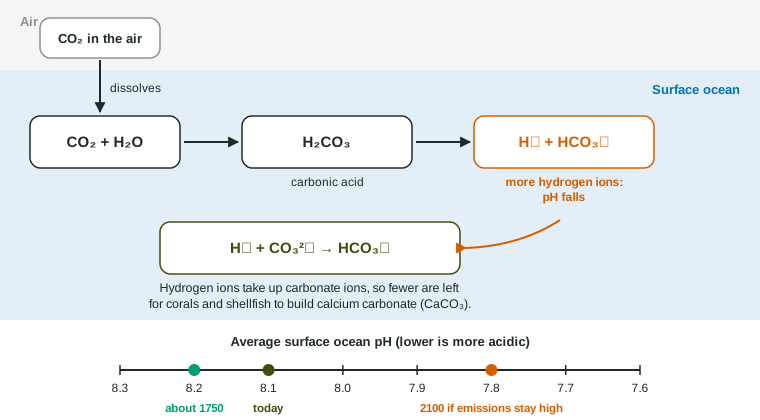
- CO₂ dissolves. Carbon dioxide from the air dissolves at the ocean surface.
- Carbonic acid forms. . Carbonic acid is a weak acid.
- Hydrogen ions are released. . More hydrogen ions means a lower pH.
- Carbonate is used up. Many of the new hydrogen ions combine with carbonate ions: . Fewer carbonate ions are left.
Corals, oysters, clams, sea urchins and some plankton build shells and skeletons of calcium carbonate (CaCO₃). With fewer carbonate ions, building takes more energy, young animals may fail to form shells, and in very low pH water existing shells can start to dissolve.
pH and the logarithmic scale
Average surface ocean pH was about 8.2 before the Industrial Revolution. It is about 8.1 today, and could fall to about 7.8 by 2100 if emissions stay high. Seawater is still basic (above 7). "Acidification" names the direction: it is becoming less basic.
A change of 0.1 sounds tiny, but the pH scale is logarithmic. Each drop of 1 pH unit means 10 times more hydrogen ions. For a drop that is not a whole number, the factor is 10 raised to the drop.
Worked example. Surface pH falls from 8.2 to 8.1. By what factor does hydrogen ion concentration increase?
Setup:
Answer: , so about 26% more hydrogen ions.
From 8.1 to 7.8:
On a scientific calculator, use the key. Write the setup with the subtraction in brackets so the drop is clear.
Reading a station record
Long-running ocean stations measure CO₂ in the air and the pH of the water beside them. Their records show the two moving in opposite directions: as atmospheric CO₂ rises year after year, seawater pH falls. When you describe such data, give both trends with numbers ("CO₂ rose from 354 to 414 ppm while pH fell from 8.110 to 8.053"), then link them with the chemistry ("more CO₂ dissolved, forming carbonic acid, which released hydrogen ions").
Who is harmed
- Coral reefs: slower growth and weaker skeletons, on top of bleaching from warm water. Reefs shelter about a quarter of ocean species.
- Shellfish: oyster hatcheries in the Pacific Northwest lost most of their larvae in the late 2000s when acidic water upwelled along the coast; some now treat their water to raise its pH.
- Plankton: some tiny shell-building plankton are at the base of food webs that feed fish, whales and seabirds.
Acidification is not acid rain
| Ocean acidification | Acid rain | |
|---|---|---|
| Cause | CO₂ dissolving from the air into the ocean | SO₂ and NOx forming sulfuric and nitric acid in clouds |
| Where | the whole ocean surface | lakes, forests and soils downwind of power plants and cities |
| Main fix | cut CO₂ emissions | scrubbers, low-sulfur fuel, catalytic converters |
Solutions
Because the cause is CO₂ itself, the only global fix is cutting CO₂ emissions: less burning of fossil fuels, more renewable energy, more efficient use. Locally, protecting seagrass and kelp beds can raise pH a little nearby, and hatcheries can buffer their water. These help in one place but do not change the open ocean.