Ocean Acidification
The ocean absorbs part of the CO₂ people add to the air.
Part 1 · Hook
Why this matters
Part 2 · Before you start
What this builds on
Part 3 · Prerequisite check
Quick check before you start
1. What happens to the pH of a solution when its hydrogen ion concentration increases?
- pH decreases
- pH increases
- pH does not change
- pH becomes exactly 7
Show the answer
More hydrogen ions means a lower pH, more acidic.
- Correct: pH decreases:
- pH increases:
- pH does not change:
- pH becomes exactly 7:
2. How did atmospheric CO₂ change at Mauna Loa from 1960 to 2023?
- It rose from about 317 to 421 ppm
- It fell from 421 to 317 ppm
- It stayed near 280 ppm
- It rose and then fell
Show the answer
The Keeling curve rose every year.
- Correct: It rose from about 317 to 421 ppm:
- It fell from 421 to 317 ppm:
- It stayed near 280 ppm:
- It rose and then fell:
Part 4 · See it
See it first
Part 5 · Step by step
How it works, step by step
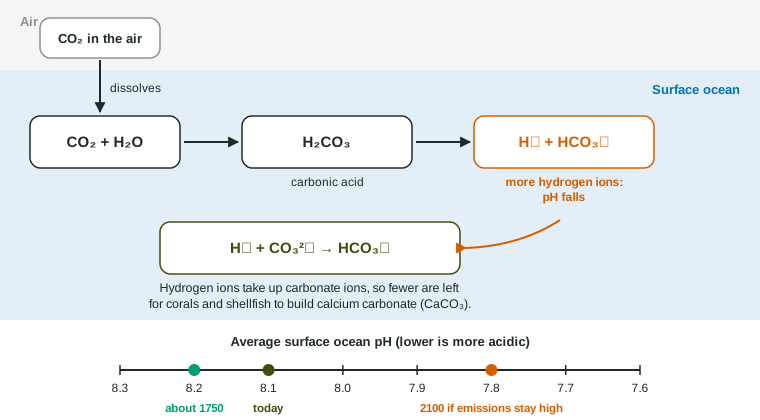
- Burning fossil fuels raises CO₂ in the airthe ocean absorbs about a quarter of it
- Dissolved CO₂ reacts with water to form carbonic acidit releases hydrogen ions, so pH falls
- Hydrogen ions combine with carbonate ionsless carbonate is left for building calcium carbonate
- Shell-builders such as corals, oysters and some plankton strugglereefs weaken and food webs that depend on them suffer
Part 6 · Key ideas
Key ideas
- Ocean acidification: seawater pH falls as it absorbs CO₂. Average surface pH has dropped from about 8.2 to about 8.1 since the 1700s and could reach about 7.8 by 2100 if emissions stay high.
- Chemistry: (carbonic acid) ; then removes carbonate.
- The pH scale is logarithmic: hydrogen ions multiply by . A drop of 0.1 is about 26% more H⁺; a drop of 0.3 is about twice as much.
- The ocean is still basic (pH above 7); "acidification" names the direction of change.
Part 7 · Misconception
A common mistake
Part 8 · Check yourself
Check yourself
Exam-style questions. Anything you miss goes into your review queue.
1. When CO₂ dissolves in seawater, which product makes the water more acidic?
- Oxygen gas released by the reaction
- Hydrogen ions from carbonic acid
- Calcium carbonate dissolving out of the water
- Nitrogen gas from the air
Show the answer
pH measures hydrogen ions: more H⁺ means lower pH and more acidic water.
- Oxygen gas released by the reaction: The reaction does not release oxygen.
- Correct: Hydrogen ions from carbonic acid: Right: CO₂ + H₂O → H₂CO₃, which releases H⁺. More H⁺ means lower pH.
- Calcium carbonate dissolving out of the water: Calcium carbonate is what shells are made of; acidification makes it harder to build.
- Nitrogen gas from the air: Nitrogen is not part of the reaction.
2. Why does ocean acidification make it harder for corals, clams and some plankton to build shells and skeletons?
- Acid water is too cold for shells to form
- Dissolved CO₂ blocks sunlight from reaching the reef
- Hydrogen ions bind carbonate, the shell material
- Acid water has too much carbonate for shells to use
Show the answer
Fewer carbonate ions mean shell-builders spend more energy making calcium carbonate, and existing shells can start to dissolve.
- Acid water is too cold for shells to form: Acidification is a chemical change, not a temperature change.
- Dissolved CO₂ blocks sunlight from reaching the reef: CO₂ in water does not block light.
- Correct: Hydrogen ions bind carbonate, the shell material: Right: H⁺ + CO₃²⁻ → HCO₃⁻ removes the carbonate these animals need.
- Acid water has too much carbonate for shells to use: It has less carbonate, not more.
Data
Atmospheric CO₂ and seawater pH at one ocean station
| Year | Atmospheric CO₂ (ppm) | Seawater pH |
|---|---|---|
| 1990 | 354 | 8.110 |
| 1995 | 361 | 8.101 |
| 2000 | 370 | 8.093 |
| 2005 | 380 | 8.084 |
| 2010 | 390 | 8.075 |
| 2015 | 401 | 8.064 |
| 2020 | 414 | 8.053 |
3. Describe the relationship between atmospheric CO₂ and seawater pH in the table.
- As CO₂ rose, pH fell
- As CO₂ rose, pH rose
- CO₂ and pH both stayed the same
- pH fell until 2005, then rose
Show the answer
An inverse relationship: more CO₂ in the air, more CO₂ dissolved, more carbonic acid, lower pH.
- Correct: As CO₂ rose, pH fell: Right: CO₂ went from 354 to 414 ppm while pH fell from 8.110 to 8.053.
- As CO₂ rose, pH rose: pH fell in every five-year step.
- CO₂ and pH both stayed the same: Both changed in every step.
- pH fell until 2005, then rose: pH kept falling through 2020.
4. By how much did the seawater pH change from 1990 to 2020? Give the change as later minus earlier.
Type a number. Scale words (2.5 million) and powers of ten (2.5 × 10^6) are read.
Show the answer
pH units.
- Answer: -0.057
5. Write the setup for the percent change in atmospheric CO₂ from 1990 to 2020 in the table, then the answer.
Type the setup as on the exam, with brackets and units, then the answer.
Show the answer
- Setup: ; answer 16.95 %
6. The pH scale is logarithmic: hydrogen ion concentration multiplies by 10 for each drop of 1 pH unit, so it multiplies by 10 raised to the drop. Using the table, by what factor did hydrogen ion concentration increase from 1990 to 2020?
Type a number. Scale words (2.5 million) and powers of ten (2.5 × 10^6) are read.
Show the answer
- Answer: 1.14
7. Which action would do the most to slow ocean acidification worldwide?
- Adding fertilizer to the open ocean
- Cutting CO₂ emissions from burning fossil fuels
- Phasing out CFCs
- Banning sulfur in gasoline
Show the answer
Acidification is driven by CO₂ itself, so the global fix is cutting CO₂ emissions.
- Adding fertilizer to the open ocean: Fertilizer causes algal blooms and dead zones.
- Correct: Cutting CO₂ emissions from burning fossil fuels: Right: less CO₂ in the air means less dissolving into the ocean.
- Phasing out CFCs: CFCs destroy ozone; they are not the cause of acidification.
- Banning sulfur in gasoline: That reduces acid rain, not ocean acidification.
Part 9 · Summary
Summary
Part 10 · Up next
What comes next
Part 11 · Connections