Invasive Species
Invasive species are nonnative species that spread quickly and cause harm.
Part 1 · Hook
Why this matters
Part 2 · Before you start
What this builds on
Part 3 · Prerequisite check
Quick check before you start
1. Which traits describe an r-selected species?
- Many offspring, little parental care
- Few offspring, lots of care
- Long life, slow maturity
- Large body, low birth rate
Show the answer
r-selected species reproduce quickly, with many offspring and little care.
- Correct: Many offspring, little parental care:
- Few offspring, lots of care:
- Long life, slow maturity:
- Large body, low birth rate:
2. What is a generalist species?
- One that can live in many habitats and eat many foods
- One with a very narrow diet
- One that lives in a single habitat
- One that eats only plants
Show the answer
Generalists tolerate a broad range of conditions and foods.
- Correct: One that can live in many habitats and eat many foods:
- One with a very narrow diet:
- One that lives in a single habitat:
- One that eats only plants:
Part 4 · See it
See it first
Part 5 · Step by step
How it works, step by step
- People move a species outside its native range, by ship, trade or on purposeit arrives where it has few predators, parasites or diseases
- Generalist, r-selected traits let it eat many foods and reproduce fastits population grows explosively
- It outcompetes, eats or smothers native speciesnative populations decline and biodiversity falls
- Once established it is very hard to removeprevention and early detection are the best control
Part 6 · Key ideas
Key ideas
- Invasive species are nonnative (exotic) species that spread quickly and cause harm. Not every nonnative species is invasive.
- They are often generalists with r-selected traits. Lacking natural predators is a feature of the new ecosystem, not a trait.
- Examples: zebra mussels (ballast water, Great Lakes), kudzu (planted for erosion control), cane toads (brought to Australia for pest control), Asian carp, emerald ash borer.
- Control: prevention (ballast rules, boat cleaning, inspections), early detection, removal, and carefully tested biological control.
Part 7 · Misconception
A common mistake
The wrong idea: An invasive species succeeds because its trait is "no predators."
What actually happens: Having few predators describes the new habitat. A trait belongs to the organism: a broad diet, fast reproduction, tolerance of many conditions.
Part 8 · Check yourself
Check yourself
Exam-style questions. Anything you miss goes into your review queue.
1. Which traits help a nonnative species become invasive?
- A narrow diet and slow reproduction
- A broad diet and fast reproduction
- A need for one kind of habitat and few offspring
- Large body size and a long time to maturity
Show the answer
Invasive species are usually generalists with r-selected traits: they tolerate many conditions and reproduce quickly.
- A narrow diet and slow reproduction: Those are specialist, K-selected traits, which make spreading hard.
- Correct: A broad diet and fast reproduction: Right: generalists find food almost anywhere, and many offspring let numbers explode.
- A need for one kind of habitat and few offspring: A narrow habitat need and few young limit spread.
- Large body size and a long time to maturity: Slow maturity limits how fast a population can grow.
Data
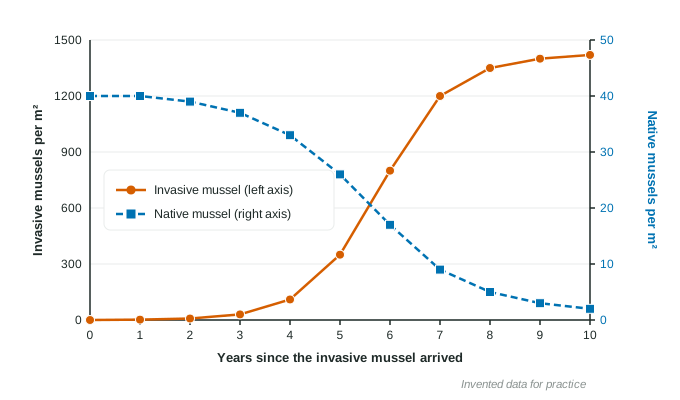
Mussels in a lake after an invader arrived
| Year | Invasive mussel (per m²) | Native mussel (per m²) |
|---|---|---|
| 0 | 0 | 40 |
| 1 | 2 | 40 |
| 2 | 8 | 39 |
| 3 | 30 | 37 |
| 4 | 110 | 33 |
| 5 | 350 | 26 |
| 6 | 800 | 17 |
| 7 | 1,200 | 9 |
| 8 | 1,350 | 5 |
| 9 | 1,400 | 3 |
| 10 | 1,420 | 2 |
2. Describe how the invasive mussel population changed over the 10 years.
- Steady, even growth each year
- Fast growth, then a crash to zero
- A steady decline from year 0 to year 10
- Slow, then explosive, then level
Show the answer
The invader’s curve is S-shaped: slow start, rapid growth, then leveling off as it nears its carrying capacity.
- Steady, even growth each year: Growth was very uneven: small at first, then huge.
- Fast growth, then a crash to zero: The population leveled off; it did not crash.
- A steady decline from year 0 to year 10: The invader rose; the native mussel declined.
- Correct: Slow, then explosive, then level: Right: under 30 per m² for 3 years, a jump to 1,200 by year 7, then near 1,400.
3. By what percent did the native mussel population change from year 0 to year 10?
Type a number, then its unit (%). Scale words (2.5 million) and powers of ten (2.5 × 10^6) are read.
Show the answer
- Answer: -95 %
4. The lake bottom covers 3,000 m². Write the setup for the total number of invasive mussels in year 10, then the answer.
Type the setup as on the exam, with brackets and units, then the answer.
Show the answer
- Setup: ; answer 4,260,000 mussels
5. Which explanation best fits the decline of the native mussel?
- The native mussel died of old age
- The lake became too cold for mussels
- The invader outcompeted it for food and space
- The native mussel moved to a new lake
Show the answer
An invader crowding out a native for the same resources is interspecific competition; invasive mussels also attach directly to native mussels’ shells.
- The native mussel died of old age: A whole population does not die of old age in a few years.
- The lake became too cold for mussels: The invader thrived, so the lake still suited mussels.
- Correct: The invader outcompeted it for food and space: Right: the native fell as the invader rose, the pattern of competition.
- The native mussel moved to a new lake: Mussels attached to the bottom do not migrate between lakes.
6. Zebra mussels from Europe arrived in the Great Lakes in the late 1980s. How did they most likely get there?
- By swimming across the Atlantic Ocean
- On the feet of migrating birds from Europe
- In ballast water released by cargo ships
- Released as pets by aquarium owners
Show the answer
Ballast water is a major pathway; rules now require ships to exchange or treat it before entering the Great Lakes.
- By swimming across the Atlantic Ocean: Zebra mussels cannot cross an ocean on their own.
- On the feet of migrating birds from Europe: This is not how they reached the Great Lakes.
- Correct: In ballast water released by cargo ships: Right: ships took on water in Europe and released it, with mussel larvae, in the Great Lakes.
- Released as pets by aquarium owners: Ballast water, not the pet trade, is the accepted route.
7. Propose a solution, other than using chemicals, to stop zebra mussels from spreading to a new lake used by boaters.
Build the answer part by part, then write it in your own words.
Show the answer
Respect "other than": a non-chemical prevention step fitted to how the invader travels.
- An answer that earns the point: Require boats to be cleaned, drained and dried at the boat ramp so that mussels and larvae are removed before boats enter the lake, which prevents the invader from reaching the new lake because boats are how it moves between lakes.
Part 9 · Summary
Summary
Part 10 · Up next
What comes next
Part 11 · Connections