Every species faces the same trade-off. It has a limited amount of energy to spend on reproduction. It can spread that energy over many offspring, each getting little, or concentrate it in a few offspring, each getting a lot. The two ends of this range are called r-selected and K-selected, and they predict how a population behaves after a disruption.
Two reproductive strategies
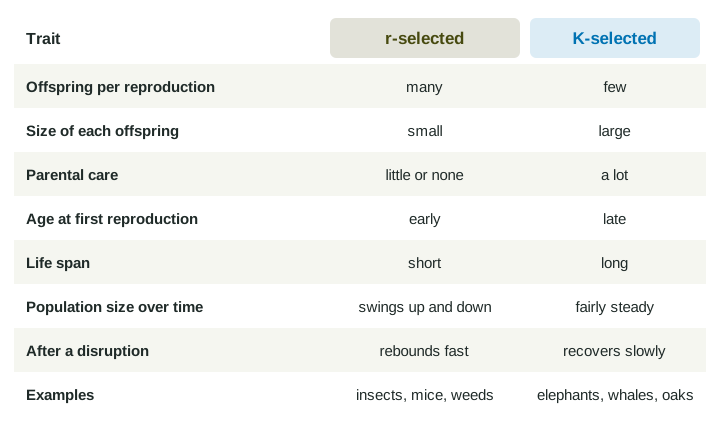
r-selected species make many small offspring, start reproducing early, give little or no care, and live short lives. Most of their offspring die young, but they make so many that the population can grow very fast when conditions allow. Insects, mice, many fish, frogs and weeds are r-selected.
K-selected species make few, large offspring, start reproducing late, give a lot of care, and live long lives. Each offspring has a much better chance of surviving, but the population grows slowly. Elephants, whales, great apes, albatrosses and many large trees are K-selected.
The letters come from population models: r stands for how fast a population can grow, and K for the largest population the environment can support over time. r-selected species are shaped by their ability to grow fast; K-selected species tend to live with their populations near that upper limit.
Biotic potential
Biotic potential is the fastest rate at which a population could grow if resources were unlimited. It depends on how many offspring each individual has, how young it starts, and how often it breeds. r-selected species have a high biotic potential; K-selected species have a low one.
Worked example. A field mouse has about 30 offspring a year, starts breeding at about 0.2 years (a few weeks old) and lives about 1 year. A gorilla has about 0.25 young a year (one every four years) and lives about 40 years, breeding from about age 10. Roughly how many offspring does each produce in a lifetime?
Mouse:
Gorilla:
Count only the years each animal can breed. The mouse produces about three times as many young in its one short year as the gorilla does in its whole life.
Responding to disruption
| r-selected | K-selected | |
|---|---|---|
| Population over time | swings up and down | fairly steady |
| After a disruption | rebounds fast | recovers slowly |
| Risk from hunting or clearing of habitat | lower | higher |
| In new places | can spread fast | spreads slowly |
Because they recover slowly, K-selected species are more likely to become threatened when people add extra deaths through hunting, fishing or collisions with ships and cars. r-selected species often rebound so fast after control efforts (spraying insects with chemicals, trapping mice) that the effort has to be repeated.
A range, not two boxes
Most species fall somewhere between the ends. Sea turtles lay many eggs and give no care, like r-selected species, but live for decades and start breeding late, like K-selected ones. On the exam, classify a species by the traits it shows and say which traits point each way.
On the exam
- Use the traits: number and size of offspring, parental care, age at first breeding, life span.
- Link strategy to recovery: r-selected rebound fast; K-selected recover slowly and are more vulnerable.
- Keep r and K about reproduction. It is a different idea from how survival changes with age, which is the next topic.