Endangered Species
Endangered species face extinction now; threatened species likely will soon.
Part 1 · Hook
Why this matters
Part 2 · Before you start
What this builds on
Part 3 · Prerequisite check
Quick check before you start
1. Which traits describe a K-selected species?
- Few offspring, lots of parental care, slow maturity
- Many offspring, little care
- Short lives, early maturity
- Rapid population booms
Show the answer
K-selected species reproduce slowly, so they recover slowly from losses.
- Correct: Few offspring, lots of parental care, slow maturity:
- Many offspring, little care:
- Short lives, early maturity:
- Rapid population booms:
2. What is a specialist species?
- One with a narrow niche, such as one food or habitat
- One that eats many foods
- One found in every biome
- One that thrives after disturbance
Show the answer
Specialists depend on a narrow set of conditions.
- Correct: One with a narrow niche, such as one food or habitat:
- One that eats many foods:
- One found in every biome:
- One that thrives after disturbance:
Part 4 · See it
See it first
Part 5 · Step by step
How it works, step by step
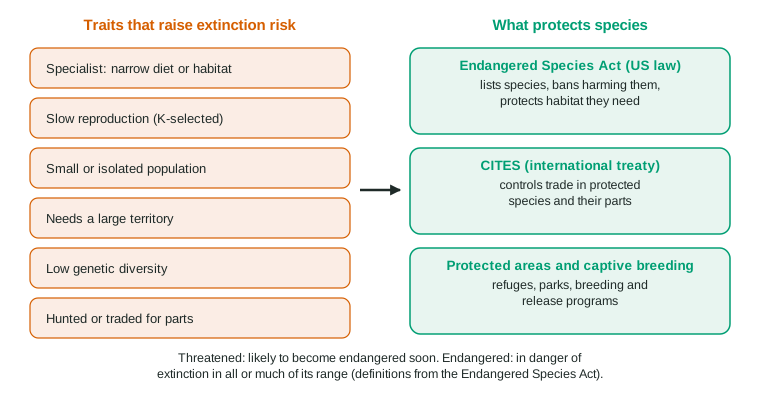
- Specialist, K-selected species with small rangescannot easily shift to new food or habitat and replace losses slowly
- Shrinking habitat, hunting, trade, pollution or invaders reduce their numbersthey become threatened, then endangered
- Small populations lose genetic diversitythey are more vulnerable to disease and change
- The Endangered Species Act, CITES, protected areas and captive breedingcan stop the decline and let numbers recover
Part 6 · Key ideas
Key ideas
- Endangered species: in danger of extinction in all or much of its range. Threatened species: likely to become endangered soon.
- Most at risk: specialists, K-selected species, small or isolated populations, species needing large territories, those hunted or traded.
- The Endangered Species Act (US, 1973) lists species, bans harming them and protects critical habitat. CITES is the international treaty controlling trade.
- Recoveries: bald eagle (DDT ban plus protection), California condor and black-footed ferret (captive breeding and release).
Part 7 · Misconception
A common mistake
The wrong idea: An endangered species just needs to be bred in zoos to be saved.
What actually happens: Captive breeding helps when numbers are very low, but a species recovers in the wild only if the cause of decline is removed and enough habitat is protected.
Part 8 · Check yourself
Check yourself
Exam-style questions. Anything you miss goes into your review queue.
1. Which species is most at risk of extinction?
- A fast-breeding generalist found on most continents
- A slow-breeding specialist with a small range
- A common bird that eats many kinds of seeds
- A weed that spreads easily into disturbed land
Show the answer
Extinction risk rises with specialization, slow reproduction, small or isolated populations and large territory needs.
- A fast-breeding generalist found on most continents: Generalists with many offspring and wide ranges are least at risk.
- Correct: A slow-breeding specialist with a small range: Right: specialist and K-selected traits plus a small range make recovery hard.
- A common bird that eats many kinds of seeds: A broad diet and large numbers lower risk.
- A weed that spreads easily into disturbed land: Weedy, r-selected species thrive in disturbed land.
Model or diagram
Traits that raise extinction risk, and protections
2. According to the figure, which trait raises extinction risk?
- A broad diet
- A large population
- High genetic diversity
- Slow reproduction
Show the answer
Slow reproduction, narrow niches, small populations, large territories, low genetic diversity and hunting all raise risk.
- A broad diet: A broad diet lowers risk; the figure lists a narrow diet.
- A large population: Small or isolated populations are at risk.
- High genetic diversity: The figure lists low genetic diversity as a risk.
- Correct: Slow reproduction: Right: K-selected species replace losses slowly.
3. Giant pandas eat mostly bamboo, have one cub every two or three years, and live in a few mountain forests. Using the figure, how many risk traits do these facts show?
- Three
- One
- Five
- Zero
Show the answer
Specialist diet + K-selected reproduction + small, fragmented range.
- Correct: Three: Right: a narrow diet, slow reproduction and a small, isolated range.
- One: Each fact shows a different risk trait.
- Five: The facts show three of the figure’s traits.
- Zero: All three facts match traits in the figure.
4. Which protection in the figure best addresses rhinos killed for their horns to be sold abroad?
- Captive breeding
- CITES
- The Endangered Species Act
- A national park
Show the answer
Match the protection to the threat: international trade calls for an international treaty.
- Captive breeding: Breeding adds animals but does not stop the trade that kills them.
- Correct: CITES: Right: it controls the international trade that drives the poaching.
- The Endangered Species Act: The ESA is a US law; the trade crosses many countries.
- A national park: A park protects land, but horns are sold across borders; the threat here is trade.
Passage
How the bald eagle came back
In 1963 only 417 nesting pairs of bald eagles were left in the lower 48 states. The pesticide DDT, sprayed widely after World War II, washed into lakes and built up in the fish that eagles eat. In the eagles it caused thin eggshells that broke during nesting. The United States banned DDT for most uses in 1972, and the Endangered Species Act protected the birds and their nesting sites from shooting and disturbance. By 2007 there were 9,789 breeding pairs, and the bald eagle was removed from the endangered and threatened species list.
Summarized from U.S. Fish and Wildlife Service, "Bald Eagle Numbers Soaring" (2007): 417 nesting pairs in 1963, 9,789 breeding pairs in 2007, lower 48 states.
5. What is the main claim of the passage?
- Bald eagles were not really at risk
- Captive breeding alone saved the bald eagle
- A DDT ban and protection let eagles recover
- Hunting is now the main threat to bald eagles
Show the answer
The author links the recovery to two actions: banning DDT and protecting the birds and their nests.
- Bald eagles were not really at risk: The passage describes a fall to 417 nesting pairs.
- Captive breeding alone saved the bald eagle: The passage credits the DDT ban and protection, not breeding alone.
- Correct: A DDT ban and protection let eagles recover: Right: the passage credits the DDT ban and legal protection.
- Hunting is now the main threat to bald eagles: The passage says shooting was banned.
6. Using the passage, what was the percent change in eagle pairs from 1963 to 2007?
Type a number, then its unit (%). Scale words (2.5 million) and powers of ten (2.5 × 10^6) are read.
Show the answer
- Answer: 2247 %
7. Which actions helped the bald eagle recover? Choose the best answer.
- A DDT ban plus legal protection
- Moving most eagles into zoos
- Introducing eagles from Europe
- Spraying more pesticides on lakes
Show the answer
DDT biomagnified up food chains and thinned eggshells; banning it removed the cause.
- Correct: A DDT ban plus legal protection: Right: DDT thinned eggshells; the 1972 ban and ESA protection let numbers recover.
- Moving most eagles into zoos: Most eagles stayed wild; captive breeding played a small part.
- Introducing eagles from Europe: Bald eagles are North American; none were brought from Europe.
- Spraying more pesticides on lakes: Pesticides such as DDT caused the decline.
Part 9 · Summary
Summary
Part 10 · Up next
What comes next
Part 11 · Connections