Extinction is natural: most species that ever lived are gone. But today species are disappearing far faster than the background rate, mostly because of people. Some species are much more likely to slip toward extinction than others. This page covers the categories of risk, the traits that make a species vulnerable, the laws that protect species and what makes a recovery work.
Threatened and endangered
The US Endangered Species Act (ESA) uses two categories:
- Endangered: in danger of extinction throughout all or a significant part of its range.
- Threatened: likely to become endangered in the foreseeable future.
Endangered is the more serious category. International groups use similar ranked categories to track species worldwide.
Who is most at risk
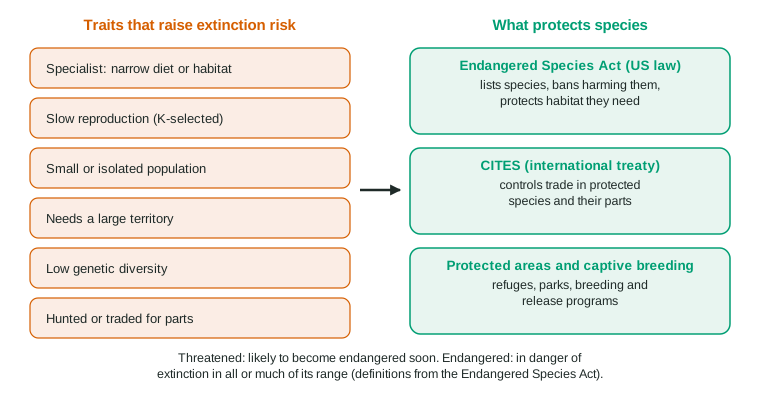
The same traits come up again and again, and they connect to Unit 3:
- Specialists with a narrow diet or habitat cannot switch when their food or home disappears. Giant pandas depend on bamboo.
- K-selected species, with few offspring and slow maturity, replace losses slowly. A female California condor raises about one chick every year or two.
- Small or isolated populations can be wiped out by one storm, fire or disease, and they lose genetic diversity, leaving less variation for adapting to change.
- Large territories: wolves, tigers and grizzly bears need more space than fragmented habitat provides.
- Hunting and trade: rhinos for horn, elephants for ivory, many parrots and orchids for collectors.
Compare this list with invasive species, which are usually the opposite: generalists with r-selected traits.
The laws that protect species
| Endangered Species Act | CITES | |
|---|---|---|
| What it is | a US law (1973) | an international treaty |
| What it does | lists threatened and endangered species; bans killing, harming or trading them; protects critical habitat; requires recovery plans | bans or limits international trade in protected species and their parts |
| Example | protecting streams a listed salamander needs from logging | the ban on international trade in ivory |
The ESA has critics: protecting critical habitat can limit how landowners use their land, which can cost jobs or money. Supporters point out that most listed species have not gone extinct, and many have improved.
A recovery: the bald eagle
After World War II, the pesticide DDT was sprayed widely. It washed into lakes, built up in fish and biomagnified up to eagles, where it caused thin eggshells that broke during nesting. By 1963 only 417 nesting pairs were left in the lower 48 states. DDT was banned for most uses in 1972, and the ESA protected the birds and their nests. By 2007 the U.S. Fish and Wildlife Service estimated 9,789 breeding pairs and removed the bald eagle from the list.
Worked example. What was the percent change in eagle pairs from 1963 to 2007?
Setup:
Answer: , an increase of about 2,200%. The population grew to about 23 times its 1963 size (), but percent change is not the same as "times as large".
The lesson: recovery came from removing the cause (DDT) and protecting habitat. Captive breeding helps species at very low numbers, such as the California condor and the black-footed ferret, but only works when released animals have safe habitat to return to.
Writing a solution
Fit the solution to the threat. For a species losing habitat to logging, name the protection and how it works: "List the salamander under the Endangered Species Act and protect its streams as critical habitat, which bans logging that would destroy them, so the population keeps the cool, shaded water it needs to breed." For a species killed for trade, the fit is CITES and enforcement against poaching.