Every topic in this unit has been about one way people change the planet. This last topic pulls them together around the question of biodiversity: why species are being lost so fast, which threats matter most, and what actually helps. It ends with how to write the kind of solution answer that scores.
HIPPCO: the six main threats
| Letter | Threat | Example |
|---|---|---|
| H | Habitat loss and fragmentation | rainforest cleared for cattle and soybeans; a highway through a forest |
| I | Invasive species | zebra mussels in the Great Lakes; cane toads in Australia |
| P | Pollution | DDT thinning eagle eggshells; fertilizer causing dead zones |
| P | Human population growth | more people needing more land, water and food |
| C | Climate change | coral bleaching; species ranges shifting toward the poles |
| O | Overexploitation | overfishing; poaching rhinos and elephants |
Habitat loss is the largest threat worldwide. The threats also stack: a species already squeezed into a small fragment is far more likely to be finished off by an invader, a disease or a heat wave.
Fragmentation and corridors
Habitat does not have to disappear completely to lose species. When roads, farms and towns cut it into pieces, each fragment acts like an island: smaller and more isolated patches hold fewer species, the same pattern you met with island biogeography.
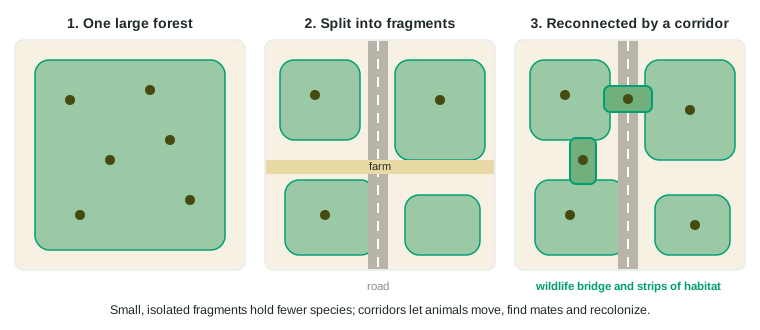
Small, isolated populations lose genetic diversity, cannot find mates, and can be wiped out by one bad year with no way for new animals to arrive. Wildlife corridors reconnect them: strips of forest along streams, overpasses and underpasses on highways. Banff National Park's overpasses are crossed by bears, elk and wolves thousands of times a year, and collisions with large animals on that highway dropped sharply.
A sixth mass extinction?
Five times in Earth's history, a large share of all species died out in a geologically short time: these are the mass extinctions, the most recent about 66 million years ago when the dinosaurs died out. Today species are being lost tens to hundreds of times faster than the slow background rate, mainly because of HIPPCO. Many scientists say this may be the start of a sixth mass extinction, the first caused by a single species.
Calculating habitat loss
Worked example. A rainforest reserve of 2,500 km² loses 4% of its original area to clearing each year for 3 years. How much is cleared in total?
Setup:
Answer: , which is 12% of the reserve.
Read the question carefully: "4% of the original area each year" is the same amount every year (100 km²). If it said "4% of what is left each year", each year's loss would shrink a little.
What helps
- Protect habitat: parks and reserves, as large as possible and connected by corridors.
- Restore habitat: replant forests, restore wetlands, remove dams that block fish.
- Limit overexploitation: catch limits below the maximum sustainable yield, hunting seasons, CITES trade bans.
- Control invaders: ballast water rules, inspections, early removal.
- Cut pollution and emissions: from banning DDT to lowering CO₂.
Writing a solution that scores
Readers look for three things: a specific action, how it works, and a fit to the scenario. For a highway that has split a forest and kills deer and bears: "Build wildlife overpasses with fences that guide animals to them, so deer and bears cross above traffic, which reduces road deaths and reconnects the populations on both sides." If the question asks for a policy, name a rule ("a law setting a catch limit below the maximum sustainable yield"), not a tool.