High above the weather, a thin band of ozone absorbs most of the Sun's ultraviolet light. In the 1970s, chemists warned that ordinary household chemicals could destroy it. In 1985, measurements over Antarctica showed they were right. This page explains what the ozone layer does, how CFCs destroy it, why the damage is worst over Antarctica, and what more ultraviolet light does to living things.
What the ozone layer does
Ozone is a molecule of three oxygen atoms, O3. About 90% of it is in the stratosphere, roughly 15 to 35 km above the surface. There it absorbs most of the Sun's ultraviolet (UV) radiation, especially the harmful UV-B, before it reaches the ground.
The same molecule near the ground is a problem: ground-level ozone in photochemical smog irritates the lungs. "Good up high, bad nearby" is a useful way to remember it. Ozone made in smog does not drift up to repair the stratosphere; it reacts and breaks down within days.
How CFCs destroy ozone
Chlorofluorocarbons (CFCs) are made of chlorine, fluorine and carbon. From the 1930s on they were used in refrigerators, air conditioners, foam and spray cans, because they are stable, nonflammable and nontoxic. That stability is the problem: they do not break down near the ground, so over years they drift up into the stratosphere.
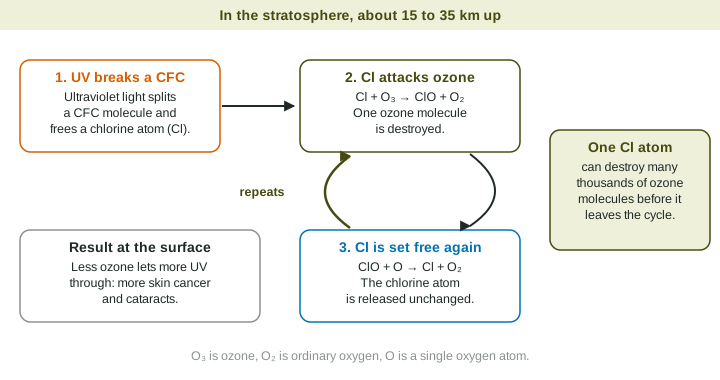
- In the stratosphere, UV light breaks a CFC molecule and frees a chlorine atom (Cl).
- The chlorine atom reacts with ozone: . One ozone molecule is destroyed.
- ClO reacts with a single oxygen atom: . The chlorine atom is free again.
Because the chlorine atom comes out unchanged, it acts as a catalyst. One chlorine atom can destroy many thousands of ozone molecules before it is finally locked away in a stable compound. Halons, used in fire extinguishers, do the same with bromine, and bromine is even more destructive per atom.
Why the hole is over Antarctica
CFCs spread through the whole atmosphere, but the worst loss is over Antarctica in its spring (September to October). In the dark polar winter, the stratosphere there becomes extremely cold, cold enough for polar stratospheric clouds to form. Reactions on these cloud particles turn chlorine into forms that are released as active chlorine as soon as sunlight returns in spring. Ozone then falls rapidly, creating the ozone hole: an area where ozone is far below normal, not a place with no ozone at all. A smaller, more variable thinning happens over the Arctic.
Worked example. Total ozone above a city fell from 300 Dobson units (DU) to 255 DU during a spring thinning event. What was the percent change?
Setup:
Answer: , a 15% decrease. The brackets make the subtraction happen first, and the old value, 300 DU, goes on the bottom.
Effects of more UV
- Skin cancer: UV-B damages the DNA in skin cells. More UV means more skin cancer, including melanoma.
- Cataracts: UV damages the lens of the eye, clouding it.
- Ecosystems: UV-B harms phytoplankton at the ocean surface, the base of marine food webs, and reduces the growth of some crops.
Ozone depletion is not climate warming
These two problems are often mixed up on the exam. Keep them apart:
| Ozone depletion | Climate warming (coming in later topics) | |
|---|---|---|
| Main cause | chlorine and bromine from CFCs and halons | heat-trapping gases such as carbon dioxide and methane |
| Radiation involved | more incoming UV reaches the ground | outgoing heat from the surface is held in |
| Layer | stratosphere | troposphere, the lowest layer |
| Main harm | skin cancer, cataracts, damage to phytoplankton | rising temperatures and sea level |
Carbon dioxide does not destroy ozone. CFCs do both: they destroy ozone and they also trap heat.
Recovery is slow
CFC molecules last 50 to 100 years or more in the atmosphere. Even after production stopped, chlorine already in the stratosphere kept destroying ozone. So the ozone hole stopped growing around 2000, but it is expected to take until about the 2060s to return to 1980 levels. The next topic covers the treaty that made that recovery possible.