Stratospheric Ozone Depletion
The stratospheric ozone layer absorbs most of the Sun’s UV.
Part 1 · Hook
Why this matters
Part 2 · Before you start
What this builds on
Part 3 · Prerequisite check
Quick check before you start
1. In which layer of the atmosphere is the ozone layer?
- Stratosphere
- Troposphere
- Mesosphere
- Thermosphere
Show the answer
The ozone layer is in the stratosphere, above the troposphere where weather happens.
- Correct: Stratosphere:
- Troposphere:
- Mesosphere:
- Thermosphere:
2. What does stratospheric ozone absorb?
- Ultraviolet radiation from the Sun
- Heat given off by the ground
- Visible light from the Sun
- Radio waves
Show the answer
Ozone in the stratosphere absorbs most incoming ultraviolet radiation.
- Correct: Ultraviolet radiation from the Sun:
- Heat given off by the ground:
- Visible light from the Sun:
- Radio waves:
Part 4 · See it
See it first
Part 5 · Step by step
How it works, step by step
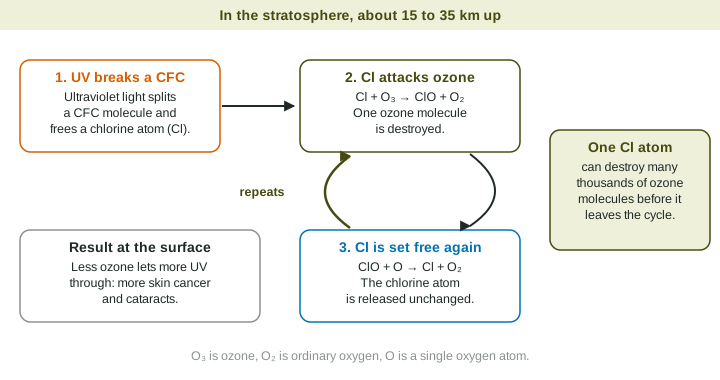
- CFCs from refrigerants, air conditioners and spray cans are stable near the groundthey last long enough to drift up into the stratosphere
- Ultraviolet light in the stratosphere breaks CFC moleculeschlorine atoms are set free
- Each chlorine atom destroys an ozone molecule and is released againone atom can destroy many thousands of ozone molecules
- A thinner ozone layer absorbs less UVmore UV-B reaches the surface, raising skin cancer and cataracts and harming phytoplankton
Part 6 · Key ideas
Key ideas
- Chlorofluorocarbons (CFCs) contain chlorine, fluorine and carbon. They were used in refrigerators, air conditioners, foams and spray cans because they are stable and nontoxic near the ground.
- In the stratosphere, UV frees chlorine; , then . The chlorine is reused.
- Ozone depletion is worst over Antarctica each spring (the ozone hole), where extreme cold forms clouds that speed the reactions.
- More UV-B at the surface means more skin cancer and cataracts and damage to phytoplankton and crops.
Part 7 · Misconception
A common mistake
The wrong idea: Carbon dioxide from burning fossil fuels is what makes the ozone hole.
What actually happens: Carbon dioxide traps heat but does not destroy ozone. The ozone hole is caused by chlorine and bromine from CFCs and halons.
Part 8 · Check yourself
Check yourself
Exam-style questions. Anything you miss goes into your review queue.
1. Which substances are the main cause of stratospheric ozone depletion?
- Carbon dioxide from burning fossil fuels
- CFCs from old refrigerants and spray cans
- Sulfur dioxide from coal-burning power plants
- Methane from cattle and landfills
Show the answer
CFCs, and halons with bromine, are the ozone-depleting substances; their chlorine and bromine destroy ozone in the stratosphere.
- Carbon dioxide from burning fossil fuels: Carbon dioxide traps heat near the surface; it does not destroy stratospheric ozone.
- Correct: CFCs from old refrigerants and spray cans: Right: chlorine released from CFCs destroys ozone.
- Sulfur dioxide from coal-burning power plants: Sulfur dioxide causes acid rain; it is not the cause of the ozone hole.
- Methane from cattle and landfills: Methane traps heat, but it is not the main ozone-depleting substance.
2. Why can one chlorine atom destroy many thousands of ozone molecules?
- Each chlorine atom splits into thousands of smaller atoms
- It absorbs ultraviolet light, which then destroys the ozone
- It traps heat from the ground, which breaks the ozone
- It is released after each cycle and reacts again
Show the answer
In Cl + O₃ → ClO + O₂ and then ClO + O → Cl + O₂, the chlorine comes out unchanged and starts again.
- Each chlorine atom splits into thousands of smaller atoms: Chlorine atoms do not split; the same atom is reused.
- It absorbs ultraviolet light, which then destroys the ozone: Ultraviolet frees chlorine from CFCs; the chlorine reacts with ozone directly.
- It traps heat from the ground, which breaks the ozone: Trapping heat is a separate problem from how chlorine destroys ozone.
- Correct: It is released after each cycle and reacts again: Right: chlorine is a catalyst; it is not used up by the reactions.
Data
Average size of the Antarctic ozone hole, 1980 to 2020
| Year | Mean area (million km²) |
|---|---|
| 1980 | 1.1 |
| 1985 | 12.0 |
| 1990 | 19.5 |
| 1995 | 22.5 |
| 2000 | 24.8 |
| 2005 | 24.6 |
| 2010 | 21.2 |
| 2015 | 23.1 |
| 2020 | 23.5 |
3. Describe the trend in the average size of the ozone hole from 1980 to 2000.
- It shrank steadily, from about 25 to about 1 million km²
- It grew from about 1 to 25 million km²
- It stayed about the same at about 20 million km²
- It grew until 1985, then shrank until 2000
Show the answer
Read the values in order: 1.1 in 1980, then 12.0, 19.5, 22.5 and 24.8 in 2000.
- It shrank steadily, from about 25 to about 1 million km²: The values rise over 1980 to 2000, so the hole grew.
- Correct: It grew from about 1 to 25 million km²: Right: the hole grew more than twentyfold over those 20 years.
- It stayed about the same at about 20 million km²: It was about 1 million km² in 1980, so it did not stay the same.
- It grew until 1985, then shrank until 2000: It kept growing through 2000.
4. By what percent did the average size of the ozone hole change from 1985 to 2000?
Type a number, then its unit (%). Scale words (2.5 million) and powers of ten (2.5 × 10^6) are read.
Show the answer
- Answer: 107 %
5. The hole stopped growing after about 2000, but did not shrink much by 2020. What best explains this?
- CFC production rose sharply after 2000
- Carbon dioxide began to rebuild the ozone layer after 2000
- The ozone hole moved from Antarctica to the Arctic after 2000
- Long-lived CFCs make recovery slow after cuts
Show the answer
The slow response fits long-lived CFCs already in the stratosphere; recovery is expected around the 2060s.
- CFC production rose sharply after 2000: CFC production was being phased out by then.
- Carbon dioxide began to rebuild the ozone layer after 2000: Carbon dioxide does not rebuild ozone.
- The ozone hole moved from Antarctica to the Arctic after 2000: The data track the Antarctic hole each year.
- Correct: Long-lived CFCs make recovery slow after cuts: Right: CFC molecules stay in the air for 50 to 100 years or more, so recovery lags behind the cuts.
6. Why does the ozone hole form over Antarctica each spring?
- Polar clouds activate chlorine; spring sun starts the loss
- Antarctica produces more CFCs than any other continent
- The Antarctic summer sun is strong enough to burn ozone away
- Antarctic ice releases chlorine as it melts each spring
Show the answer
Extreme cold over Antarctica forms polar stratospheric clouds, where chlorine becomes reactive; when sunlight returns in spring, ozone loss is rapid.
- Correct: Polar clouds activate chlorine; spring sun starts the loss: Right: polar stratospheric clouds form in the extreme cold and turn chlorine into active forms; spring sunlight starts the destruction.
- Antarctica produces more CFCs than any other continent: Few CFCs are released in Antarctica; they mix through the whole atmosphere.
- The Antarctic summer sun is strong enough to burn ozone away: The hole forms in spring (September to October), and sunlight alone does not remove ozone.
- Antarctic ice releases chlorine as it melts each spring: The chlorine comes from CFCs, not from ice.
7. Which effects are expected from more UV-B radiation reaching Earth’s surface? Select all that apply.
- More cases of skin cancer
- More cataracts, a clouding of the eye’s lens
- Damage to phytoplankton at the ocean surface
- Faster loss of sea ice in the Arctic Ocean
- A rise in global average air temperature
- More acid rain in the eastern United States
Show the answer
More UV-B harms skin, eyes and some organisms, including phytoplankton; it is not the cause of global warming or acid rain.
- Correct: More cases of skin cancer: Right: UV-B damages DNA in skin cells.
- Correct: More cataracts, a clouding of the eye’s lens: Right: UV-B damages the eye.
- Correct: Damage to phytoplankton at the ocean surface: Right: UV-B harms phytoplankton, the base of ocean food webs.
- Faster loss of sea ice in the Arctic Ocean: Sea ice melts with warming, not because of more UV.
- A rise in global average air temperature: Warming is driven by heat-trapping gases, not by more UV.
- More acid rain in the eastern United States: Acid rain comes from NOx and SOx emissions.
Part 9 · Summary
Summary
Part 10 · Up next
What comes next
Part 11 · Connections