Reducing Ozone Depletion
The Montreal Protocol of 1987 phased out CFCs, halons and other ozone-depleting substances worldwide.
Part 1 · Hook
Why this matters
Part 2 · Before you start
What this builds on
Part 3 · Prerequisite check
Quick check before you start
1. Which chemicals release the chlorine that destroys stratospheric ozone?
- CFCs
- Carbon dioxide
- Sulfur dioxide
- Methane
Show the answer
UV breaks CFCs in the stratosphere and frees chlorine.
- Correct: CFCs:
- Carbon dioxide:
- Sulfur dioxide:
- Methane:
2. Why can one chlorine atom destroy thousands of ozone molecules?
- It is released again after each reaction
- It splits into many atoms
- It absorbs visible light
- It makes more CFCs
Show the answer
Chlorine is a catalyst: it comes out of each cycle unchanged.
- Correct: It is released again after each reaction:
- It splits into many atoms:
- It absorbs visible light:
- It makes more CFCs:
Part 4 · See it
See it first
Part 5 · Step by step
How it works, step by step
- Scientists linked CFCs to ozone loss and found the Antarctic ozone holenations signed the Montreal Protocol in 1987
- The treaty phased out CFCs and halons, with more time and help for developing countriesproduction of ozone-depleting substances fell by more than 99%
- Replacements such as HCFCs, then HFCs and hydrocarbons, took their placefar less chlorine reaches the stratosphere
- Long-lived CFCs already in the air slowly break downozone is recovering and should return to 1980 levels around 2066 over Antarctica
Part 6 · Key ideas
Key ideas
- The Montreal Protocol (1987) is the treaty that phased out CFCs, halons and other ozone-depleting substances. Every UN member has ratified it.
- HCFCs were a temporary replacement: less ozone-depleting, but they still contain chlorine, so they are being phased out too.
- HFCs contain no chlorine and do not harm ozone, but many trap heat thousands of times more strongly than CO₂. The Kigali Amendment (2016) phases them down.
- Other fixes: hydrocarbons such as isobutane, ammonia and CO₂ as refrigerants, and capturing refrigerant from old equipment.
Part 7 · Misconception
A common mistake
The wrong idea: Since CFC production ended in 2010, the ozone hole should already be gone.
What actually happens: CFCs stay in the atmosphere for 50 to 100 years or more, so chlorine already up there keeps destroying ozone. Recovery is under way but should take until about the 2060s over Antarctica.
Part 8 · Check yourself
Check yourself
Exam-style questions. Anything you miss goes into your review queue.
1. What did the Montreal Protocol, signed in 1987, do?
- It phased out CFCs and other ozone-depleting chemicals
- It set limits on carbon dioxide emissions from power plants
- It banned the trade of endangered animals and their parts
- It required cars to use catalytic converters
Show the answer
The Montreal Protocol is an international treaty that phased out the production of CFCs, halons and other ozone-depleting substances.
- Correct: It phased out CFCs and other ozone-depleting chemicals: Right: it is the treaty that ended most production of ozone-depleting chemicals.
- It set limits on carbon dioxide emissions from power plants: Carbon dioxide limits are the subject of climate agreements, not the Montreal Protocol.
- It banned the trade of endangered animals and their parts: That describes a wildlife trade treaty, not the Montreal Protocol.
- It required cars to use catalytic converters: Catalytic converters were required by national air pollution laws, not this treaty.
2. HFCs replaced many CFCs and HCFCs in air conditioners. Which statement describes a drawback of HFCs?
- They destroy ozone faster than the CFCs they replaced
- They do not work as refrigerants in air conditioners
- They spare ozone but trap far more heat than CO₂
- They are banned by the original 1987 Montreal Protocol
Show the answer
Solving one problem created another: HFCs protect ozone but warm the climate, so the 2016 Kigali Amendment phases them down.
- They destroy ozone faster than the CFCs they replaced: HFCs contain no chlorine or bromine, so they do not destroy ozone.
- They do not work as refrigerants in air conditioners: HFCs work well as refrigerants; that is why they spread.
- Correct: They spare ozone but trap far more heat than CO₂: Right: HFCs contain no chlorine, but many are powerful heat-trapping gases.
- They are banned by the original 1987 Montreal Protocol: HFCs were added later, by the Kigali Amendment of 2016.
Model or diagram
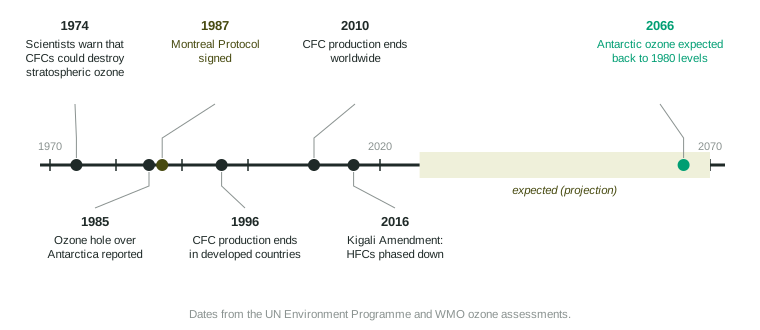
Timeline of ozone depletion and the Montreal Protocol
3. According to the timeline, how many years passed between the Montreal Protocol and the end of CFC production worldwide?
- 9 years
- 36 years
- 79 years
- 23 years
Show the answer
Developed countries stopped by 1996 and developing countries had until 2010: years.
- 9 years: That is the gap from 1987 to 1996, when developed countries ended production.
- 36 years: That is the gap from 1974, the first warning, to 2010.
- 79 years: That is the gap from 1987 to the expected recovery around 2066.
- Correct: 23 years: Right: 2010 − 1987 = 23 years.
4. Why does the timeline show recovery of Antarctic ozone around 2066, decades after CFC production ended?
- CFCs already released last for decades
- Countries are still allowed to make CFCs until 2066
- The ozone layer needs new CFCs to rebuild itself
- UV light will stop reaching the stratosphere in 2066
Show the answer
Recovery lags production cuts because CFCs are long-lived.
- Correct: CFCs already released last for decades: Right: CFCs last 50 to 100 years or more, so their chlorine keeps destroying ozone.
- Countries are still allowed to make CFCs until 2066: Production ended worldwide by 2010.
- The ozone layer needs new CFCs to rebuild itself: CFCs destroy ozone; they do not rebuild it.
- UV light will stop reaching the stratosphere in 2066: UV keeps reaching the stratosphere; that is how ozone forms.
5. Scientists first warned about CFCs in 1974, and Antarctic ozone is expected back to 1980 levels around 2066. How many years separate the warning and the expected recovery?
Type a number, then its unit (yr). Scale words (2.5 million) and powers of ten (2.5 × 10^6) are read.
Show the answer
years: almost a century from warning to recovery.
- Answer: 92 yr
6. What does the timeline suggest about why the Montreal Protocol is seen as a success?
- Ozone recovered fully within a year of the treaty
- CFCs were found to be harmless after the treaty
- Quick action, and ozone is on track to recover
- The treaty was signed before anyone had measured ozone loss
Show the answer
From the 1974 warning to the 1987 treaty took 13 years; with every UN member taking part, ozone-depleting substances fell sharply and recovery is under way.
- Ozone recovered fully within a year of the treaty: Recovery is expected to take until about 2066.
- CFCs were found to be harmless after the treaty: CFCs do destroy ozone; that is why they were phased out.
- Correct: Quick action, and ozone is on track to recover: Right: quick, worldwide action, then measured recovery.
- The treaty was signed before anyone had measured ozone loss: The ozone hole was reported in 1985, two years before the treaty.
7. A country used 120,000 metric tons of CFCs a year before the Montreal Protocol and 6,000 metric tons a year a decade later. Write the setup for the percent change, then the answer.
Type the setup as on the exam, with brackets and units, then the answer.
Show the answer
- Setup: ; answer -95 %
Part 9 · Summary
Summary
Part 10 · Up next
What comes next
Part 11 · Connections