The Greenhouse Effect
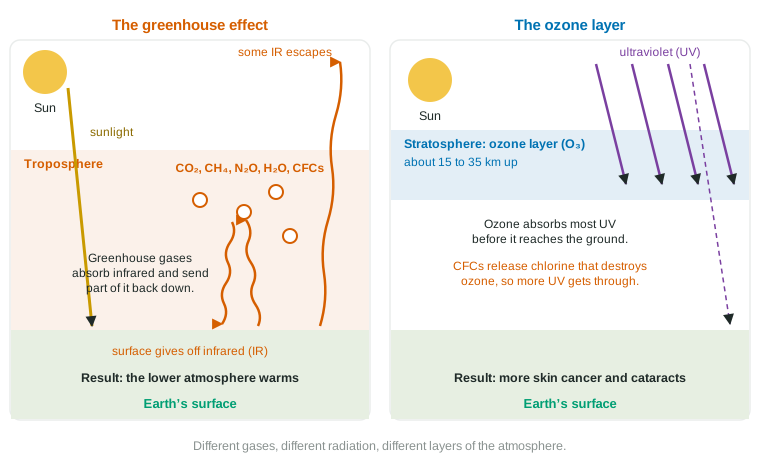
Sunlight warms the surface, which gives off infrared; greenhouse gases (water vapor, CO₂, methane, nitrous oxide, CFCs) absorb it and send part back down, keeping Earth about 33 °C warmer.
Part 1 · Hook
Why this matters
Part 2 · Before you start
What this builds on
Part 3 · Prerequisite check
Quick check before you start
1. What does the stratospheric ozone layer absorb?
- Ultraviolet radiation from the Sun
- Heat given off by the ground
- Visible light
- Radio waves
Show the answer
The ozone layer absorbs incoming UV; it is a different process from the one in this topic.
- Correct: Ultraviolet radiation from the Sun:
- Heat given off by the ground:
- Visible light:
- Radio waves:
2. Which gas is released when fossil fuels are burned?
- Carbon dioxide
- Oxygen
- Nitrogen
- Ozone
Show the answer
Burning fossil fuels combines their carbon with oxygen, releasing CO₂.
- Correct: Carbon dioxide:
- Oxygen:
- Nitrogen:
- Ozone:
Part 4 · See it
See it first
Part 5 · Step by step
How it works, step by step
- Sunlight, mostly visible light, passes through the airit warms Earth’s surface
- The warm surface gives off infrared radiationgreenhouse gases in the troposphere absorb much of it
- The gases re-emit that energy in all directions, part of it back downthe lower atmosphere and surface stay warmer than they would be
- Adding more greenhouse gasestraps more heat, strengthening the effect and raising temperatures
Part 6 · Key ideas
Key ideas
- The greenhouse effect: greenhouse gases absorb infrared radiation given off by the surface and re-emit part of it downward, warming the lower atmosphere.
- Greenhouse gases: water vapor (most abundant), carbon dioxide, methane, nitrous oxide (N₂O) and CFCs and HFCs. SO₂ and particulates are not greenhouse gases.
- Global warming potential (GWP) compares the heat trapped by a gas with the same mass of CO₂ over 100 years: CO₂ 1; methane roughly 25 to 30 (the IPCC value depends on the report); N₂O roughly 265 to 300; CFCs thousands. A calculation question gives you the GWP to use.
- The natural greenhouse effect keeps Earth about 33 °C warmer than it would be. Ozone depletion is a separate problem: UV and the stratosphere.
Part 7 · Misconception
A common mistake
The wrong idea: The ozone hole lets heat in, and that is the cause of global warming.
What actually happens: The ozone hole lets in more UV, which raises skin cancer. Warming comes from greenhouse gases trapping outgoing infrared in the lower atmosphere. CFCs are the one link: they do both.
Part 8 · Check yourself
Check yourself
Exam-style questions. Anything you miss goes into your review queue.
1. Which statement describes the greenhouse effect?
- Low-level gases absorb infrared from the surface
- Ozone in the stratosphere absorbs ultraviolet light from the Sun
- Chlorine from CFCs destroys ozone and lets more UV reach the ground
- Clouds reflect sunlight back to space and cool the planet
Show the answer
The greenhouse effect: sunlight warms the surface, the surface gives off infrared, and greenhouse gases absorb and re-emit it, warming the lower atmosphere.
- Correct: Low-level gases absorb infrared from the surface: Right: greenhouse gases absorb outgoing infrared and send part of it back down.
- Ozone in the stratosphere absorbs ultraviolet light from the Sun: That is the ozone layer’s job, a different process in a different layer.
- Chlorine from CFCs destroys ozone and lets more UV reach the ground: That is ozone depletion, not the greenhouse effect.
- Clouds reflect sunlight back to space and cool the planet: Reflecting sunlight is part of albedo; the greenhouse effect traps outgoing infrared.
2. Which gas is NOT a greenhouse gas?
- Methane (CH₄)
- Nitrous oxide (N₂O)
- Sulfur dioxide (SO₂)
- Water vapor (H₂O)
Show the answer
The main greenhouse gases are water vapor, carbon dioxide, methane, nitrous oxide and CFCs. SO₂ and particulates are not greenhouse gases.
- Methane (CH₄): Methane absorbs infrared strongly; it is a greenhouse gas.
- Nitrous oxide (N₂O): Nitrous oxide is a long-lived greenhouse gas.
- Correct: Sulfur dioxide (SO₂): Right: sulfur dioxide causes acid rain and forms particles that reflect sunlight; it is not a greenhouse gas.
- Water vapor (H₂O): Water vapor is the most abundant greenhouse gas.
Model or diagram
The greenhouse effect and the ozone layer side by side
3. In the left panel, what kind of radiation do greenhouse gases absorb?
- Infrared given off by Earth’s surface
- Ultraviolet coming in from the Sun
- Visible light coming in from the Sun
- Radio waves from space
Show the answer
Incoming sunlight is mostly visible light; outgoing radiation from the surface is infrared.
- Correct: Infrared given off by Earth’s surface: Right: the warm surface gives off infrared, which the gases absorb.
- Ultraviolet coming in from the Sun: UV is absorbed by ozone in the stratosphere (right panel).
- Visible light coming in from the Sun: Most visible light passes through the atmosphere and warms the surface.
- Radio waves from space: Radio waves are not part of either process in the figure.
4. According to the figure, which statement correctly contrasts the two processes?
- Both processes take place in the stratosphere
- Gases warm low air; ozone blocks UV high up
- Both processes involve ultraviolet light from the Sun
- Ozone traps infrared, and greenhouse gases absorb UV
Show the answer
Two separate stories: infrared and the troposphere for warming, UV and the stratosphere for the ozone layer.
- Both processes take place in the stratosphere: The greenhouse effect warms the troposphere, the lowest layer.
- Correct: Gases warm low air; ozone blocks UV high up: Right: different gases, radiation and layers.
- Both processes involve ultraviolet light from the Sun: The greenhouse effect involves outgoing infrared.
- Ozone traps infrared, and greenhouse gases absorb UV: This swaps the two: ozone absorbs UV; greenhouse gases absorb infrared.
5. A student says, "The ozone hole lets more heat in, and that is what causes global warming." Using the figure, why is this wrong?
- The ozone hole makes Earth colder, which cancels global warming
- Global warming is caused by UV, so the student is right
- The hole admits UV; warming is trapped infrared
- The ozone hole is over the equator, where there is no warming
Show the answer
Ozone depletion raises UV at the surface; the greenhouse effect traps infrared. Mixing them up is a common exam error.
- The ozone hole makes Earth colder, which cancels global warming: Ozone loss is not a main cause of cooling or warming.
- Global warming is caused by UV, so the student is right: Warming is from trapped infrared, not UV.
- Correct: The hole admits UV; warming is trapped infrared: Right: they involve different radiation and different gases.
- The ozone hole is over the equator, where there is no warming: The ozone hole is over Antarctica, and warming is global.
Data
Global warming potential of five greenhouse gases
| Gas | Global warming potential (100 years) | Lifetime in the air (years) |
|---|---|---|
| Carbon dioxide (CO₂) | 1 | no single value: centuries to millennia |
| Methane (CH₄) | 28 | 12.4 |
| Nitrous oxide (N₂O) | 265 | 121 |
| HFC-134a | 1,300 | 13.4 |
| CFC-12 | 10,200 | 100 |
6. A landfill releases 2.0 metric tons of methane in a year. Use the global warming potential of methane in the table, 28. What is this release in metric tons of carbon dioxide equivalent (the mass of CO₂ that would trap the same heat over 100 years)?
Type a number, then its unit (metric tons). Scale words (2.5 million) and powers of ten (2.5 × 10^6) are read.
Show the answer
metric tons of CO₂ equivalent.
- Answer: 56 metric tons
7. A farm’s fertilized fields release 0.40 metric tons of nitrous oxide in a year. Use the global warming potential of nitrous oxide in the table, 265. Write the setup for the carbon dioxide equivalent, then give the answer in metric tons.
Type the setup as on the exam, with brackets and units, then the answer.
Show the answer
metric tons of CO₂ equivalent.
- Setup: ; answer 106 metric tons
Part 9 · Summary
Summary
Part 10 · Up next
What comes next
Part 11 · Connections