Earth's average surface temperature is about 15 °C. Without the gases in its atmosphere that trap heat, it would be about −18 °C, frozen almost everywhere. That warming is the greenhouse effect, and it is natural and necessary. The problem in the news is that people are making it stronger. This page explains how the greenhouse effect works, which gases cause it, how to compare them, and how it differs from ozone depletion.
How the greenhouse effect works
- Sunlight comes in. Most of the Sun's energy arrives as visible light, which passes through the atmosphere and warms the ground and oceans.
- The surface gives off infrared. Any warm object gives off energy. Earth's surface, much cooler than the Sun, gives it off as infrared radiation (IR), which we feel as heat.
- Greenhouse gases absorb it. Certain gases in the troposphere absorb much of that outgoing infrared.
- They re-emit it in all directions. Part goes back down to the surface. Less heat escapes to space, so the surface and lower air stay warmer.
The name comes from a greenhouse, which lets light in and keeps warm air from escaping, though the atmosphere works differently from glass. A better picture is a blanket: it does not make heat, it slows how fast heat leaves.
The greenhouse gases
A gas is a greenhouse gas if its molecules absorb infrared. Nitrogen (N₂) and oxygen (O₂), 99% of dry air, barely do. Molecules with three or more atoms do.
- Water vapor: the most abundant greenhouse gas and the largest part of the natural effect. How much the air holds depends on temperature, so it amplifies warming started by other gases.
- Carbon dioxide (CO₂): from burning fossil fuels, deforestation and cement making. The largest cause of human-made warming.
- Methane (CH₄): from cattle, rice paddies, landfills and leaks from natural gas systems.
- Nitrous oxide (N₂O): mostly from fertilized soils and manure; it lasts over a century in the air.
- CFCs and HFCs: human-made, released in small amounts but very powerful per molecule.
Not greenhouse gases: sulfur dioxide and particulates (they cause acid rain and smog, and many particles reflect sunlight, which cools), and nitrogen and oxygen.
Global warming potential
Gases differ in how much heat they trap. Global warming potential (GWP) compares the heat a mass of gas traps over 100 years with the same mass of CO₂.
| Gas | GWP (100 years) | Lifetime in the air |
|---|---|---|
| Carbon dioxide | 1 (the reference) | centuries to millennia |
| Methane | 28 | about 12 years |
| Nitrous oxide | 265 | about 120 years |
| CFC-12 | 10,200 | about 100 years |
Values are from the IPCC Fifth Assessment Report (2013). Each IPCC report updates them a little: methane is 25 in the 2007 report, 28 in 2013 and about 27 to 30 in 2021, so methane traps roughly 25 to 30 times as much heat as CO₂ over 100 years, and nitrous oxide roughly 265 to 300 times. You do not need to memorize one value: a question that asks for a CO₂ equivalent gives you the GWP to use.
Worked example. A landfill releases 2.0 metric tons of methane in a year. Using a GWP of 28 for methane, what is that in metric tons of CO₂ equivalent?
Setup:
Answer: metric tons of CO₂ equivalent. Each ton of methane traps as much heat over 100 years as 28 tons of CO₂.
Why, then, is CO₂ the biggest concern? Because people release so much of it: tens of billions of metric tons each year. Total effect is the amount released times its potential.
The greenhouse effect is not the ozone layer
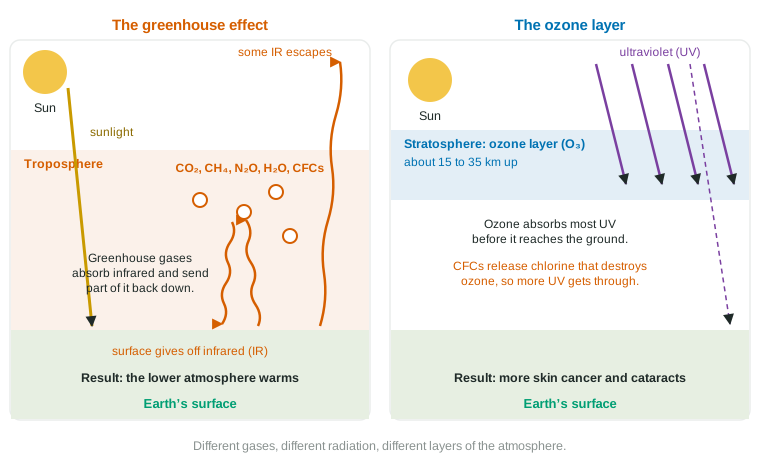
| Greenhouse effect | Ozone layer and its depletion | |
|---|---|---|
| Radiation | outgoing infrared from the surface | incoming ultraviolet from the Sun |
| Layer | troposphere | stratosphere |
| Key gases | water vapor, CO₂, methane, N₂O, CFCs | ozone, destroyed by chlorine from CFCs |
| Human effect | more gases, more warming | thinner ozone, more UV, more skin cancer |
CFCs are the only overlap: they trap infrared and they destroy ozone. Carbon dioxide traps heat but does not destroy ozone, and the ozone hole does not cause global warming.