Savers can buy bonds, stocks and bank deposits in other countries almost as easily as at home. So when one country starts paying savers more, money moves. This topic ties together three graphs you already know: the loanable funds market sets the real interest rate, the foreign exchange market sets the value of the currency, and the AD-AS model shows what happens to output when net exports change. The thread through all three is international capital flows.
Savers chase the real return
A saver choosing between a bond in Arland and one in Belvia (both invented countries) compares what each pays after inflation: the real interest rate, the nominal rate minus expected inflation. If Arland's real rate rises relative to Belvia's, savers in both countries move funds toward Arland. Money coming into a country to buy its assets is a capital inflow; money leaving to buy assets abroad is a capital outflow.
Compare real, not nominal. Arland bonds pay 7% with expected inflation of 4%. Belvian bonds pay 5% with expected inflation of 1%. Where do funds tend to go?
- Arland's real rate: percent.
- Belvia's real rate: percent.
- Compare: Belvia pays the higher real return, so financial capital tends to flow toward Belvia, even though Arland's nominal rate is higher.
A country whose nominal rate rises only because expected inflation rose offers savers nothing extra, so it draws no extra capital.
The full chain, link by link
Suppose Arland's government borrows more to pay for a budget deficit, and nothing changes in Belvia.
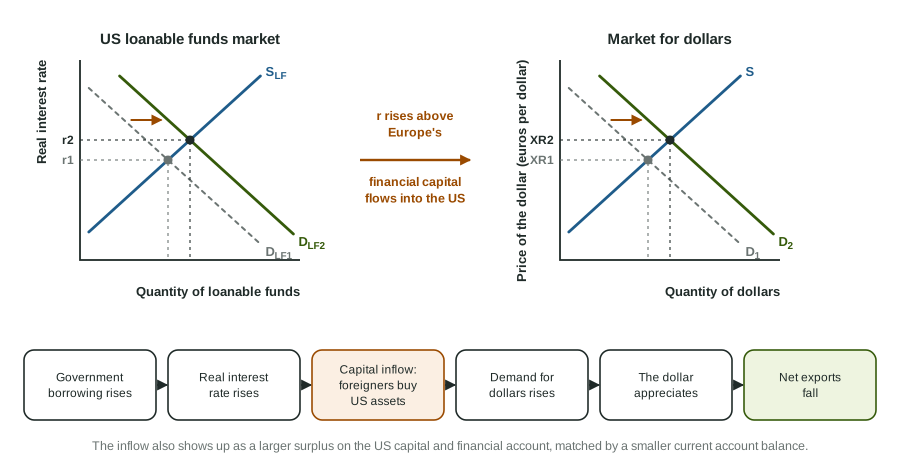
- Loanable funds: government borrowing shifts the demand for loanable funds right, so Arland's real interest rate rises.
- Capital flows: Arland's real rate is now above Belvia's, so Belvian savers buy Arland bonds: a capital inflow into Arland, a credit in its capital and financial account.
- Currency market: to buy Arland bonds, Belvian savers need arls, so the demand for arls shifts right (on a graph priced in bels per arl), and the arl appreciates. In the market for bels, the supply of bels shifts right and the bel depreciates.
- Net exports: the stronger arl makes Arland goods dearer for Belvians and Belvian goods cheaper for Arland, so Arland's net exports fall, and AD in Arland shifts left, other things equal.
- The accounts: the capital and financial account balance rose, and the current account balance fell by the same amount. The two still sum to zero.
| Arland's real interest rate, relative to Belvia's | Rises | Falls |
|---|---|---|
| Financial capital | Flows into Arland | Flows out of Arland |
| Arland's capital and financial account balance | Rises | Falls |
| Demand for arls | Rises (and supply may fall) | Falls (and supply may rise) |
| The arl | Appreciates | Depreciates |
| Arland's net exports and current account balance | Fall | Rise |
Back to loanable funds
The inflow does not stop at the currency market. Once Belvian savings are changed into arls, they are lent in Arland, so the supply of loanable funds in Arland shifts right. That holds down the rise in Arland's real interest rate, and so it softens the crowding out of private investment that government borrowing would cause in a closed economy. In Belvia, savings leave, the supply of loanable funds shifts left, and Belvia's real rate rises. The flows narrow the gap between the two countries' real rates.
Policy through this channel
Monetary policy works through the same chain. With ample reserves, a central bank that lowers its administered rates (the interest rate it pays on reserve balances) lowers interest rates at home; with expected inflation unchanged, real rates fall relative to other countries'. Financial capital flows out, the currency depreciates, and net exports rise, adding to the rise in AD from cheaper borrowing at home. Contractionary policy runs the other way. With limited reserves, the tools are open market operations, but the open-economy links are the same once interest rates move.
Where points are lost. Readers report students who do not explain that higher real interest rates draw financial capital in (a capital and financial account surplus), who treat the capital and financial account as unrelated to the current account, and who confuse a government budget deficit with a trade or capital and financial account deficit. On a long free-response question, write each link: real rate, capital flow, demand for the currency, appreciation, net exports.