Every country with its own currency has to answer a question each time its residents trade with the rest of the world: how much of our money is one unit of theirs worth? A US company paying a supplier in Japan needs yen, a family from Mexico visiting Canada needs Canadian dollars, and a student from Chicago renting a room in Madrid needs euros. The answer to that question is a price, and it has a name.
An exchange rate is a price
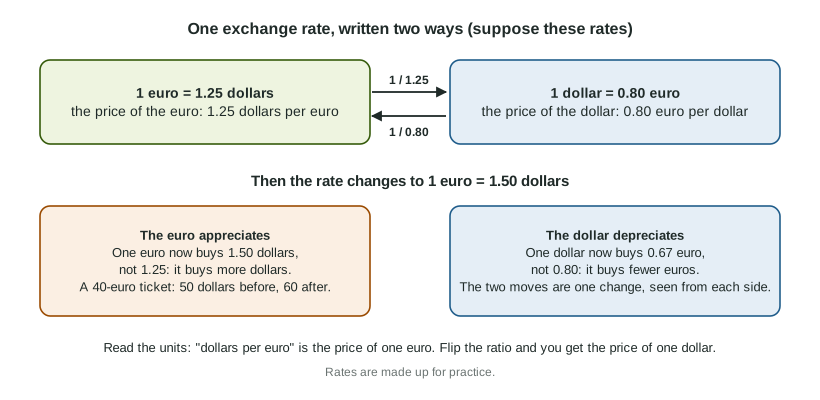
An exchange rate is the price of one currency in units of another. "1 euro = 1.25 dollars" says that one euro costs 1.25 dollars, so its units are dollars per euro. Read it the way you read any price: a coffee at 3 dollars per cup is the price of a cup; 1.25 dollars per euro is the price of a euro.
Every exchange rate can be written two ways, and the two are reciprocals. If one euro costs 1.25 dollars, then one dollar costs
euro per dollar.
Both lines describe the same rate. The first is the price of the euro (in dollars); the second is the price of the dollar (in euros). The rates in these notes are made up for practice; real rates change every day.
Converting a price
To turn a price in one currency into another, multiply by the rate whose units cancel. A price in euros times dollars per euro gives dollars, because "euros" cancels:
Convert both ways. Suppose 1 dollar trades for 0.80 euro. A hostel in Madrid costs 32 euros a night, and a T-shirt in a Chicago shop costs 20 dollars.
- Check the units. The rate is euros per dollar: the price of one dollar.
- The T-shirt for a visitor from Spain: dollars times euros per dollar gives euros: euros.
- The hostel for the student from Chicago: she needs dollars per euro, so flip the rate: dollars per euro. Then dollars a night.
- Check: dividing gives the same answer, , because dividing by euros per dollar is multiplying by dollars per euro.
The common slip is to multiply when you should divide. Writing the units next to every number catches it every time.
Appreciation and depreciation
Exchange rates move. Suppose the price of a euro rises from 1.25 dollars to 1.50 dollars. Each euro now buys more dollars: the euro has appreciated. Each dollar now buys fewer euros, about 0.67 instead of 0.80: the dollar has depreciated. These are not two events. They are one change in one price, seen from the two sides.
| The price of a euro goes from 1.25 to 1.50 dollars | The euro | The dollar |
|---|---|---|
| What one unit buys | More dollars (1.50 instead of 1.25) | Fewer euros (0.67 instead of 0.80) |
| Its value | Appreciates | Depreciates |
| Goods priced in it, for the other side | A 40-euro ticket costs 60 dollars, up from 50 | A 20-dollar shirt costs about 13.33 euros, down from 16 |
So a stronger euro makes European goods dearer for Americans and American goods cheaper for Europeans. Who gains? An American firm selling goods priced in euros (each euro it earns is worth more dollars), and a European traveling in the United States. Who loses? The student from Chicago with her rent in euros, and an American firm buying European parts priced in euros.
Read the units first. Students lose points by assuming that a bigger number always means a stronger currency. In "dollars per euro", a bigger number means the euro appreciated. In "euros per dollar", a bigger number means the dollar appreciated. Before you say which currency gained, find the currency the rate is "per": a higher price of one unit of it means it appreciated, and the other currency depreciated.
Where the rate comes from
For most major currencies, no one sets the rate by decree. It is a price set by the buyers and sellers of currencies, like the price of any good, and it changes when what they want to buy and sell changes. The next topic draws that market as a supply and demand graph, with the exchange rate on the vertical axis written exactly as these notes taught: the price of one currency in units of the other.