Your town owns one empty lot downtown. Residents want a park, store owners want a parking garage, and a grocery chain offers to lease it for a new store. Each group has a good case, and there is one lot. No amount of arguing makes the lot big enough for all three. That ordinary problem, more wants than resources, is the starting point of all of economics.
Scarcity: unlimited wants, limited resources
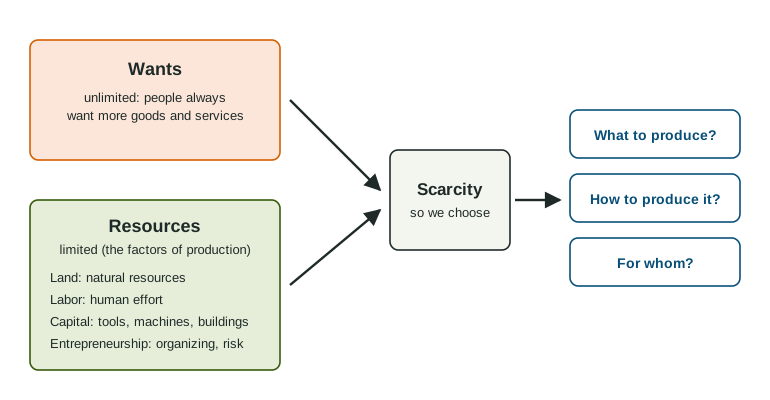
Scarcity means that people's wants are greater than the resources available to satisfy them. It is not the same as being poor. A billionaire still has 24 hours in a day and must choose how to spend them; a wealthy country still has a fixed amount of land, workers and machines this year. As long as wants keep growing, and they do, scarcity never goes away.
Because resources are scarce, every person, business and government has to choose, and every choice is a trade-off: using a resource one way means not using it another way. A city that spends this year's budget on a new bridge repairs fewer schools. A student who spends Saturday working a shift does not spend it studying.
Scarcity is not a sold-out shelf. When a store runs out of a popular game, that is a temporary gap between what buyers want and what sellers offer at the current price, which economists call a shortage (Topic 1.6). A higher price or a new shipment can end a shortage. Scarcity is permanent: it is the reason prices exist at all.
The four factors of production
Economists sort the resources that make goods and services into four groups, the factors of production:
| Factor | What it is | Examples |
|---|---|---|
| Land | natural resources, as found in nature | the ground, water, oil and natural gas still in the earth, forests |
| Labor | human effort, physical and mental | a construction crew, a nurse's shift, a programmer's work |
| Capital | made tools, machines and buildings used to produce other goods | cranes, delivery vans, factory robots, office buildings |
| Entrepreneurship | organizing the other factors and taking the risk of a new venture | a developer who risks her savings to build a garage |
One word causes trouble: capital. In everyday speech it often means money, but in economics it means made tools, machines and buildings. Money is not a factor of production. It buys factors of production, but a pile of cash makes nothing by itself.
Worked example: sort the resources. Riverton's garage plan needs the lot, a crew of 40 construction workers, two cranes and a fleet of dump trucks, and a developer who puts up her own savings to run the project.
- The lot is a natural resource: land.
- The 40 workers supply human effort: labor.
- The cranes and trucks are made goods used to build something else: capital.
- The developer organizes the project and bears the risk: entrepreneurship. Her savings are not the factor; her decision to risk them and run the project is.
The things resources produce are goods (physical items, such as bread or a car) and services (actions done for someone, such as a haircut or a lesson).
Three questions every society answers
Scarcity forces every society to answer three questions: what to produce (and how much), how to produce it (which mix of factors), and for whom (who gets the output). The way a society answers them is its economic system.
| Market economy | Command economy | Mixed economy | |
|---|---|---|---|
| Who decides | households and firms, buying and selling | government planners | mostly households and firms, with some government roles |
| Who owns most businesses | private owners | the government | mostly private owners |
| For whom | buyers willing and able to pay market prices | whoever the plan assigns | mostly by markets, with some public services such as schools |
Pure market and pure command economies are the two ends of a range. Every real economy sits somewhere between them, relying mainly on markets while government provides some goods (roads, schools, national defense) and sets rules. That is why most real economies are called mixed. This course studies how a mostly market economy behaves as a whole: its total output, its prices, its jobs and the policies that affect them.
Why this matters for the rest of the course
Every model you will learn is a way of tracing trade-offs. The next topic puts a whole economy's trade-off on a graph and gives it a number, the cost of one choice measured in the other choice given up. Later, the same logic explains why a country cannot produce more of everything at once unless it gains resources or better technology.