A surgeon types faster than anyone in her office, yet she pays an assistant to type her notes. She is not being lazy. Every hour she spends typing is an hour of surgery she does not do, and that hour of surgery is worth far more than the assistant's wage. People, firms and countries trade for the same reason, even when one of them is better at making everything.
Absolute and comparative advantage
A producer has an absolute advantage in a good if it can make more of it with the same resources (or the same amount with fewer resources). The surgeon has the absolute advantage in typing. A producer has a comparative advantage in a good if it can make it at a lower opportunity cost. The assistant has the comparative advantage in typing, because an hour of typing costs the assistant much less than it costs the surgeon.
A country can have the absolute advantage in both of two goods, but it cannot have the comparative advantage in both. The opportunity cost of one good is the reciprocal of the opportunity cost of the other, so a lower cost of one means a higher cost of the other.
Reading output data
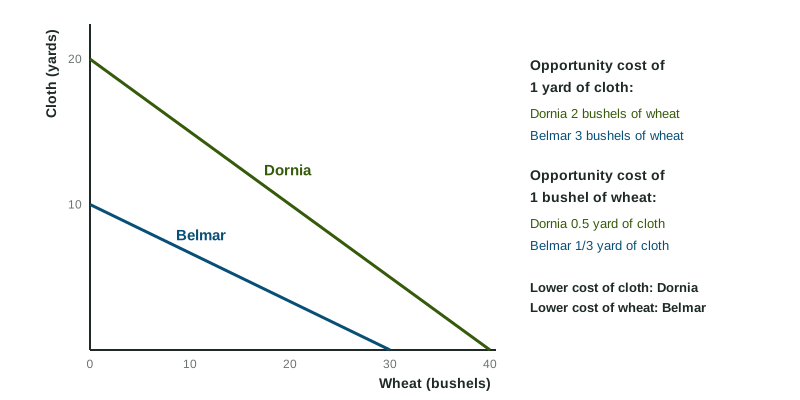
Output data (the output method) tell you how many units one worker, or one country, can make. The cost of one unit of a good is the other good's output divided by its own output.
Worked example: output data. One Dornia worker makes 40 bushels of wheat or 20 yards of cloth a day; one Belmar worker makes 30 bushels of wheat or 10 yards of cloth.
- Absolute advantage. Dornia makes more of both (40 > 30, 20 > 10), so Dornia has the absolute advantage in both goods.
- Opportunity cost of 1 yard of cloth. Dornia: bushels of wheat. Belmar: bushels.
- Opportunity cost of 1 bushel of wheat. Dornia: yard of cloth. Belmar: , a third of a yard.
- Comparative advantage. Dornia has the lower cost of cloth (2 < 3 bushels); Belmar has the lower cost of wheat (a third < a half yard). Dornia specializes in cloth, Belmar in wheat.
Reading input data
Input data (the input method) tell you how many hours, or workers, it takes to make one unit. Now the absolute advantage goes to whoever needs fewer hours, and the cost of one unit of a good is its own hours divided by the other good's hours.
Worked example: input data. Ellis needs 2 hours to make a table and 1 hour to make a chair; Fenwick needs 6 hours per table and 2 hours per chair.
- Absolute advantage. Ellis needs fewer hours for both, so Ellis has the absolute advantage in both.
- Opportunity cost of a table. Ellis: the 2 hours could make chairs. Fenwick: chairs. Ellis has the comparative advantage in tables.
- Opportunity cost of a chair. Ellis: of a table. Fenwick: , a third of a table. Fenwick has the comparative advantage in chairs.
| Output data (units per worker) | Input data (hours per unit) | |
|---|---|---|
| Absolute advantage | the larger number | the smaller number |
| Cost of 1 unit of X, in Y | Y's output divided by X's output | X's hours divided by Y's hours |
Both methods give the same comparative advantage when read correctly. The common slip is to divide input data the way you divide output data, which flips every answer.
Specialization, terms of trade and the gains
When each country specializes in the good it makes at the lower opportunity cost and trades for the other, their combined output of both goods rises. The terms of trade are the rate at which they swap, such as 1 yard of cloth for 2.5 bushels of wheat. Terms that help both sides lie between the two opportunity costs: Dornia makes cloth at a cost of 2 bushels, so it gains by selling a yard for more than 2; Belmar would pay 3 bushels to make a yard itself, so it gains by buying one for less than 3. Any price between 2 and 3 bushels per yard leaves both better off.
The gains from trade show up on the PPC: after specializing and trading, each country can consume a combination outside its own PPC, something it could never reach alone. Trade does not shift either country's PPC, because it does not change their resources or technology; it changes what they can consume.