Money is the most liquid financial asset, but what makes something money? Not what it is made of. People have used shells, salt, cigarettes and gold. Something is money when it does three jobs, and economists measure how much of it there is in two standard ways, M1 and M2.
Why money exists: the trouble with barter
Without money, people barter: they trade goods directly for goods. Barter needs a double coincidence of wants. A plumber who wants shoes has to find a shoemaker who happens to need a plumber, at the same time and in the right amounts. Money removes that problem. The plumber sells plumbing to anyone for money and buys shoes from anyone with it. Trade becomes cheaper, so people can specialize more.
The three functions of money
| Function | What it means | Example |
|---|---|---|
| Medium of exchange | Accepted in payment for goods and services | Paying for lunch with a debit card drawn on your checking account |
| Unit of account | The yardstick for stating and comparing prices | A menu that lists every price in dollars |
| Store of value | Holds buying power from today into the future | Keeping $100 in a drawer to spend next month |
Money is not the best store of value: it pays little or no interest, and inflation erodes it. Its advantage is liquidity. When inflation is very high, money loses its store-of-value function first, because cash held for a few months buys much less. People then spend it as fast as they can.
Commodity money and fiat money
Commodity money has value as a good in its own right: gold, silver, salt. Modern money is fiat money: paper and coins (and bank balances) that have value because the government declares them legal tender and people trust that others will accept them. A dollar bill costs a few cents to print. What keeps it valuable is that people accept it and that its quantity is kept limited.
Measuring money: M1 and M2
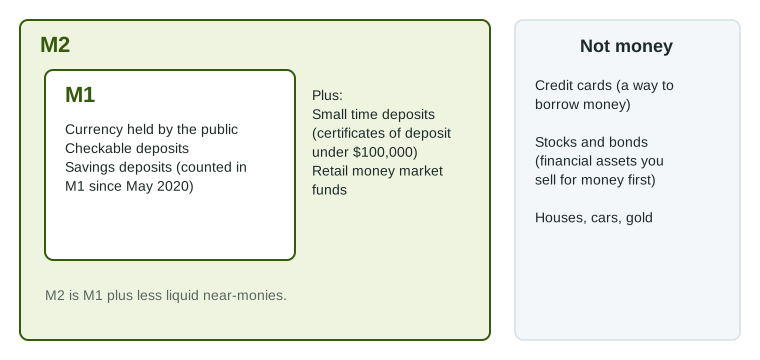
The money supply measures group assets by liquidity.
- M1, the most spendable money: currency held by the public (not cash sitting in bank vaults), checkable deposits, and other deposits that can be withdrawn at once. U.S. official statistics have counted savings deposits in M1 since May 2020; many textbooks, written earlier, place them in M2 only.
- M2: all of M1 plus near-money that is a little harder to spend, mainly small time deposits (certificates of deposit under $100,000) and retail money market funds.
What is not money: a credit card (paying with one is borrowing from the card issuer; the money is what pays the bill), stocks and bonds (they must be sold for money first), and houses, cars or gold jewelry. A debit card is not money either, but the checkable deposit it draws on is.
Worked example: M1 and M2 from a table. The public in an invented country holds $300 billion in currency, $500 billion in checkable deposits, $200 billion in small time deposits, $150 billion in retail money market funds, $2,000 billion in stock and $400 billion of unused credit card limits.
- M1 = currency + checkable deposits = $300 + $500 = $800 billion.
- M2 = M1 + small time deposits + retail money market funds = $800 + $200 + $150 = $1,150 billion.
- Left out: the stock and the credit limits. Neither is money.
The method: sort each item into M1, the extra part of M2, or not money at all, then add.
Moving money between categories can change one measure and not the other. Depositing cash into checking swaps currency for a checkable deposit, so M1 does not change. Moving money from checking into a certificate of deposit lowers M1, but M2 does not change, because the money stays inside M2.
A common slip is to call a credit card money, or to count stocks in M2. A credit card is a loan; stocks are financial assets that must be sold before they can be spent.
For your exam
- Name the function from the example: paying is a medium of exchange, pricing is a unit of account, saving is a store of value.
- M1 is currency held by the public plus checkable deposits (and other deposits you can withdraw at once); M2 adds small time deposits and retail money market funds.
- Cash deposited into checking leaves M1 unchanged at first; the next topic shows how bank lending then creates new money.