Monetary policy is the most-missed topic on the exam, and almost always for one reason: answering an ample-reserves question with limited-reserves tools, or the reverse. This page teaches both, side by side, and the one sentence to write first in every answer: which framework the question sets.
What monetary policy is for
Monetary policy is the central bank changing interest rates to shift aggregate demand. The Federal Reserve aims for stable prices and maximum employment. In a recessionary gap it uses expansionary monetary policy: lower interest rates. In an inflationary gap it uses contractionary monetary policy: higher interest rates. The rate it targets is its policy rate, for the Federal Reserve the federal funds rate: the rate banks charge each other for overnight loans of reserves.
Limited reserves: change the money supply
With limited reserves, banks hold few reserves beyond what is required, so the amount of reserves controls how much banks can lend and so the money supply. The central bank has three tools, and you show each on the money market graph as a shift of the vertical money supply.
- Open market operations: buying government bonds pays banks (or the public) with new reserves, so banks can lend more and MS shifts right; the nominal interest rate falls. Selling bonds drains reserves: MS shifts left and the rate rises.
- The discount rate: the rate the central bank charges banks for loans of reserves. Lowering it makes borrowing reserves cheaper, so MS rises; raising it does the reverse.
- The reserve requirement: lowering the required reserve ratio raises the money multiplier, so MS rises; raising it lowers MS.
Worked example: an open market purchase (limited reserves). The central bank buys $20 million of bonds from banks. The required reserve ratio is 0.2.
- Reserves: banks gain $20 million of reserves and no new deposits, so all $20 million is excess.
- Money multiplier: 1 / 0.2 = 5.
- Most the money supply can grow: $20 million x 5 = $100 million.
- Graph: on the money market, MS shifts right and the nominal interest rate falls from i1 to i2.
If the bonds were bought from the public instead, the sellers' $20 million of new deposits is money at once, and banks can lend the $16 million of excess reserves for $80 million more: the same $100 million at most.
Ample reserves: set the administered rates
Since the 2008 financial crisis, the Federal Reserve has supplied so many reserves that banks hold far more than any requirement (the reserve requirement has been zero since March 2020). This is the ample-reserves framework, how the Federal Reserve sets rates now. Its graph is the reserve market.
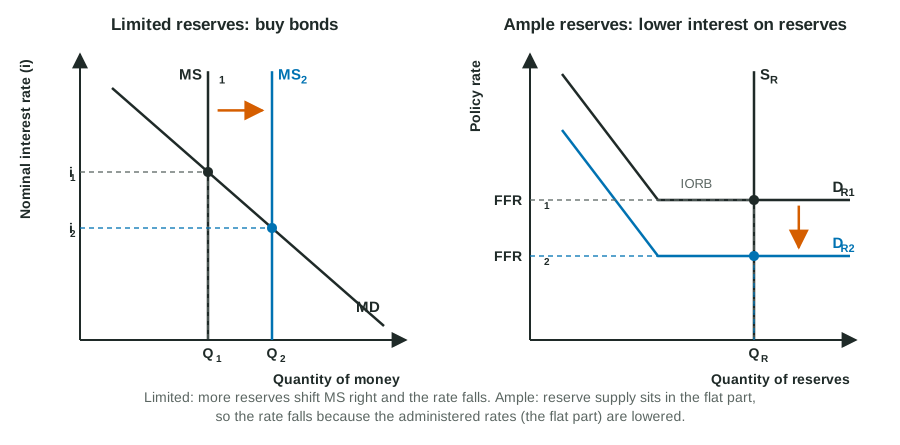
- Axes: the policy rate (federal funds rate) on the vertical axis and the quantity of reserves on the horizontal axis.
- Reserve demand slopes down when reserves are scarce, then turns flat at the interest on reserve balances (IORB): no bank lends its reserves overnight for less than the central bank pays it to hold them.
- Reserve supply is vertical, set by the central bank, and it crosses demand in the flat, ample part.
The tools are the administered rates, the rates the central bank simply sets: mainly the interest on reserve balances, with the overnight reverse repurchase agreement (ON RRP) rate as a floor for other lenders. To raise the policy rate, the central bank raises the administered rates and the flat part of reserve demand moves up; the federal funds rate rises with it. Changing reserve supply in the ample range slides supply along the flat part, so the rate does not change. Open market operations still happen, but to keep reserves ample, not to set the rate.
| Limited reserves | Ample reserves | |
|---|---|---|
| Graph | Money market: nominal interest rate and quantity of money | Reserve market: policy rate and quantity of reserves |
| Expansionary tool | Buy bonds, lower the discount rate or the reserve requirement | Lower the administered rates (interest on reserve balances) |
| What shifts | Money supply (MS) right | The flat part of reserve demand down |
| Contractionary tool | Sell bonds, raise the discount rate or the reserve requirement | Raise the administered rates |
From the policy rate to output and prices
Both frameworks end in the same chain, and an "explain" point needs every link:
Worked example: ample reserves in a recession.
- Tool: the central bank lowers the interest rate on reserve balances (and the ON RRP rate).
- Policy rate: the flat part of reserve demand moves down, so the federal funds rate falls.
- Other rates: loan, mortgage and bond rates fall with it.
- Spending: cheaper borrowing raises investment and interest-sensitive consumption, such as cars and homes.
- AD: aggregate demand shifts right.
- Outcome: in the short run real output and the price level rise, and unemployment falls.
Contractionary policy runs the same links in reverse: higher administered rates (or a bond sale with limited reserves), higher interest rates, less investment, AD left, a lower price level and less output.
The slip readers report most: a question says the central bank operates with ample reserves, and the answer says "buy bonds" or draws a money market. With ample reserves, name the administered rate (interest on reserve balances), draw the reserve market, and move the flat part of reserve demand, not reserve supply.
For your exam
- First line of every answer: the framework, then its tool and its graph.
- Reserve market labels: policy rate (federal funds rate) and quantity of reserves; reserve supply vertical in the flat part of reserve demand.
- Write the chain: tool, policy rate, other interest rates, investment, AD, output, price level, unemployment.