Monetary Policy
Monetary policy is the central bank changing interest rates to shift aggregate demand.
Part 1 · Hook
Why this matters
Part 2 · Before you start
What this builds on
Part 3 · Prerequisite check
Quick check before you start
1. The money supply increases and money demand does not change. What happens to the nominal interest rate?
- It falls
- It rises
- It stays the same
- It doubles
Show the answer
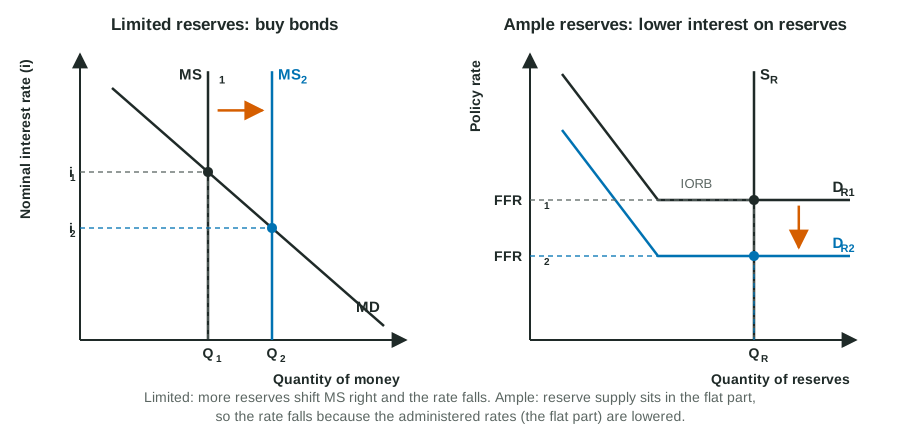
MS shifts right along downward-sloping MD, so the nominal interest rate falls.
- Correct: It falls:
- It rises:
- It stays the same:
- It doubles:
2. The required reserve ratio is 0.1 and banks get $1,000 of new excess reserves. What is the most the money supply can grow?
- $10,000
- $1,000
- $100
- $900
Show the answer
Excess reserves x 1 / ratio = $1,000 x 10 = $10,000.
- Correct: $10,000:
- $1,000:
- $100:
- $900:
3. Which of these shifts aggregate demand to the right?
- A rise in investment spending
- A rise in input costs
- A fall in consumer confidence
- A fall in exports
Show the answer
Investment is part of AD = C + I + G + (X - M).
- Correct: A rise in investment spending:
- A rise in input costs:
- A fall in consumer confidence:
- A fall in exports:
Part 4 · See it
See it first
Part 5 · Step by step
How it works, step by step
- With ample reserves, the central bank lowers its administered rates (interest on reserve balances)the flat part of reserve demand moves down, so the policy rate falls
- The policy rate fallsother interest rates fall, so investment and interest-sensitive consumption rise
- Investment and consumption riseaggregate demand shifts right
- Aggregate demand shifts rightreal output and the price level rise and unemployment falls in the short run
Part 6 · Key ideas
Key ideas
- Monetary policy is the central bank changing interest rates to shift AD: expansionary (lower rates) for a recessionary gap, contractionary (higher rates) for an inflationary gap.
- Limited reserves (money market graph): open market operations (buy bonds to raise the money supply, sell to lower it), the discount rate and the reserve requirement shift MS.
- Ample reserves (reserve market graph): the central bank sets administered rates, mainly interest on reserves; the flat part of reserve demand moves with them, and so does the policy rate.
- With ample reserves, shifting reserve supply in the flat part leaves the policy rate alone. Always say which framework a question sets.
Part 7 · Misconception
A common mistake
The wrong idea: With ample reserves, the central bank lowers the policy rate by buying bonds and drawing a money supply shift on the money market graph.
What actually happens: With ample reserves, it lowers its administered rates and you draw the reserve market: the flat part of reserve demand moves down. Buying bonds and the money market belong to the limited-reserves framework.
Part 8 · Check yourself
Check yourself
Exam-style questions. Anything you miss goes into your review queue.
1. Label the axes and the curves of the reserve market graph (ample reserves).
Work on the graph (it needs JavaScript), then check.
Show the answer
The reserve market has the policy rate (the federal funds rate) on the vertical axis and the quantity of reserves on the horizontal axis, with reserve demand (DR) and a vertical reserve supply (SR). It is not the money market.
- Key: see the explanation
2. The central bank operates with ample reserves and wants to fight inflation. It raises the interest rate it pays on reserve balances. Shift the right curve and mark the new equilibrium.
Work on the graph (it needs JavaScript), then check.
Show the answer
Raising the administered rate raises the flat part of reserve demand, so the federal funds rate rises; reserve supply, and the quantity of reserves, stay the same.
- Key: the demand for reserves shifts up
3. What is the federal funds rate?
- The rate banks charge each other for overnight loans of reserves
- The rate the government pays on its bonds
- The rate banks charge their best business customers
- The rate of inflation the central bank aims for
Show the answer
The federal funds rate, the rate on overnight loans of reserves between banks, is the Federal Reserve's policy rate.
- Correct: The rate banks charge each other for overnight loans of reserves: Right: it is the Federal Reserve's policy rate.
- The rate the government pays on its bonds: That is a Treasury bond rate, which the policy rate influences but is not.
- The rate banks charge their best business customers: That is a bank lending rate, which moves with the policy rate.
- The rate of inflation the central bank aims for: That is an inflation target, not an interest rate.
Graph
A reserve market with ample reserves, after a policy change
4. The central bank operates with ample reserves. The graph shows the flat part of reserve demand moving down from DR1 to DR2. Which action caused this?
- Buying government bonds from banks
- Lowering the interest rate it pays on reserve balances
- Raising the required reserve ratio
- Lowering taxes on bank profits
Show the answer
With ample reserves, the central bank moves the policy rate by changing its administered rates, mainly the interest on reserve balances, which sets the height of the flat part of reserve demand.
- Buying government bonds from banks: Buying bonds adds reserves, which would move the vertical supply curve; with ample reserves that leaves the rate alone.
- Correct: Lowering the interest rate it pays on reserve balances: Right: banks will not lend reserves for less than the central bank pays them, so a lower administered rate lowers the flat part.
- Raising the required reserve ratio: Reserve requirements are not how an ample-reserves central bank sets its rate.
- Lowering taxes on bank profits: Taxes are fiscal policy; the shift shows a change in an administered rate.
5. In the graph, what happens to the policy rate (the federal funds rate) and the quantity of reserves?
- The policy rate falls and the quantity of reserves rises
- Both stay the same, since reserve supply did not move
- The policy rate falls and the quantity of reserves is unchanged
- The policy rate rises and the quantity of reserves falls
Show the answer
Lowering the administered rate lowers the flat part of reserve demand, so the federal funds rate falls; reserve supply, and so the quantity, stay put.
- The policy rate falls and the quantity of reserves rises: Reserve supply did not move, so the quantity of reserves is unchanged.
- Both stay the same, since reserve supply did not move: The flat part of demand moved down, so the rate where supply crosses it fell.
- Correct: The policy rate falls and the quantity of reserves is unchanged: Right: the vertical supply now crosses demand at a lower flat part.
- The policy rate rises and the quantity of reserves falls: The flat part moved down, so the rate fell.
6. After the change in the graph, what happens to business investment in the short run?
- It falls, because banks have fewer reserves
- It rises, because borrowing costs fall
- It does not change, because investment depends on taxes
- It falls, because savers earn less interest
Show the answer
A lower policy rate lowers other interest rates, which raises interest-sensitive spending such as business investment.
- It falls, because banks have fewer reserves: The quantity of reserves did not change; interest rates fell.
- Correct: It rises, because borrowing costs fall: Right: a lower policy rate pulls other interest rates down, so more investment projects pay off.
- It does not change, because investment depends on taxes: Investment is interest sensitive: lower rates make borrowing cheaper.
- It falls, because savers earn less interest: Lower rates encourage borrowing and spending; investment rises.
7. A central bank with ample reserves fights a recession. Put the links in order.
- The central bank lowers its administered rates
- The policy rate (federal funds rate) falls
- Other interest rates, such as loan and mortgage rates, fall
- Investment and interest-sensitive consumption rise
- Aggregate demand shifts right, so real output rises and unemployment falls
Show the answer
Every link matters on the exam: the tool, the policy rate, other rates, interest-sensitive spending, AD, then output and unemployment.
- Correct order: 1. The central bank lowers its administered rates 2. The policy rate (federal funds rate) falls 3. Other interest rates, such as loan and mortgage rates, fall 4. Investment and interest-sensitive consumption rise 5. Aggregate demand shifts right, so real output rises and unemployment falls
Part 9 · Summary
Summary
Part 10 · Up next
What comes next
Part 11 · Connections