The foreign exchange market is a supply and demand market, so a currency's value changes for the same reason any price does: something shifts demand or supply. The skill this topic asks for is the one readers check point by point: name the shifter, name the curve it moves and which way, and only then say whether the currency appreciates or depreciates. "The dollar gets stronger" with no curve behind it earns nothing.
The shifters
Each shifter changes what people in one country want to buy from the other. Work out who now wants more or less of which currency, and you have the shift. The table is written for the market for the dollar, with Europe as the other side.
| Change (other things equal) | Who acts | Market for dollars | The dollar |
|---|---|---|---|
| Tastes: Europeans want more US goods | Europeans buy dollars to pay for them | Demand shifts right | Appreciates |
| Relative incomes: US incomes grow faster than Europe's | Americans buy more imports, selling dollars for euros | Supply shifts right | Depreciates |
| Relative price levels: US inflation is higher than Europe's | US goods get relatively dearer: Europeans buy fewer, Americans buy more European goods | Demand left and supply right | Depreciates |
| Relative interest rates: US real rates rise above Europe's | European savers buy US bonds with dollars | Demand shifts right | Appreciates |
| Expectations: traders expect the dollar to rise | Traders buy dollars now to sell later | Demand shifts right | Appreciates now |
Two of these trip students up. Faster income growth at home does not strengthen the currency: richer households buy more imports, and they pay by selling their own currency. And higher inflation does not make a currency "worth more because prices are higher": it makes the country's goods less attractive, so the currency loses value.
The interest rate that matters is the real interest rate, the return after expected inflation. A country whose nominal rates rise only because its expected inflation rose offers savers no better real return.
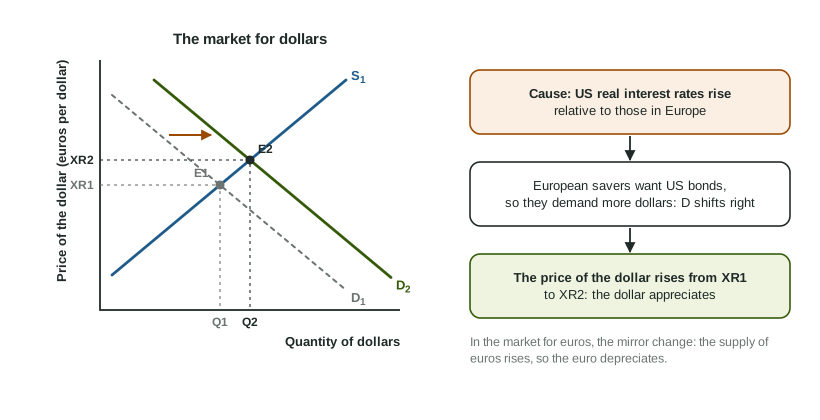
Show a shift in the right market. US real interest rates rise relative to those in Europe. Show the effect on the market for dollars, then say what happens to the euro.
- Draw and label: Quantity of dollars across; Price of the dollar (euros per dollar) up the side; D1 and S1 crossing at XR1 and Q1.
- Who acts? European savers now earn more on US bonds. To buy them they need dollars: the demand side.
- Shift: demand shifts right, from D1 to D2. (US savers also have less reason to buy European bonds, which would shift the supply of dollars left; either way the dollar's price rises. Draw the change the question describes.)
- New equilibrium: XR2 is above XR1 and Q2 is to the right of Q1. The dollar appreciates.
- The other currency: European savers paid with euros, so the supply of euros rose in the market for euros, and the euro depreciates.
Policies move currencies through interest rates and prices
Monetary and fiscal policy change exchange rates mainly by changing interest rates. Say which reserves framework the question sets, and use its tool.
- Contractionary monetary policy, ample reserves: the central bank raises its administered rates (the interest rate it pays on reserve balances), so the policy rate and other interest rates rise. With expected inflation slow to move, real rates rise too, foreign savers demand the currency, and it appreciates.
- Contractionary monetary policy, limited reserves: the central bank sells bonds on the open market, the money supply falls and interest rates rise, with the same result for the currency.
- Expansionary monetary policy in either framework lowers interest rates, so the currency depreciates.
- Expansionary fiscal policy paid for by borrowing: government borrowing raises the demand for loanable funds, the real interest rate rises, and the currency appreciates.
Two slips readers report. First, using a limited-reserves tool (buying or selling bonds) when the question says the central bank works with ample reserves; the ample-reserves tool is the administered rate. Second, stating that a currency appreciates or depreciates without tying it to a shift in the demand for or supply of that currency. Write the link: "so the demand for dollars increases, and the dollar appreciates."
When two curves shift
Higher inflation at home shifts both curves: demand for the home currency left and its supply right. Both push the price down, so the currency depreciates for sure. But one shift raises the quantity traded and the other lowers it, so the quantity is indeterminate unless you know the sizes. The same reasoning applies when several shifters act at once in opposite directions on the price: if one pushes the currency up and another pushes it down, the direction of the exchange rate is indeterminate too. Say so, and say why.