Effect of Changes in Policies and Economic Conditions on the Foreign Exchange Market
A currency's value moves when its demand or supply shifts, and four shifters do most of the work: tastes, relative incomes, relative price levels and relative real interest rates, plus expectations.
Part 1 · Hook
Why this matters
Part 2 · Before you start
What this builds on
Part 3 · Prerequisite check
Quick check before you start
1. A bond pays a nominal interest rate of 5% and expected inflation is 2%. What is the real interest rate?
- 3%
- 7%
- 2.5%
- 10%
Show the answer
Real rate = nominal rate - expected inflation: 5 - 2 = 3 percent.
- Correct: 3%:
- 7%:
- 2.5%:
- 10%:
2. In an ample-reserves framework, how does a central bank raise its policy rate?
- It raises administered rates, such as the interest rate it pays on reserves
- It sells government bonds to shrink the money supply
- It raises the reserve requirement
- It asks the government to raise taxes
Show the answer
With ample reserves, the central bank moves the policy rate by changing the administered rates it sets.
- Correct: It raises administered rates, such as the interest rate it pays on reserves:
- It sells government bonds to shrink the money supply:
- It raises the reserve requirement:
- It asks the government to raise taxes:
3. In the market for euros, who demands euros?
- People outside Europe buying European goods, services or assets
- Europeans buying goods from the United States
- European banks lending to European firms
- European governments collecting taxes
Show the answer
Demand for a currency comes from people abroad who want things priced in it.
- Correct: People outside Europe buying European goods, services or assets:
- Europeans buying goods from the United States:
- European banks lending to European firms:
- European governments collecting taxes:
Part 4 · See it
See it first
Part 5 · Step by step
How it works, step by step
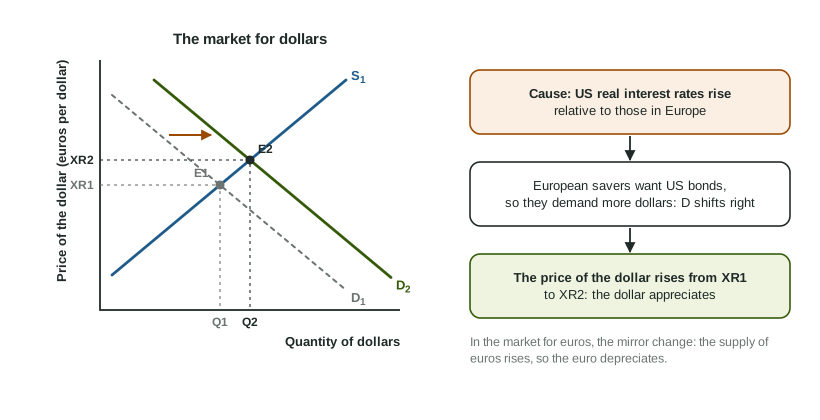
- A country's real interest rates rise relative to other countries'its bonds and other assets pay savers more than those abroad
- Savers abroad want more of its assetsthey need its currency, so the demand for its currency shifts right
- The demand for the currency risesits price in other currencies rises: the currency appreciates
- Savers abroad pay for that currency with their ownthe supply of the other currency rises in its own market, so the other currency depreciates: the mirror change
Part 6 · Key ideas
Key ideas
- Four shifters to know: tastes for a country's goods; relative incomes (higher income at home raises imports, so the supply of the home currency rises); relative price levels (higher inflation at home lowers demand for the home currency and raises its supply); relative interest rates (a higher real rate at home raises demand for the home currency).
- Expectations matter too: if traders expect a currency to appreciate, they buy it now, and it appreciates now.
- Policy works through these shifters. Contractionary monetary policy (raising administered rates with ample reserves, or selling bonds with limited reserves) and borrowing to fund a budget deficit both raise interest rates, so the currency appreciates.
- When demand and supply both shift, say what is certain (the price) and call the other indeterminate.
Part 7 · Misconception
A common mistake
The wrong idea: When a country's income rises, its currency appreciates, because its economy is stronger.
What actually happens: Higher income at home raises spending on imports. Residents sell their currency to buy foreign goods, so the supply of the home currency shifts right and it depreciates, other things equal.
Part 8 · Check yourself
Check yourself
Exam-style questions. Anything you miss goes into your review queue.
Scenario
Belvia's central bank raises rates
Belvia's central bank works in an ample-reserves framework. It raises the interest rate it pays on reserve balances, so Belvia's policy rate rises, and other interest rates in Belvia follow. Expected inflation does not change, so Belvia's real interest rates rise relative to those in Arland. Savers in Arland can buy bonds in either country. (Arland and Belvia are invented; Arland's currency is the arl and Belvia's is the bel.)
1. What happens in the market for bels?
- The supply of bels increases, so the bel depreciates
- The demand for bels increases, so the bel appreciates
- The demand for bels decreases, so the bel depreciates
- Nothing changes, because interest rates are not traded
Show the answer
Higher relative real interest rates in Belvia raise the demand for bels, so the bel appreciates.
- The supply of bels increases, so the bel depreciates: Belvians have more reason to keep their savings at home, not less, so they do not offer more bels.
- Correct: The demand for bels increases, so the bel appreciates: Right: Belvian bonds now pay a higher real return, so Arland savers demand bels to buy them, and the price of the bel rises.
- The demand for bels decreases, so the bel depreciates: Higher real interest rates make Belvian assets more attractive, which raises demand for bels.
- Nothing changes, because interest rates are not traded: Bonds are traded across borders, and buying Belvian bonds requires bels.
2. What is the matching change in the market for arls?
- The supply of arls increases, so the arl depreciates
- The demand for arls increases, so the arl appreciates
- The supply of arls decreases, so the arl appreciates
- The demand for arls decreases, so the arl appreciates
Show the answer
More demand for bels is more supply of arls: the bel appreciates and the arl depreciates.
- Correct: The supply of arls increases, so the arl depreciates: Right: Arland savers sell arls to get the bels they need for Belvian bonds, so the supply of arls rises and the arl depreciates.
- The demand for arls increases, so the arl appreciates: The new buyers of Belvian bonds are paying with arls, so they supply arls rather than demand them.
- The supply of arls decreases, so the arl appreciates: Arland savers offer more arls, not fewer, to buy Belvian bonds.
- The demand for arls decreases, so the arl appreciates: A fall in demand would lower the price of the arl, not raise it.
3. Which action by Arland savers links the higher Belvian interest rates to the currency markets?
- They buy more Belvian goods for their homes
- They save less, since Arland rates did not change
- They use bels to buy more Arland bonds
- They sell arls for bels to buy Belvian bonds
Show the answer
Savers move funds toward the higher real return, buying that country's currency to buy its bonds.
- They buy more Belvian goods for their homes: The scenario is about where savers put their savings, not about goods.
- They save less, since Arland rates did not change: The change that matters is the gap between the two countries' real rates and where savers put their funds.
- They use bels to buy more Arland bonds: Arland savers hold arls, and the higher return is on Belvian bonds, not Arland bonds.
- Correct: They sell arls for bels to buy Belvian bonds: Right: to earn the higher real return on Belvian bonds, they need bels, which they buy with arls.
4. A student writes that Belvia's central bank raised rates by selling bonds on the open market. Why does that answer not fit this scenario?
- Selling bonds is fiscal policy, set by the government
- Selling bonds would lower interest rates, not raise them
- With ample reserves, the bank moves its policy rate by changing administered rates such as interest on reserves
- It fits: the two frameworks use the same tools
Show the answer
An ample-reserves question uses the administered rates (interest on reserves), not open market operations.
- Selling bonds is fiscal policy, set by the government: Open market operations are a central bank tool, but in a limited-reserves framework, not the ample-reserves one the scenario sets.
- Selling bonds would lower interest rates, not raise them: In a limited-reserves system, selling bonds raises interest rates; the problem is that it is the wrong framework here.
- Correct: With ample reserves, the bank moves its policy rate by changing administered rates such as interest on reserves: Right: the scenario sets an ample-reserves framework, whose tool is the rate paid on reserves. Selling bonds to shrink the money supply is the limited-reserves tool.
- It fits: the two frameworks use the same tools: The frameworks use different tools and different graphs; the question names ample reserves, so its tool is the administered rate.
5. Arland's central bank raises its policy rate to fight inflation, and expected inflation does not change, so Arland's real interest rates rise relative to Belvia's. In the market for arls, show the effect and mark the new equilibrium.
Work on the graph (it needs JavaScript), then check.
Show the answer
Belvian savers want Arland bonds and need arls to buy them, so the demand for arls shifts right; the price of the arl in bels rises: the arl appreciates. (Arland savers buying fewer Belvian bonds, the supply of arls shifting left, also raises the price of the arl and is also accepted.)
- Key: demand shifts right
6. Arland's government raises spending and pays for it by borrowing, so it runs a larger budget deficit. Through the loanable funds market, what happens to the arl?
- It appreciates: the real interest rate rises, so foreign savers want Arland bonds
- It depreciates: a budget deficit makes Arland poorer
- It depreciates: the real interest rate falls as the government spends
- Nothing happens, because a budget deficit is not a trade deficit
Show the answer
More government borrowing raises the real interest rate, drawing demand for the currency: it appreciates.
- Correct: It appreciates: the real interest rate rises, so foreign savers want Arland bonds: Right: government borrowing raises the demand for loanable funds, the real interest rate in Arland rises relative to Belvia's, and Belvian savers demand arls to buy Arland bonds.
- It depreciates: a budget deficit makes Arland poorer: The link to the currency runs through the real interest rate, which rises when the government borrows more.
- It depreciates: the real interest rate falls as the government spends: Government borrowing raises the demand for loanable funds, which raises the real interest rate.
- Nothing happens, because a budget deficit is not a trade deficit: They are different measures, but the borrowing still changes interest rates and so the currency.
Part 9 · Summary
Summary
Part 10 · Up next
What comes next
Part 11 · Connections