Changes in the Foreign Exchange Market and Net Exports
When a currency appreciates, everything the country sells costs foreign buyers more and everything it buys from abroad costs its residents less.
Part 1 · Hook
Why this matters
Part 2 · Before you start
What this builds on
Part 3 · Prerequisite check
Quick check before you start
1. Which is a component of aggregate demand?
- Net exports, X - M
- The money supply
- The price level
- The labor force
Show the answer
AD is C + I + G + (X - M), so net exports are one of its four parts.
- Correct: Net exports, X - M:
- The money supply:
- The price level:
- The labor force:
2. The dollar appreciates against the euro. What happens to the dollar price of a jacket priced at 45 euros?
- It falls
- It rises
- It stays the same
- It doubles
Show the answer
Each dollar buys more euros, so the same 45 euros take fewer dollars.
- Correct: It falls:
- It rises:
- It stays the same:
- It doubles:
Part 4 · See it
See it first
Part 5 · Step by step
How it works, step by step
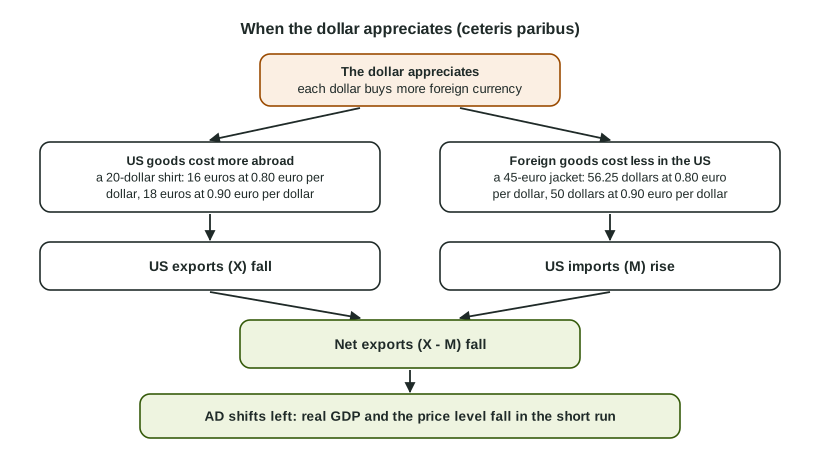
- The dollar appreciatesUS goods cost foreign buyers more of their currency, and foreign goods cost Americans fewer dollars
- US goods are dearer abroad and foreign goods cheaper at homeUS exports fall and US imports rise
- Exports fall and imports risenet exports (X - M) fall
- Net exports, a component of AD, fallAD shifts left, so real GDP and the price level fall and unemployment rises in the short run
Part 6 · Key ideas
Key ideas
- Appreciation makes a country's exports dearer abroad and its imports cheaper at home, so net exports fall and AD shifts left, other things equal.
- Depreciation does the opposite: exports get cheaper abroad, imports dearer at home, net exports rise and AD shifts right.
- In a two-country story, one country's exports are the other's imports: when Arland's net exports fall, Belvia's rise.
- Net exports are in the current account, so a fall in net exports lowers the current account balance and raises the capital and financial account balance by the same amount.
- Higher domestic income raises imports, so net exports fall; income is not the same as competitiveness.
Part 7 · Misconception
A common mistake
The wrong idea: A stronger currency helps a country's exporters, because what they earn is worth more.
What actually happens: A stronger currency makes their goods cost more for foreign buyers, so they sell less abroad. Exports fall, imports rise and net exports fall.
Part 8 · Check yourself
Check yourself
Exam-style questions. Anything you miss goes into your review queue.
Data
Arland's trade before and after the arl appreciates
| Year | Exports | Imports |
|---|---|---|
| Before | 500 | 450 |
| After | 470 | 490 |
1. Use the table. What were Arland's net exports in the year before the appreciation, in billions of arls?
Type a number. A four-function calculator is allowed, as on the exam.
Show the answer
Net exports are exports minus imports: billion arls.
- Answer: 50
2. Use the table. By how much did Arland's net exports change from the year before to the year after, in billions of arls? Write a decrease as a negative number.
Type a number. A four-function calculator is allowed, as on the exam.
Show the answer
Before: . After: . Change: billion arls. Exports fell and imports rose, so net exports fell on both counts.
- Answer: -70
3. Use the table. Other things equal, what happens to Arland's aggregate demand?
- It shifts right, because exports are still large
- It does not shift, because imports are not part of GDP
- It shifts left, because net exports fell
- Short-run aggregate supply shifts left instead
Show the answer
Lower net exports shift AD left.
- It shifts right, because exports are still large: What moves AD is the change in net exports, and net exports fell.
- It does not shift, because imports are not part of GDP: Net exports, exports minus imports, are part of AD; a rise in imports lowers net exports.
- Correct: It shifts left, because net exports fell: Right: net exports are a component of AD (C + I + G + X - M), and they fell by 70 billion arls, so AD shifts left.
- Short-run aggregate supply shifts left instead: A change in net exports is a change in spending, so it shifts AD.
4. The arl appreciates sharply against other currencies. Considering only the effect on Arland's net exports, shift the right curve on Arland's AD-AS graph and mark the new short-run equilibrium.
Work on the graph (it needs JavaScript), then check.
Show the answer
An appreciation makes Arland exports dearer abroad and imports cheaper at home, so net exports fall and AD shifts left. In the short run the price level and real output both fall.
- Key: aggregate demand shifts left
5. Arland's real income rises during an expansion. A classmate predicts that Arland's net exports will rise because Arland is producing more. Which response is best?
- Right: more output means more goods to sell abroad
- Right, as long as the arl does not change in value
- Wrong: net exports do not depend on income
- Wrong: higher income raises imports, so net exports tend to fall
Show the answer
Higher domestic income raises imports, so net exports fall.
- Right: more output means more goods to sell abroad: Exports depend mainly on foreign incomes and prices; higher Arland income mainly raises Arland's imports.
- Right, as long as the arl does not change in value: Even with an unchanged exchange rate, higher Arland income raises imports, which lowers net exports.
- Wrong: net exports do not depend on income: Income matters: higher Arland income raises imports.
- Correct: Wrong: higher income raises imports, so net exports tend to fall: Right: Arland households spend part of their extra income on imported goods, so imports rise and net exports fall, other things equal.
6. After the arl appreciates, Arland's net exports fall while its income and transfers with the rest of the world do not change. What happens to its balance of payments?
- Its current account balance falls, and its capital and financial account balance rises
- Both balances fall by the same amount
- Its current account balance rises, because the arl is worth more
- Nothing changes, because the exchange rate is not in the accounts
Show the answer
Lower net exports lower the current account balance; the capital and financial account balance rises by the same amount.
- Correct: Its current account balance falls, and its capital and financial account balance rises: Right: net exports are part of the current account, which falls; the two accounts sum to zero, so the capital and financial account balance rises by the same amount.
- Both balances fall by the same amount: The two balances sum to zero, so when one falls the other rises.
- Its current account balance rises, because the arl is worth more: Net exports fell, and they are part of the current account, so its balance falls.
- Nothing changes, because the exchange rate is not in the accounts: The exchange rate is not an entry, but the trade it changes is.
Part 9 · Summary
Summary
Part 10 · Up next
What comes next
Part 11 · Connections