Real Interest Rates and International Capital Flows
Relative real interest rates steer financial capital between countries.
Part 1 · Hook
Why this matters
Part 2 · Before you start
What this builds on
Part 3 · Prerequisite check
Quick check before you start
1. A government borrows more to fund a budget deficit. In its loanable funds market, what happens?
- Demand for loanable funds shifts right and the real interest rate rises
- Supply of loanable funds shifts right and the real interest rate falls
- Demand shifts left and the real interest rate falls
- Nothing, because government borrowing is not lending
Show the answer
Government borrowing adds to the demand for loanable funds, raising the real interest rate.
- Correct: Demand for loanable funds shifts right and the real interest rate rises:
- Supply of loanable funds shifts right and the real interest rate falls:
- Demand shifts left and the real interest rate falls:
- Nothing, because government borrowing is not lending:
2. US real interest rates rise relative to Europe's. In the market for dollars, what happens?
- Demand for dollars rises and the dollar appreciates
- Supply of dollars rises and the dollar depreciates
- Demand for dollars falls and the dollar depreciates
- Nothing, because interest rates are not traded
Show the answer
Savers abroad buy dollars to buy US bonds, so demand for dollars rises.
- Correct: Demand for dollars rises and the dollar appreciates:
- Supply of dollars rises and the dollar depreciates:
- Demand for dollars falls and the dollar depreciates:
- Nothing, because interest rates are not traded:
3. A country has a capital and financial account surplus of 50. What is its current account balance?
- -50
- +50
- 0
- +100
Show the answer
The two balances sum to zero, so the current account balance is -50.
- Correct: -50:
- +50:
- 0:
- +100:
Part 4 · See it
See it first
Part 5 · Step by step
How it works, step by step
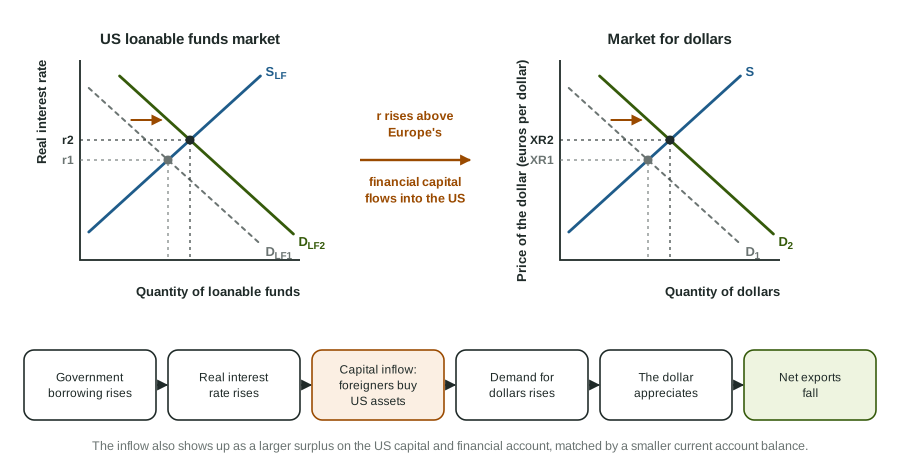
- A country's real interest rate rises relative to other countries' (for example, its government borrows more)its assets pay savers a higher real return than assets abroad
- Savers abroad move funds toward the higher real returnfinancial capital flows in, and the capital and financial account balance rises
- Savers abroad need the country's currency to buy its assetsthe demand for its currency rises, so the currency appreciates
- The currency appreciatesexports cost more abroad and imports cost less at home, so net exports and the current account balance fall
Part 6 · Key ideas
Key ideas
- Financial capital flows toward the country with the higher real interest rate, other things equal: savers compare returns after expected inflation.
- A capital inflow raises the capital and financial account balance and the demand for the currency, so the currency appreciates and net exports fall. The current account balance falls by the same amount, keeping the sum at zero.
- The inflow also adds to the supply of loanable funds in the receiving country, which holds down its real interest rate; in the sending country, the supply of loanable funds falls.
- Lower relative real rates, as after expansionary monetary policy, send capital out: the currency depreciates and net exports rise.
Part 7 · Misconception
A common mistake
The wrong idea: Financial capital flows toward the country with the higher nominal interest rate.
What actually happens: Savers compare real returns: nominal rate minus expected inflation. A country paying 7% with 4% expected inflation (3% real) draws less than one paying 5% with 1% expected inflation (4% real).
Part 8 · Check yourself
Check yourself
Exam-style questions. Anything you miss goes into your review queue.
Graph
Arland's loanable funds market after its government borrows more (Arland and its trading partner Belvia are invented)
1. What happened to Arland's real interest rate?
- It fell, because more funds were lent
- It rose, because the demand for loanable funds increased
- It did not change, because supply did not shift
- It rose, because the supply of loanable funds shifted left
Show the answer
Demand for loanable funds right: the real interest rate rises.
- It fell, because more funds were lent: The demand for loanable funds rose, which raises the real interest rate along the supply curve.
- Correct: It rose, because the demand for loanable funds increased: Right: government borrowing shifted the demand for loanable funds right, so the real interest rate rose.
- It did not change, because supply did not shift: A shift in demand alone moves the equilibrium along the supply curve, changing the rate.
- It rose, because the supply of loanable funds shifted left: The graph shows demand shifting right; supply did not move.
2. Belvia's real interest rate does not change. Which way does financial capital flow?
- From Belvia into Arland
- From Arland into Belvia
- It does not flow, because the change was in government borrowing
- It flows both ways equally, so there is no net flow
Show the answer
Financial capital flows toward the higher relative real interest rate.
- Correct: From Belvia into Arland: Right: Arland assets now pay a higher real return than Belvian ones, so savers move funds into Arland, a capital inflow for Arland.
- From Arland into Belvia: Savers move toward the higher real return, which is now in Arland.
- It does not flow, because the change was in government borrowing: The cause does not matter to savers; the higher real return does.
- It flows both ways equally, so there is no net flow: The gap in real interest rates makes the net flow go toward Arland.
3. What happens in the market for arls?
- The supply of arls rises, and the arl depreciates
- The demand for arls falls, and the arl depreciates
- The demand for arls rises, and the arl appreciates
- Nothing, because loanable funds are not currency
Show the answer
The capital inflow raises demand for arls: the arl appreciates.
- The supply of arls rises, and the arl depreciates: Foreign savers buying Arland assets need arls: they demand arls, they do not supply them.
- The demand for arls falls, and the arl depreciates: More foreign savers want Arland assets, so demand for arls rises.
- Correct: The demand for arls rises, and the arl appreciates: Right: to buy Arland assets, Belvian savers need arls, so demand for arls shifts right and the arl appreciates.
- Nothing, because loanable funds are not currency: The funds come from abroad, so they must be changed into arls first.
4. Following the chain from the loanable funds market, what happens to Arland's net exports, other things equal?
- They rise, because more funds flow into Arland
- They do not change, because the flow is in the financial account
- They rise, because the arl appreciates
- They fall, because the arl appreciates
Show the answer
Higher real rate, capital inflow, demand for arls, appreciation, lower net exports.
- They rise, because more funds flow into Arland: The inflow is in the capital and financial account; through the stronger arl it lowers net exports.
- They do not change, because the flow is in the financial account: The appreciation of the arl changes the prices that foreign and Arland buyers face, which changes trade.
- They rise, because the arl appreciates: An appreciation makes Arland exports dearer abroad and imports cheaper, so net exports fall.
- Correct: They fall, because the arl appreciates: Right: the stronger arl makes Arland goods cost more bels and Belvian goods fewer arls, so exports fall, imports rise and net exports fall.
5. Arland's real interest rates rise relative to Belvia's, and financial capital flows into Arland. Draw the market for arls: label it, shift a curve and mark the new equilibrium.
Work on the graph (it needs JavaScript), then check.
Show the answer
Belvian savers need arls to buy Arland assets, so the demand for arls shifts right and the arl appreciates (Arland savers keeping their funds at home, the supply of arls shifting left, is also accepted). The vertical axis is the price of the arl: bels per arl.
- Key: demand shifts right
6. Foreign residents buy 90 billion arls more of Arland's assets than Arland residents buy of foreign assets this year. Which must be true of Arland's current account?
- It has a surplus of 90 billion arls
- It is balanced, because asset trades are not in the current account
- It has a deficit of 90 billion arls
- It equals Arland's government budget deficit
Show the answer
A capital and financial account surplus of 90 means a current account deficit of 90.
- It has a surplus of 90 billion arls: The two balances sum to zero, so a capital and financial account surplus of 90 is matched by a current account deficit of 90.
- It is balanced, because asset trades are not in the current account: Asset trades are not in the current account, but the two balances still sum to zero, so the current account is in deficit.
- Correct: It has a deficit of 90 billion arls: Right: the net inflow is a capital and financial account surplus of 90, so the current account balance is -90.
- It equals Arland's government budget deficit: The budget balance is not part of the balance of payments.
Part 9 · Summary
Summary
Part 10 · Up next
What comes next
This is the last topic in the course.
Part 11 · Connections