The last two topics showed how a currency's value is set and what moves it. This one asks why anyone outside the currency market should care. The answer runs through trade: a change in a currency's value changes what every exporter and importer pays and charges in the other currency, so it changes net exports, and net exports are part of aggregate demand.
Prices to buyers on each side
Suppose a US shirt is priced at 20 dollars and a European jacket at 45 euros, and neither price changes. Only the exchange rate moves, from 0.80 euro per dollar to 0.90 euro per dollar: the dollar appreciates. (The rates are made up for practice.)
| At 0.80 euro per dollar | At 0.90 euro per dollar | What changes | |
|---|---|---|---|
| The US shirt, to a European buyer | euros | euros | US exports cost more abroad, so fewer are sold |
| The European jacket, to a US buyer | dollars | dollars | Imports cost less at home, so more are bought |
Neither firm changed its price, yet the shirt is dearer in Europe and the jacket cheaper in the United States. That is the whole mechanism.
From net exports to aggregate demand
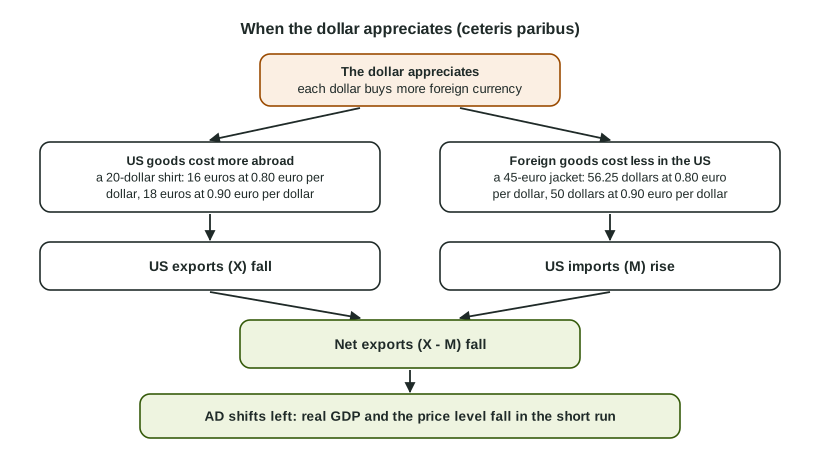
When the dollar appreciates, other things equal:
- US goods cost more abroad, so US exports fall;
- foreign goods cost less in the US, so US imports rise;
- both lower net exports, X - M;
- net exports are a component of aggregate demand, C + I + G + (X - M), so AD shifts left;
- in the short run, real GDP and the price level fall and unemployment rises.
A depreciation runs every link the other way: exports rise, imports fall, net exports rise, AD shifts right, and real GDP and the price level rise in the short run. That is why a falling currency can give a boost to an economy with idle resources, and why a rising one can slow an economy that is overheating.
Follow the change in a table and on a graph. Arland (invented) trades with Belvia alone. Before the arl appreciates, Arland exports 500 billion arls of goods and imports 450 billion. The year after, exports are 470 and imports 490.
- Net exports before: billion arls.
- Net exports after: billion arls.
- Change: billion arls: net exports fell.
- Graph: on Arland's AD-AS graph (Price level up the side, Real GDP across), shift AD left from AD1 to AD2. The new short-run equilibrium on SRAS has a lower price level (PL2 below PL1) and lower real output (Y2 below Y1).
- The partner: Arland's exports are Belvia's imports and the reverse, so Belvia's net exports rose by 70 billion arls' worth, and Belvia's AD shifts right.
Winners, losers and the accounts
An appreciation hurts exporters and firms that compete with imports, and it helps importers, travelers going abroad and anyone who owes debts in a foreign currency. A depreciation reverses each of these. Because net exports sit in the current account, a fall in net exports with nothing else changing lowers the current account balance, and the capital and financial account balance rises by the same amount: the country pays for its extra imports by selling more assets abroad or borrowing more.
Slips readers report on net exports. Believing that net exports rise when domestic income rises: higher income raises imports, so net exports fall. Explaining a change in net exports with the price level when the question is about the exchange rate. And mixing up the two countries: when one country's net exports fall, its partner's rise. Keep each country's exports, imports and currency straight, and write the link to AD.