Some reactions are over in a flash, like a match head catching fire. Others take years, like an iron railing rusting. Chemists measure how fast a reaction goes and ask what controls it. This topic is about the first part: what a reaction rate is, how you read it from data, and how the rates of different substances in one reaction are linked.
What a rate measures
A reaction rate is how fast the concentration of a reactant or product changes. Concentration is in molarity (mol/L, written M) and time in seconds, so a rate has units of M/s, which is mol/(L·s).
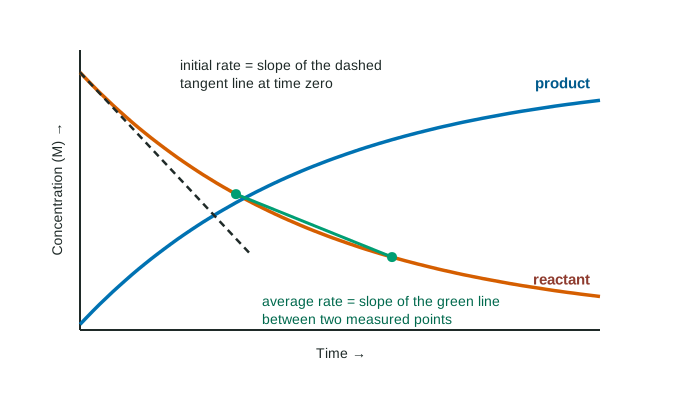
As a reaction runs, reactant concentrations fall and product concentrations rise (Figure 1). A reactant's rate of disappearance is −Δ[reactant]/Δt. The minus sign makes the rate positive, because Δ[reactant] is negative. A product's rate of appearance is +Δ[product]/Δt.
Average, instantaneous and initial rates
- The average rate over an interval is the change in concentration divided by the change in time between two measured points: the slope of the straight line joining them.
- The instantaneous rate is the rate at one moment: the slope of the tangent to the curve at that time.
- The initial rate is the instantaneous rate at t = 0, before much reactant is used up. It is the easiest rate to compare between experiments, because you know exactly what was mixed.
For most reactions the curve is steepest at the start and flattens out. With fewer reactant particles in each liter, fewer react each second.
Worked example: an average rate from a table
Hydrogen peroxide breaks down: 2 H₂O₂(aq) → 2 H₂O(l) + O₂(g). At t = 0 s, [H₂O₂] = 1.000 M. At t = 600 s, [H₂O₂] = 0.700 M. Find the average rate of disappearance of H₂O₂ and the average rate of appearance of O₂.
Step 1. Δ[H₂O₂] = 0.700 M − 1.000 M = −0.300 M. Δt = 600 s − 0 s = 600 s.
Step 2. Rate of disappearance = −Δ[H₂O₂]/Δt = −(−0.300 M)/(600 s) = 5.00 × 10⁻⁴ M/s.
Step 3. The equation says 1 O₂ forms for every 2 H₂O₂ used, so O₂ appears half as fast: (1/2)(5.00 × 10⁻⁴ M/s) = 2.50 × 10⁻⁴ M/s.
Units stay with every number, and the answer is rounded once, at the end.
One reaction, one rate: using the coefficients
In 2 N₂O₅ → 4 NO₂ + O₂, every 2 molecules of N₂O₅ that break apart make 4 NO₂ and 1 O₂. So NO₂ appears twice as fast as N₂O₅ disappears, and O₂ appears half as fast. To get one rate for the reaction whichever substance you measure, divide each rate by its coefficient:
rate = −½ Δ[N₂O₅]/Δt = ¼ Δ[NO₂]/Δt = Δ[O₂]/Δt
A common mistake is to treat every species as changing at the same speed. Always check the coefficients, and say which substance a rate belongs to.
Rate is not amount
A faster reaction gets to the end sooner; it does not make more product. How much product forms is set by stoichiometry and the limiting reactant. How quickly it forms is the rate. If two trials use the same mass of a limiting reactant, they end with the same amount of product even if one is ten times faster.
What changes a rate
Reactions happen when particles meet. Anything that makes particles meet more often, or meet with more energy, speeds a reaction up:
| Change | Effect on rate | Particle-level reason |
|---|---|---|
| Higher concentration (or gas pressure) | Faster | More reactant particles in each liter meet more often. |
| Higher temperature | Faster | Particles move faster, so they meet more often and with more energy. |
| Smaller pieces of a solid (more surface area) | Faster | Only particles at the surface can meet the other reactant; grinding exposes more of them. |
| Adding a substance that opens a faster pathway and is not used up | Faster | Explained in topic 5.11. |
Topic 5.5 explains in detail why temperature matters so much.
How rates are measured
You can follow any quantity that changes with concentration: the volume of a gas collected, the mass lost as a gas escapes, or the color of a solution. For a colored substance, a spectrophotometer measures absorbance, and by the Beer-Lambert law (A = εbc) absorbance is proportional to concentration. So a graph of absorbance against time has the same shape as a graph of concentration against time.