Why chemists count by weighing
Atoms are far too small to see or count. A single drop of water holds about 10²¹ water molecules: if you counted one per second, it would take thousands of times the age of the universe. Yet chemistry is all about counting, because substances combine particle by particle, in fixed ratios. Two hydrogen atoms join one oxygen atom to make water, never any other ratio.
The solution is the same one a bakery uses for eggs or a print shop for paper: count in groups. A dozen is 12 eggs; a ream is 500 sheets. Chemists use a group so large that a handful of matter contains only a few of them. That group is the mole.
Atoms, elements, molecules and compounds
An atom is the smallest piece of an element that still behaves like that element. An element is a substance made of only one kind of atom: carbon, oxygen, iron. Every element has a box on the periodic table, which gives its symbol and its atomic mass.
A molecule is two or more atoms held together as one particle. A compound is a substance made of two or more different elements joined in a fixed ratio. Water (H₂O) and carbon dioxide (CO₂) are compounds made of molecules. Oxygen gas is made of O₂ molecules, but it is still an element, because every atom in it is oxygen. The subscripts in a formula count atoms: H₂O has two H atoms and one O atom.
The mole and Avogadro's number
One mole is 6.022 × 10²³ particles. That number is Avogadro's number. The particles can be atoms, molecules or anything else, so always say which:
- 1 mol of water molecules = 6.022 × 10²³ H₂O molecules.
- That same sample holds 2 mol of H atoms and 1 mol of O atoms, 3 mol of atoms in all, because each molecule has three atoms.
Moles let you count by groups: "2.50 mol of water" means 2.50 × 6.022 × 10²³ = 1.51 × 10²⁴ molecules, without ever writing the big number until you need it.
From atomic mass units to grams per mole
The mass of one atom is measured in atomic mass units (amu). The periodic table lists each element's atomic mass in amu: hydrogen 1.008, carbon 12.01, oxygen 16.00, aluminum 26.98.
The mole was chosen so that the same number works at both scales. One aluminum atom has a mass of 26.98 amu, and one mole of aluminum atoms has a mass of 26.98 grams. The mass of one mole of a substance is its molar mass, in grams per mole (g/mol). So the periodic table gives you molar masses directly.
For a compound, add the atomic masses of every atom in one particle (use the subscripts):
| Substance | Formula | Sum of atomic masses | Molar mass |
|---|---|---|---|
| Water | H₂O | 2(1.008) + 16.00 | 18.02 g/mol |
| Carbon dioxide | CO₂ | 12.01 + 2(16.00) | 44.01 g/mol |
| Calcium carbonate | CaCO₃ | 40.08 + 12.01 + 3(16.00) | 100.09 g/mol |
| Glucose | C₆H₁₂O₆ | 6(12.01) + 12(1.008) + 6(16.00) | 180.16 g/mol |
The path: grams, moles, particles
Almost every problem in this topic moves along one path (Figure 1). The molar mass connects grams and moles. Avogadro's number connects moles and particles. You never jump straight from grams to particles: you go through moles.
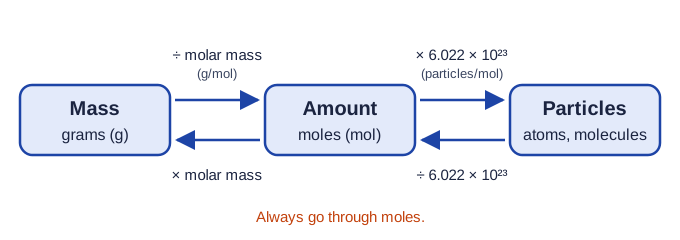
Use each one as a conversion factor, written the right way up so that units cancel.
Worked example. How many moles of aluminum atoms are in 13.5 g of aluminum foil?
13.5 g × (1 mol / 26.98 g) = 0.5004 mol
The mass has three significant figures, so the answer is 0.500 mol. Check: 13.5 g is about half of 27 g, so about half a mole. It fits.
Worked example. How many hydrogen atoms are in 23.0 g of ethanol, C₂H₆O (46.07 g/mol)?
Grams to moles of molecules: 23.0 g × (1 mol / 46.07 g) = 0.4992 mol of C₂H₆O.
Moles of molecules to moles of H atoms (6 per molecule): 0.4992 mol × 6 = 2.995 mol of H.
Moles to atoms: 2.995 mol × 6.022 × 10²³ atoms/mol = 1.804 × 10²⁴, reported as 1.80 × 10²⁴ H atoms.
The 6 is an exact count from the formula, so only 23.0 g (three significant figures) limits the answer.
Worked example. What is the mass of 0.0250 mol of glucose, C₆H₁₂O₆?
From the table, the molar mass is 180.16 g/mol.
0.0250 mol × (180.16 g / 1 mol) = 4.504 g, reported as 4.50 g.
Equal masses are not equal numbers
A gram of hydrogen gas and a gram of oxygen gas weigh the same, but they do not hold the same number of molecules. An H₂ molecule (2.016 amu) is about 16 times lighter than an O₂ molecule (32.00 amu), so a gram of hydrogen holds about 16 times as many molecules: 0.496 mol against 0.0313 mol.
The same reasoning answers questions about pictures of particles. If two boxes hold the same number of particles, the box with the heavier particles is heavier. If they hold the same mass, the box with the lighter particles holds more of them. And counting particles is not the same as counting atoms: a box of 6 water molecules holds 18 atoms.
| You have | You want | Do this |
|---|---|---|
| grams | moles | divide by the molar mass (g/mol) |
| moles | grams | multiply by the molar mass |
| moles | particles | multiply by 6.022 × 10²³ |
| particles | moles | divide by 6.022 × 10²³ |
| moles of molecules | moles of one kind of atom | multiply by that atom's subscript |
Checking an answer by estimating
Before you trust a calculator, estimate. 2.0 g of helium (4.003 g/mol) is about half a mole, so it holds about half of 6 × 10²³, or 3 × 10²³ atoms. If your calculation gives 4.8 × 10²⁴, something went the wrong way: here, multiplying by the molar mass instead of dividing. One particle has a mass of about 10⁻²³ g or less; one mole of an ordinary substance has a mass of a few grams to a few hundred grams. Answers far outside these ranges point to a factor upside down.