Inside the atom
Every atom has a tiny, dense center, the nucleus, surrounded by a much larger cloud of electrons. The nucleus holds two kinds of particles:
| Particle | Where | Charge | Mass (amu) |
|---|---|---|---|
| Proton | nucleus | +1 | about 1 |
| Neutron | nucleus | 0 | about 1 |
| Electron | around the nucleus | −1 | about 1/1800 (0.00055) |
Almost all of an atom's mass is in its nucleus, because electrons are so light. The number of protons decides which element an atom is. That number is the atomic number: every carbon atom has 6 protons, every oxygen atom 8, every iron atom 26. The periodic table is ordered by atomic number.
The mass number is the number of protons plus neutrons. It is a count, so it is always a whole number, and it is close to (but not exactly) the atom's mass in amu.
Isotopes
Atoms of one element always have the same number of protons, but they can have different numbers of neutrons. Atoms of the same element with different numbers of neutrons are isotopes. They behave almost the same chemically, but they have different masses.
An isotope is named by its mass number: chlorine-35 and chlorine-37, or ³⁵Cl and ³⁷Cl. Both have 17 protons. Chlorine-35 has 35 − 17 = 18 neutrons; chlorine-37 has 20.
Worked example. How many protons, neutrons and electrons does a neutral atom of iron-56 have? Iron's atomic number is 26.
Protons = atomic number = 26. Neutrons = mass number − atomic number = 56 − 26 = 30. A neutral atom has as many electrons as protons: 26.
Ions
An atom can gain or lose electrons. It then has unequal numbers of protons and electrons, and carries a charge. A charged atom (or group of atoms) is an ion.
- Losing electrons leaves more protons than electrons: a positive ion, or cation. Na⁺ has 11 protons and 10 electrons.
- Gaining electrons gives more electrons than protons: a negative ion, or anion. O²⁻ has 8 protons and 10 electrons.
Gaining or losing electrons never changes the element (that would take a change in protons), and it barely changes the mass.
The mass spectrometer
A mass spectrometer measures the masses of atoms and how many of each are present (Figure 1). It works in four steps:
- Ionize. The sample is turned into a gas and hit with fast electrons, which knock one electron off each atom, making 1+ cations.
- Accelerate. An electric field speeds the ions into a beam.
- Sort. A magnetic field bends the beam. Lighter ions bend more, heavier ions less, so ions of different masses separate.
- Detect. A detector counts the ions arriving at each mass.
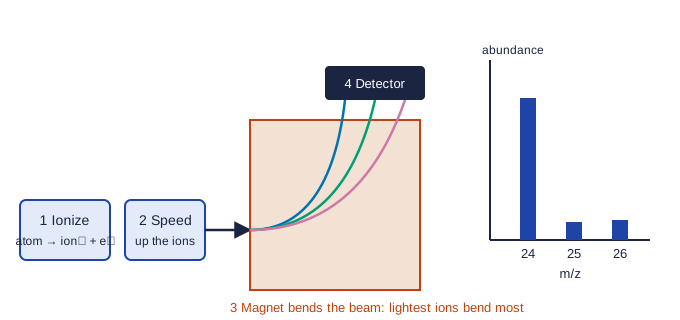
The instrument really sorts by the mass-to-charge ratio, m/z, because the fields push on charge. For the singly charged ions in this course, z = 1, so m/z is simply the mass of the ion, which is the mass of the atom (the lost electron is negligible).
Reading a mass spectrum
The output is a mass spectrum: a graph with m/z along the bottom and the number of ions (as relative abundance) up the side. For a pure element:
- each peak is one isotope;
- the peak's position is that isotope's mass;
- the peak's height is proportional to how many atoms of that isotope are present, the relative abundance.
So the number of peaks is the number of isotopes, and comparing heights tells you which isotope is most common. A spectrum of magnesium, for example, has a tall peak at 24 and two shorter peaks at 25 and 26.
Average atomic mass
Natural samples of an element are almost always a mix of isotopes, in nearly the same proportions everywhere on Earth. The atomic mass on the periodic table is the average atomic mass: the mean mass of the atoms, with each isotope weighted by its abundance.
Average atomic mass = (fraction₁ × mass₁) + (fraction₂ × mass₂) + …
Use fractions, not percents: 78.99% is 0.7899.
Worked example. A mass spectrum shows three isotopes of an element: mass 23.985 amu (78.99%), 24.986 amu (10.00%) and 25.983 amu (11.01%). What is the average atomic mass, and which element is it?
(0.7899)(23.985 amu) = 18.946 amu
(0.1000)(24.986 amu) = 2.499 amu
(0.1101)(25.983 amu) = 2.861 amu
Sum: 24.31 amu. That matches magnesium on the periodic table.
Check: most of the atoms are the light isotope, so the average should sit near 24. It does. A simple average of the three masses (24.98) would be wrong, because it treats rare and common isotopes as equally important.
Worked example. Boron has two isotopes, boron-10 (10.013 amu) and boron-11 (11.009 amu), and an average atomic mass of 10.81 amu. What fraction of boron atoms are boron-11?
Let x be the fraction of boron-11; the rest, 1 − x, is boron-10.
10.013(1 − x) + 11.009x = 10.81 → 10.013 + 0.996x = 10.81 → x = 0.797 / 0.996 = 0.800.
So 80.0% of boron atoms are boron-11. The average (10.81) is nearer 11, which agrees.
What this topic does not test
The exam uses mass spectra only for samples of one element made into singly charged ions of single atoms. Spectra of compounds or mixtures of elements, and peaks from ions with larger charges or from molecules, are beyond the scope of the course.