The periodic table as a map
Elements on the periodic table sit in rows called periods and columns called groups (or families). Elements in one group have the same number of valence electrons: every group 1 element ends in s¹, every group 17 element in s² p⁵. That is why elements in a group behave alike.
Many properties change steadily across a period or down a group. Each such pattern is a periodic trend. You do not need to memorize them as rules: every one follows from Coulomb's law (charge and distance) and shielding. The exam rewards the explanation more than the trend itself.
Effective nuclear charge
A valence electron does not feel the full charge of the nucleus. The core electrons between them shield it. The net pull it feels is the effective nuclear charge, roughly the number of protons minus the number of core electrons.
| Element | Protons | Core electrons | Rough effective nuclear charge |
|---|---|---|---|
| Na | 11 | 10 | +1 |
| Mg | 12 | 10 | +2 |
| P | 15 | 10 | +5 |
| Cl | 17 | 10 | +7 |
- Across a period, each element adds a proton, but the core stays the same (period 3 always has the 10-electron neon core). The effective nuclear charge rises, and the valence electrons stay in the same shell.
- Down a group, each element adds a whole shell. The protons go up, but so do the core electrons, so the effective nuclear charge stays about the same while the valence electrons get farther away.
Atomic radius
Atomic radius is the size of an atom, measured as half the distance between the nuclei of two bonded or touching atoms of the element (Figure 1).
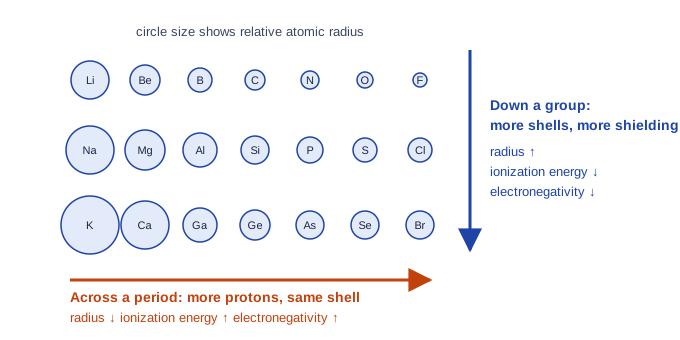
- Across a period, radius decreases. A larger effective nuclear charge pulls the same shell closer. Na is 186 pm; Cl is 99 pm.
- Down a group, radius increases. Each added shell puts the valence electrons farther out.
Ionic radius
A cation is smaller than its atom: Na⁺ has lost its only 3rd-shell electron, so its outer electrons are now in shell 2. An anion is larger than its atom: Cl⁻ has an extra electron, more electron-electron repulsion and the same protons, so its electron cloud spreads out. For ions with the same number of electrons, the one with more protons is smaller: O²⁻ (8 protons) > F⁻ (9) > Na⁺ (11) > Mg²⁺ (12), all with 10 electrons. This size is the ionic radius.
Ionization energy
The first ionization energy is the energy to remove the most loosely held electron from a gaseous atom.
- Across a period, it increases: the valence electrons feel a larger effective nuclear charge at a similar distance.
- Down a group, it decreases: the valence electron is farther away and more shielded, which outweighs the added protons.
Two small dips across a period are worth knowing:
- Mg → Al (738 → 578 kJ/mol): aluminum's electron is removed from 3p, which is higher in energy than 3s and partly shielded by the 3s electrons.
- P → S (1012 → 1000 kJ/mol): sulfur's 3p⁴ has one orbital with two electrons in it, and the repulsion between those paired electrons makes one of them slightly easier to remove.
Successive ionization energies
Removing electrons one after another takes more energy each time, because each comes from a more positive ion. The big jump comes when the next electron must come from an inner shell.
Worked example. A period 3 element has successive ionization energies of 577.5, 1816.7, 2744.8, 11,577 and 14,842 kJ/mol. Identify it.
The first three rise steadily. The 4th is about 4.2 times the 3rd (11,577 ÷ 2744.8): a huge jump.
So the first three electrons are valence electrons, and the 4th is a core electron from shell 2, closer and much less shielded. Three valence electrons in period 3 is aluminum, [Ne] 3s² 3p¹.
The energy to remove all three valence electrons is 577.5 + 1816.7 + 2744.8 = 5139.0 kJ/mol.
Electronegativity and electron affinity
Electronegativity is how strongly an atom attracts electrons it shares with another atom. It follows ionization energy: it rises across a period and falls down a group, for the same reasons. Fluorine is the most electronegative element; the metals at the lower left are the least.
Electron affinity is the energy change when a gaseous atom gains an electron. Atoms with a large effective nuclear charge and a small radius, such as chlorine, attract an added electron strongly and release a lot of energy when they gain one. The trend is less regular than the others, so the exam asks you to explain it more than to rank it.
Metals and nonmetals
Metals fill the left side and the middle of the table. Their few valence electrons are held loosely (low ionization energy), so they tend to lose them. Nonmetals at the upper right hold their electrons tightly and tend to gain or share electrons. Metalloids, along the staircase between them, are in between.
Writing the explanation
Worked example. Explain why potassium has a lower first ionization energy than sodium.
K's valence electron is in shell 4 (4s¹); Na's is in shell 3 (3s¹). K's electron is farther from the nucleus and shielded by 18 core electrons instead of 10. Although K has more protons (19 vs 11), the greater distance and shielding mean its valence electron feels a weaker Coulombic attraction, so less energy removes it.
A full answer names the protons, the shell (distance) and the core electrons (shielding), for both atoms. Saying only "K is bigger" or citing mass does not earn the point; the readers flag both every year.