A number is not a measurement until it has a unit
If a lab partner tells you "the sample is 12.6", you do not know anything yet. Is that 12.6 grams, 12.6 milliliters or 12.6 degrees? A unit is the agreed-on amount a measurement counts in, and every measured number in chemistry carries one. On the exam, an answer without its unit usually loses the point, even when the number is right.
Chemistry uses the metric system, built on SI units (the International System). The ones you meet first:
| Quantity | Unit | Symbol | Notes |
|---|---|---|---|
| Mass | gram, kilogram | g, kg | The SI base unit is the kilogram; labs weigh in grams. |
| Length | meter | m | Atoms are measured in picometers (pm). |
| Volume | liter, milliliter, cubic centimeter | L, mL, cm³ | 1 mL = 1 cm³ exactly. |
| Temperature | kelvin, degree Celsius | K, °C | K = °C + 273.15 |
| Time | second | s | 1 min = 60 s |
| Energy | joule, kilojoule | J, kJ | 1 kJ = 1000 J |
Metric prefixes
Instead of inventing a new unit for every size, the metric system puts a metric prefix in front of a unit. The prefix multiplies the unit by a fixed factor of ten. A kilogram is 1000 grams; a milliliter is one thousandth of a liter.
| Prefix | Symbol | Means | Example |
|---|---|---|---|
| giga | G | 1,000,000,000 × | 1 GJ = 1,000,000,000 J |
| mega | M | 1,000,000 × | 1 MJ = 1,000,000 J |
| kilo | k | 1000 × | 1 km = 1000 m |
| centi | c | 1/100 × | 100 cm = 1 m |
| milli | m | 1/1000 × | 1000 mL = 1 L |
| micro | µ | 1/1,000,000 × | 1,000,000 µg = 1 g |
| nano | n | 1/1,000,000,000 × | 1,000,000,000 nm = 1 m |
| pico | p | 1/1,000,000,000,000 × | atoms are about 100 pm across |
You do not need to memorize the table for the exam: the official equations sheet lists the prefixes. You do need to use them quickly and in the right direction.
Conversion factors: multiplying by 1
Since 1 km and 1000 m are the same length, the ratio 1000 m / 1 km equals 1. So does its flip, 1 km / 1000 m. A ratio like this is a conversion factor. Multiplying a quantity by it changes the number and the unit together, but not the amount itself, because you multiplied by 1.
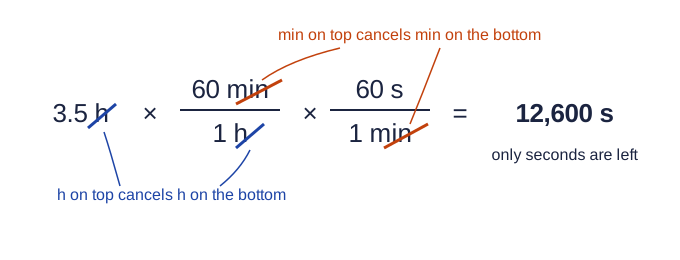
The trick is choosing which way up the factor goes. Units cancel like numbers: a unit on the top and the same unit on the bottom divide out. So put the unit you have on the bottom, and the unit you want on the top. This method is called dimensional analysis (or the factor-label method), and it is the single most useful habit in this course (Figure 1).
Worked example. A hiking trail is 2.45 km long. How long is it in meters?
Start with what you know, then put km on the bottom of the factor so it cancels:
2.45 km × (1000 m / 1 km) = 2450 m
Check the size: a meter is much smaller than a kilometer, so you need many more of them. 2450 is larger than 2.45, as it should be.
Chains of factors
When no single factor connects the two units, chain several. Each factor cancels the unit left over from the step before.
Worked example. Convert 4250 mg into kilograms.
There is no direct mg-to-kg factor on most lists, so go through grams:
4250 mg × (1 g / 1000 mg) × (1 kg / 1000 g) = 0.00425 kg
mg cancels in the first step and g cancels in the second. A kilogram is a million milligrams, so the number had to shrink a lot. If your answer had grown instead, a factor was upside down.
A rate such as "15 mg per kilogram of body mass" is also a conversion factor: 15 mg / 1 kg. A speed in km/h is a factor between distance and time. Any "per" is a ratio you can use.
Density: mass and volume
Density is mass divided by volume: d = m / V. Liquids and solids are usually given in g/mL or g/cm³ (the same thing, since 1 mL = 1 cm³). Water is about 1.00 g/mL; a solid denser than the liquid it is placed in sinks.
Worked example. Ethanol has a density of 0.789 g/mL. What is the mass of 250.0 mL of ethanol?
The density is a conversion factor from volume to mass. Put mL on the bottom:
250.0 mL × (0.789 g / 1 mL) = 197.25 g, reported as 197 g.
How many digits to keep is the subject of a later page in this chapter. For now, notice that the answer has the same number of meaningful digits as the least detailed measurement.
Going the other way, from mass to volume, flip the density: volume = mass × (1 mL / 0.789 g).
Temperature and the kelvin
Temperatures in chemistry are measured in degrees Celsius in the lab, but most equations need the kelvin (K, no degree sign). A kelvin is the same size as a Celsius degree; only the starting point differs. Zero kelvin is absolute zero, the coldest temperature possible, so no temperature in kelvin is ever negative.
K = °C + 273.15. Room temperature, 25 °C, is 298.15 K, often rounded to 298 K. Forgetting this conversion is one of the most common lost points on the free-response section, especially in gas and energy problems.
Worked example. Convert body temperature, 37.0 °C, to kelvin.
K = 37.0 + 273.15 = 310.15, reported as 310.2 K (the measurement was given to one decimal place).
Habits that save points
- Write the unit on every number, in every line, not just at the end.
- Set up the whole chain of factors before you touch the calculator.
- Before you report an answer, ask if the size makes sense: more of a smaller unit, fewer of a larger one.
- Watch J and kJ, mL and L, °C and K: the exam's readers name these as the most common unit slips.