Why chemists write numbers this way
Chemistry jumps between the very large and the very small. A glass of water holds about 8 × 10²⁴ molecules; one molecule has a mass of about 3 × 10⁻²³ g. Written out in full, these numbers are a string of zeros that you can miscount without noticing. Scientific notation moves the zeros into an exponent so the size of the number is visible at a glance.
The form
A number in scientific notation has two parts (Figure 1):
- a coefficient, at least 1 and less than 10, holding the digits that were measured;
- a power of ten, whose exponent says how many places the decimal point moved.
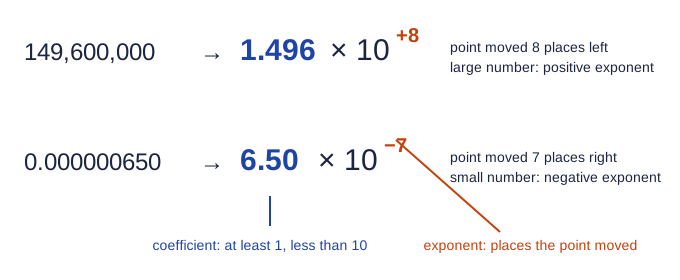
To convert, slide the decimal point until exactly one nonzero digit is in front of it, and count the places you moved:
- If the original number is 10 or more, you moved the point left, and the exponent is positive.
- If the original number is less than 1, you moved the point right, and the exponent is negative.
- A number from 1 to 10 has exponent 0 (10⁰ = 1).
Worked example. Write 149,600,000 km (the Earth-Sun distance) in scientific notation, keeping four digits.
Move the point left until it sits after the 1: 1.496. That took 8 moves to the left.
The number is large, so the exponent is positive: 1.496 × 10⁸ km.
Worked example. Write 0.000000650 m (the width of a fine smoke particle) in scientific notation.
Move the point right until it sits after the 6: 6.50. That took 7 moves to the right.
The number is small, so the exponent is negative: 6.50 × 10⁻⁷ m. The trailing zero is kept because it was part of the measurement.
Fixing a coefficient out of range
A calculation can leave a coefficient outside 1-10, such as 52 × 10⁵ or 0.47 × 10⁻². Fix it without changing the value: if you make the coefficient 10 times smaller, make the power of ten 10 times larger.
52 × 10⁵ = 5.2 × 10¹ × 10⁵ = 5.2 × 10⁶, and 0.47 × 10⁻² = 4.7 × 10⁻¹ × 10⁻² = 4.7 × 10⁻³.
Multiplying and dividing
Handle the coefficients and the powers of ten separately, using the exponent rules from the previous page.
Worked example. Calculate (3.0 × 10⁴) × (2.0 × 10⁻⁶).
Coefficients: 3.0 × 2.0 = 6.0. Powers: 10⁴ × 10⁻⁶ = 10⁴⁺⁽⁻⁶⁾ = 10⁻².
Answer: 6.0 × 10⁻², which is 0.060.
Worked example. Calculate (8.4 × 10⁶) ÷ (2.1 × 10⁻³).
Coefficients: 8.4 ÷ 2.1 = 4.0. Powers: 10⁶ ÷ 10⁻³ = 10⁶⁻⁽⁻³⁾ = 10⁹. Subtracting a negative adds.
Answer: 4.0 × 10⁹.
Adding and subtracting
To add, the numbers must have the same exponent, just as you line up decimal points. Rewrite the smaller one, then add the coefficients.
(6.0 × 10³) + (4.0 × 10²) = (6.0 × 10³) + (0.40 × 10³) = 6.4 × 10³. As ordinary numbers: 6000 + 400 = 6400.
Comparing sizes: orders of magnitude
With the coefficient always between 1 and 10, the exponent tells you the size. 3 × 10⁻⁵ is smaller than 8 × 10⁻⁴, even though 3 is smaller than 8 only by chance: the exponent −5 is more negative than −4. Compare exponents first, and use coefficients only to break a tie.
Each factor of ten is one order of magnitude. A cell in your body (about 2 × 10⁻⁵ m) is one order of magnitude longer than a bacterium (about 2 × 10⁻⁶ m). Estimating the order of magnitude of an answer before calculating is a quick way to catch a slip.
Scientific notation on a calculator
Use the EE or EXP key, which means "× 10 to the power". To enter 3.2 × 10⁻⁵, type 3.2 EE (−) 5. Do not type "× 10" as well: 3.2 × 10 EE −5 gives a number ten times too large. Calculators often show results as 3.2E-5, which means 3.2 × 10⁻⁵. On this site you can type answers the same way, for example 6.50e-7 or 6.50 × 10^-7.